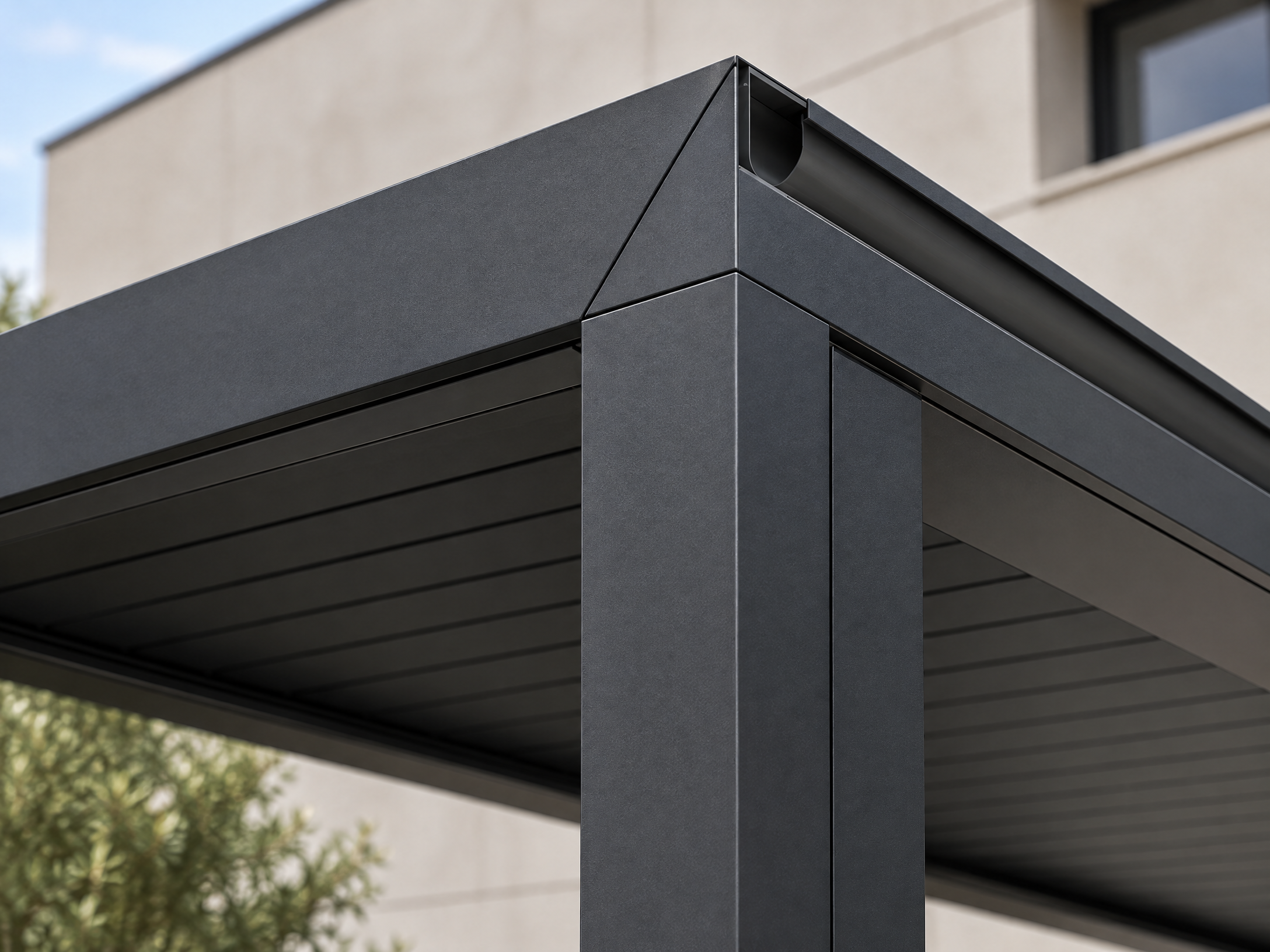
# How Do You Maintain an Aluminium Carport? A B2B Inspection and Care Guide
Aluminium carport maintenance is a condition-led routine of safe observation, drainage clearing, finish-compatible cleaning, documented escalation and controlled change—not a universal annual repair programme. Start with the project handover pack: identify the roof and finish, water route, approved access method, connection details and responsible parties. Plan ground-level observations and event-led checks around exposure, tree cover, traffic and local weather. Keep water paths clear; record deposits, coating changes, seals, roof details, visible connections and vehicle strikes; then refer structural, roofing or electrical work to the appropriate specialist. Do not walk on the roof, re-torque fasteners, apply unapproved sealant or attach equipment simply to “maintain” the carport. The required scope and frequency must follow the issued O&M information, project conditions and applicable local requirements.
Buyer context and scope boundary
An aluminium carport is an exterior asset system, not only a frame. Its maintenance boundary can include posts and beams, gutters and downpipes, roof or cladding, gaskets and sealants, base interfaces and fasteners. A solar carport adds PV modules, cabling, inverters, monitoring and electrical safety boundaries. These components can have different O&M manuals, owners and specialist contractors.
This distinction matters to dealers handing a system to an asset owner and to operators of workplaces, retail, residential, fleet or logistics sites. The aim is to preserve drainage, identify change early and prevent unsuitable access or modifications. The National Roofing Contractors Association (NRCA) notes that roof systems are exposed to weather, traffic and damage, and recommends periodic inspection, record retention and logging access. [1]
This guide supports the maintenance planning of architectural aluminium systems such as NordArch and NordFlat, and the structural enclosure scope of a solar canopy such as SolarGrid. It does not replace the issued O&M pack, design calculations, local code, roof manufacturer instructions, PV O&M plan, risk assessment or advice from the manufacturer, engineer, roofer or electrical professional. It does not establish capacity, waterproofing, coating life, warranty coverage or site suitability. Where snow is relevant, align the plan with project information and the related aluminium carport snow load guide; do not infer a safe snow-clearing method or allowable accumulation from generic content.
Core principle: observe, preserve, decide and record
Aluminium naturally forms a thin, adherent oxide layer that supports corrosion resistance. Hydro states that this layer is stable in the general pH range 4–9, while strongly acidic or alkaline conditions can accelerate corrosion. [2] The material benefit does not make every exterior detail maintenance-free. Persistent moisture, deposits, coating damage, aggressive cleaning agents, poorly managed metal interfaces and physical damage can require attention.
Use four rules. Observe before intervening: a site team can report an overflow mark, scrape or displaced seal from a safe position, but roof access, connection work and electrical work are separate authorised tasks. Follow water: inspect from roof surface to gutter, outlet, downpipe and discharge, because a clean beam does not prove a concealed channel is clear. Match method to material: FGIA’s current AAMA 609 & 610-25 guide addresses cleaning of anodized and painted architectural aluminium after construction and during periodic maintenance. [3] The original finish and roof instructions control the method. Turn findings into evidence: keep dated, location-specific photographs, weather context, action owner and close-out status.
Record the observation, location, evidence, decision, authority and outcome. Do not mark a carport “passed” unless a defined project criterion and competent assessment support that conclusion.
Build an inspection plan before the first routine visit
Create a system register and exposure profile
Set up an asset record for each independently drained carport block or zone. Match its identifier to as-built drawings without drilling new labels into the structure. Capture system type, roof material, finish type/colour, drainage route, approved access restrictions, connection and anchor references, PV interface and current O&M documents. Identify the technical escalation route before an event occurs.
Then profile exposure. A tree-lined campus may have recurring leaf debris; a coastal or industrial site may have greater deposit or salt exposure; a fleet yard may have greater vehicle-contact risk. This does not predict failure or set a fixed interval. It helps an owner choose relevant observation triggers and document why a targeted check was requested.
| Trigger or setting | Safe, initial observation | Controlled next step | Record |
|---|---|---|---|
| Planned ground-level review | Debris, overflow staining, blocked discharge, coating deposits, obvious scrapes | Clean only by approved method or request targeted review | Date, asset zone, photos, weather, owner |
| Relevant storm, wind, snow, flood or impact event | New debris, displaced detail, damaged downpipe, visible deformation | Apply site controls and seek competent assessment where condition is uncertain | Event facts, images, restrictions, escalation |
| Tree-lined, coastal, industrial or high-traffic location | Repeated leaves, organic deposits, salt/de-icing splash, bird residue or impact exposure | Adjust observation/cleaning scope to approved O&M guidance | Exposure note and trend images |
| PV-equipped carport | Visible module debris, exposed-looking cable issue, reported inverter alert | Follow PV O&M plan; use qualified electrical personnel | Operator notification and work close-out |
Make access a written control
The plan should state who may observe from ground level, who may use elevated access, who authorises roof work and what documents are needed. HSE says roof work must be organised and planned safely, with trained, competent and instructed personnel. It also says roofs should be treated as fragile until a competent person confirms otherwise. [4]
Do not treat an aluminium panel, membrane, glazing, gutter or PV module as a walkway. Use the issued access route and task-specific method. If roof construction or access rules are unknown, pause and obtain the handover information or specialist advice.
Drainage, deposits and finish care
Follow the water path and remove restrictions safely
Inspect water in sequence: roof surface and roof details; gutter or integral channel; outlet or leaf guard where fitted; downpipe; and ground discharge. Look for leaves, twigs, litter, nesting material, sediment, standing water, overflow staining, detached guards, misaligned pipes, loose brackets or obstructed discharge. Inspect concealed drainage only through approved access points. Do not probe with sharp tools, drill access holes or remove covers without system instructions.
NRCA recommends periodic roof inspection, including after severe storms, and clearing roof-drain debris so it cannot be washed into drains. [1] This is a useful maintenance principle, not a universal carport interval. Final frequency must reflect the roof, canopy geometry, climate, exposure and safe-access arrangement. Collect debris for removal rather than pushing it into an outlet. If water enters an occupied, electrical or equipment area, report it promptly and preserve the evidence before anyone masks it with sealant.
Remove deposits without turning cleaning into repair
Dust, pollen, leaf tannins, bird residue, road splash and industrial deposits can retain moisture around horizontal surfaces, joints and accessories. The purpose of cleaning is to remove deposits using a finish-compatible method, not to polish away a damaged coating or improvise a repair.
Use a conservative process: confirm the finish and roof material in the O&M pack; check the proposed cleaner’s label and safety data sheet (SDS); obtain written compatibility advice if uncertain; use the mildest approved method; test in an inconspicuous location if instructions require it; rinse as directed; and log the product, dilution, test result, operator and unresolved condition. HSE explains that an SDS describes chemical hazards and provides information needed for an employer’s risk assessment, although the SDS is not itself an assessment. [5]
Avoid abrasive pads, wire brushes, strong acid, strong alkali, unapproved solvents and improvised mixtures unless the responsible finish supplier expressly permits them. Aluminium’s pH limitations provide one reason for this caution. [2] Coating, seal and roof compatibility are equally important.
Assess the finish as a condition, not a diagnosis
Record chalking, gloss or colour variation, blistering, flaking, scratches, exposed substrate, white products, staining beneath joints or abrasion at moving interfaces. A superficial scratch may be primarily aesthetic; coating loss at a water-retaining joint may merit earlier review. Do not infer root cause from one photograph. Consider location, extent, drainage, environment and the original finish system before authorising touch-up paint, polish, sealant or a protective spray.
Roof, seals and connections: protect interfaces
Review the roof and seals from a safe location
A carport roof may use panels, sheet, glazing, membrane, integrated drainage or PV modules. Check, from approved access positions, for displaced panels, lifted edges, cracked glazing, damaged roof fasteners, tears, punctures, standing water, loose trim, displaced gaskets, split sealant, open laps, staining near penetrations and water that bypasses the intended channel.
A clean-looking seal does not prove a joint is watertight, and a small blemish does not prove roof failure. Record the exact detail, its relationship to drainage, recent weather and whether the condition is active, recurrent or changing. A roofing or system specialist can investigate the relevant detail without destroying evidence or creating a new water path.
For solar carports, coordinate structural and electrical scopes. The U.S. Department of Energy describes preventive O&M as important to PV safety and performance; it highlights debris and wire management, and advises electrical inspection after inverter nuisance tripping rather than simply cycling the system. [6] Only the responsible qualified PV team should isolate, test, clean or repair electrical/PV components under the applicable O&M plan.
Inspect connections—do not casually re-torque them
From a safe position, look for missing or damaged fasteners, displaced washers, corrosion staining, cracked or distorted brackets, enlarged-looking holes, unusual gaps, movement, damaged cover caps, base-plate staining or new member misalignment. Compare like-for-like bays using issued drawings rather than assumed appearance.
Do not set a generic torque, replace a fastener with a locally available alternative, add washers, drill, weld, clamp equipment to a beam or remove a bracket for a casual check. Such actions can alter preload, load path, corrosion behaviour or weathering. The Aluminum Association publishes the Aluminum Design Manual and errata within its standards resources; connections should remain within the applicable engineering and system information. [7]
Record the presence of insulating washers, sleeves, tapes, coatings or sealant at metal interfaces. The American Galvanizers Association explains that galvanic corrosion needs dissimilar metals, an electrical path and a conductive electrolyte, and identifies electrical isolation and reduced electrolyte exposure as mitigation approaches. [8] Do not remove a potentially intentional isolator without review.
| Observation | First controlled action | Remedy decision |
|---|---|---|
| Outlet debris or gutter overflow mark | Photograph; clear only by an approved safe method; monitor water path | Facilities lead; roofing/system specialist if recurrence or flow uncertainty |
| Coating scratch, loss or staining | Record extent, finish if known, drainage and adjacent interfaces | Finish/system provider; engineer if impact or distortion is involved |
| Missing fastener, bracket movement or distorted connection | Restrict affected area if risk is suspected; do not re-torque or substitute parts | System provider and appropriate structural engineer |
| Displaced seal, open joint or roof damage | Preserve evidence; do not apply unapproved sealant | Roofing/system specialist; PV coordinator where relevant |
| Vehicle scrape, leaning post or damaged downpipe | Manage immediate site hazard and document incident | Asset owner, system provider and appropriate engineer |
Vehicle impacts, modifications and handover control
Respond to an impact without creating a second incident
Posts, low beams, gutters and downpipes can be exposed to vans, forklifts, trailers, snow equipment or refuse vehicles. If there is a sharp edge, unstable-looking part, fallen material, damaged electrical equipment or risk to pedestrians, restrict the area under site procedures and escalate. Then record date/time, location, vehicle or equipment if known, photographs, observed deformation/coating loss, weather, PV proximity and temporary controls.
Do not pull a member straight, hammer a dent, add a prop, heat aluminium, patch a penetration or repaint before the responsible technical party assesses it. A seemingly cosmetic mark can coincide with alignment or connection changes beyond the impact point. The remedy may range from cosmetic work to component replacement or engineered remediation; a generic checklist cannot decide it.
Put every addition through change control
Requests for lights, cameras, signs, EV equipment, cable trays, barriers, bird deterrents, banners, drainage extensions, storage hooks or new PV equipment can affect load paths, water routes, electrical safety, corrosion interfaces, clearance and access. Establish a visible rule: no drilling, cutting, welding, clamping, roof penetration, re-fastening or re-coating without documented review and approval.
| Proposed change | Review questions | Evidence and decision path |
|---|---|---|
| Light, sign, camera or cable route | Does it introduce load, drilling/clamping, drainage or access conflict? | Marked-up drawing and fixing proposal; system-provider review, plus engineering/electrical review as relevant |
| EV equipment or electrical containment | What are the routing, clearance, structural and electrical implications? | Coordinated electrical/structural design, applicable approvals and as-built update |
| Bollard or barrier | Does it conflict with foundations, vehicle movements, drainage or access? | Layout and interface review by site designer/engineer and system provider as applicable |
| Finish repair or roof/PV alteration | Is the finish/detail identified and is material compatibility confirmed? | Manufacturer-approved repair/detail and coordinated specialist review |
Make handover information usable after ownership changes
At handover, ask for a project-specific pack: as-built layout and asset IDs; product/finish data; roof, drainage and seal details; approved access/cleaning guidance; O&M manuals; connection information; warranties only where issued; records only where actually completed; PV electrical documents and monitoring responsibility where relevant; contact process; and inspection, incident, repair and modification logs.
The UK Building Safety Regulator’s “golden thread” applies specifically to higher-risk buildings in England, not every carport. Its broader information-management principles are still useful: keep digital information secure, accessible, usable and version-controlled; retain change, inspection and maintenance records. [9] Nominate a document custodian and retain known gaps as open actions—never represent a missing approval, drawing, inspection or certificate as existing.
A six-step buyer workflow
- Validate the handover pack. Build the asset register from as-builts and O&M information; flag unknown roof, finish, access and connection details.
- Assign boundaries. Name the owner, facilities lead, dealer contact, roof/PV contractor and structural escalation route. Separate ground observation from work at height, structural and electrical work.
- Set planned and event-led checks. Combine routine observations with checks after relevant storms, impacts, unusual debris or reported water ingress.
- Inspect consistently. Observe vehicle context, water path, gutters/outlets, downpipes, deposits, visible seals/connections and impact-prone areas, using repeatable photo locations.
- Triage and authorise. Categorise findings as monitor, planned technical review or urgent restriction. Obtain approval before changing roof, connections, finishes or PV components.
- Close the record. Add findings, work orders, approvals, before/after images and outstanding actions. Review recurring locations or events in the next asset-management meeting.
Need a project-specific care and handover review?
Bring the roof type, finish, drainage layout, exposure, access constraints and PV scope into the discussion before issuing a care plan or alteration. Carportiva can help frame the system information and project questions that need to be resolved. Use the inquiry page or email info@carportiva.com. Any technical confirmation remains project-specific and subject to the appropriate design, manufacturer and authority review.
FAQ and conclusion
How often should an aluminium carport be inspected?
There is no responsible universal interval. Use the O&M manual, roof/finish instructions, climate, tree cover, industrial/coastal exposure, traffic and access constraints. Ground-level observations can be more frequent than roof work. NRCA supports periodic roof inspection and post-storm review, but a carport still needs a project-specific plan. [1]
Can facilities staff pressure-wash an aluminium carport?
Do not assume so. Water pressure, nozzle position, detergent and access method can affect seals, finishes, roof components and electrical equipment. Follow the relevant written instructions. Work at height requires a planned safe system; HSE requires roof work to be planned and performed by trained, competent and instructed personnel. [4]
What should be done when white marks appear on aluminium?
Document location, finish, deposits, drainage condition and recent exposures. White marks may be residue, surface change or corrosion-related products. Do not abrade or chemically “test” the area. Seek finish-specific guidance, especially where the mark is near a joint, seal or dissimilar-metal interface.
Should bolts be re-torqued on every visit?
No generic rule is responsible. Torque and fastener requirements are design-specific. Unauthorised re-torquing, substitution or removal can alter a designed connection. Log visible concerns and refer them with the original connection information.
What is the first action after a vehicle strikes a post?
Protect people and manage the site hazard. Restrict the area when stability, sharp edges, fallen material or electrical proximity are uncertain. Document safely and obtain technical assessment before straightening, patching or returning the area to normal use.
Can a tenant attach signs, cameras or EV equipment?
Only through documented change control. Attachments may affect load paths, drainage, corrosion interfaces, electrical routing, clearances and access. Require drawings and project-specific review before drilling, clamping or connecting anything.
Conclusion: Effective aluminium carport maintenance keeps water moving, removes deposits without damaging finishes, identifies changes at interfaces, responds safely to impacts and blocks unreviewed alterations. A live, project-specific record is more useful than generic calendar tasks. For a carport care, handover or modification discussion, submit the project context at Carportiva’s inquiry form or email info@carportiva.com. Do not treat this guide as authorisation for roof access, repair or modification.
References
Bring the actual project brief to the engineering table.
Share your location, layout, target application and available technical inputs. Carportiva can help identify the relevant product-interface information before a project-specific commercial discussion.
Request a project discussion