Short answer (120–180 words)
Selecting a solar parking structure supplier is a procurement decision that must prioritize integrated design, verifiable factory evidence, and clear technical interfaces between structure, PV equipment and site utilities. A rigorous specification balances structural performance (wind/snow/fatigue), PV equipment coordination and electrical pathway planning with construction sequencing, warranty clarity and operations access. Require supplier deliverables that include stamped structural calculations, shop drawings tied to module/inverter layouts, a Bill of Materials, factory quality records, and defined responsibilities for foundations, metering and interconnection. Score bids against lifecycle metrics (energy yield estimates, maintenance access planning, total cost of ownership) and confirm utility and permit interface expectations early. Use the six-step buyer workflow in this guide to translate site inputs into an executable contract. Site-specific structural capacity, foundations, permits, electrical design, approvals, lead time, price, energy yield and warranty require a documented project basis and relevant local qualified professionals, installers, utilities and authorities. For integrated system options see SolarGrid commercial solar system.
Buyer context and scope boundary
Purpose and audience
- This guide is written for distributors, architects, general contractors, developers, solar EPCs and fleet operators procuring or specifying a solar parking structure supplier for commercial carport projects.
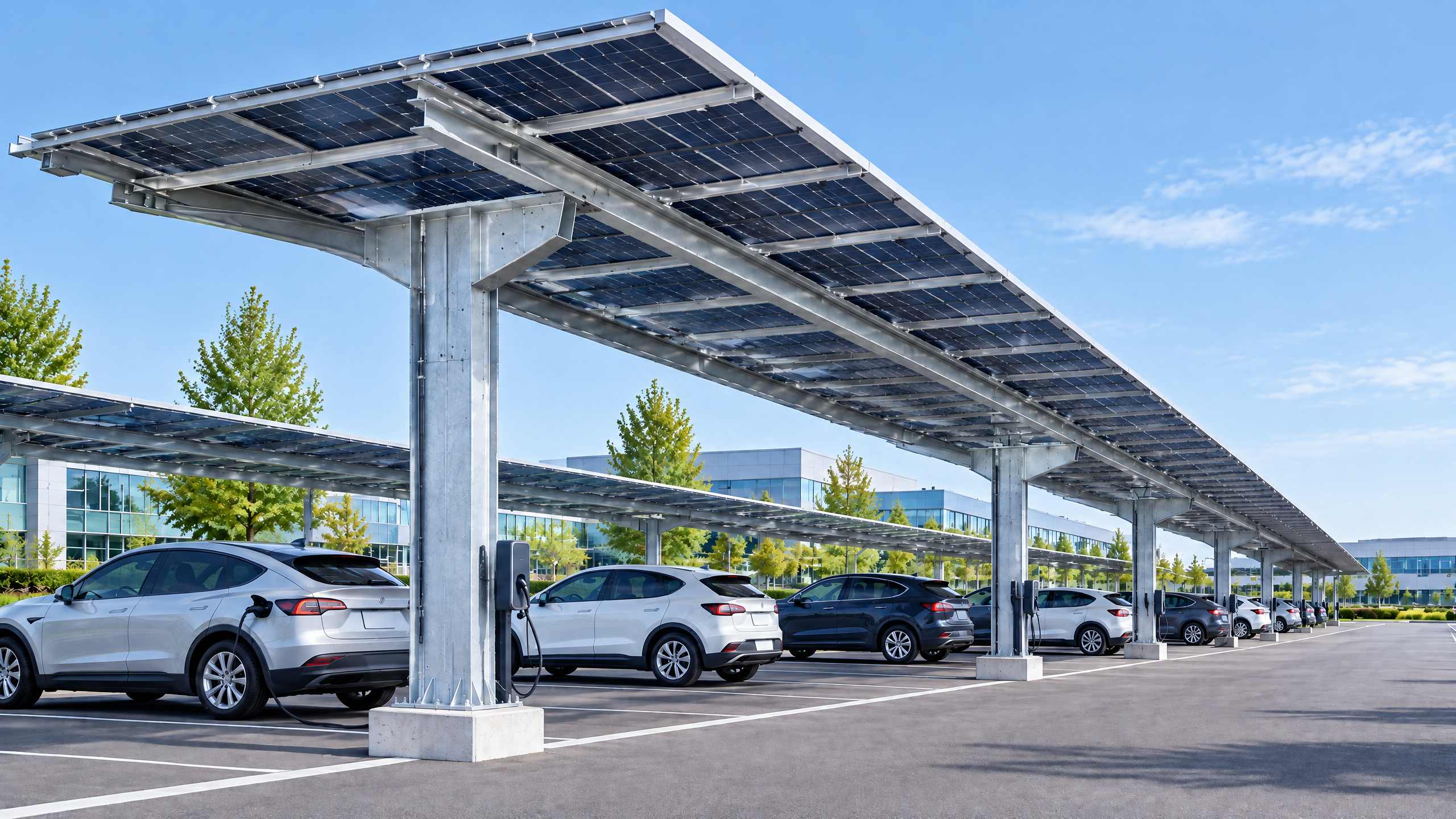
- The primary objective is to make "solar parking structure supplier" the central procurement locus: the supplier must supply the engineered aluminium or steel carport structure and manage its coordination with PV modules, racking, power collection, and required structural interfaces.
Typical scope options to define up front
- Supply-only: engineered carport structure, shop drawings, and anchor details. Buyer or contractor handles PV procurement, foundations and electrical work.
- Supply-and-coordination: supplier supplies the structure and coordinates PV equipment delivery, mounting, and cable routing but does not supply electrical equipment beyond DC combiner or conduit penetrations.
- Turnkey (EPC model): supplier manages structure, PV modules, inverters, combiner/AC equipment, interconnection paperwork, commissioning and handover.
- Hybrid models where the supplier handles structural + PV mounting and another subcontractor handles inverters and grid-side works.
Clarify responsibilities by contract to avoid scope gaps (example deliverables):
- Structural package: stamped calculations, lift drawings, corrosion treatment, warranty on structural members.
- PV coordination package: module attachment details, stringing diagram, rail/clip specifications.
- Electrical pathway planning: conduit routes, cable tray support points, metering locations, AC disconnects.
- Foundations: soil report reliance, foundation type proposals (footing, pile), anchor bolts and tolerances.
Decision table — responsibility allocation (example)
| Workstream | Typical supplier responsibility | Typical buyer/third-party responsibility |
|---|---|---|
| Structural design & calculations | Yes (stamped for structure) | No |
| PV module supply | Optional (supply or coordinate) | Yes (if supply-only) |
| Inverter/transformer supply | Optional | Yes (EPC or buyer) |
| Foundations & geotechnical | Provide anchor design; not soil | Buyer/GEOTECH to provide reports and build foundations |
| Electrical interconnection & permitting | Provide interface points & conduit runs | Utility-side approvals and final interconnection handled by buyer/EPC |
| Commissioning & grid testing | Assist in commissioning if contracted | EPC/Installer performs electrical commissioning |
Define the scope boundary explicitly in the procurement documents so that bidders price to the same set of responsibilities.
Core decision principle
Choose a solar parking structure supplier who can reliably demonstrate that their structural solution reduces overall project risk and cost across the lifecycle, not just initial capital cost. The core principle is integrated performance: the structure must enable predictable energy yield, safe long-term operation, and efficient installation and maintenance, while aligning technical interfaces between the structure, PV equipment and utility systems.
Key attributes that embody this principle:
- Documented engineering (stamped drawings, load cases) tied to the actual PV array layout.
- Clear PV equipment coordination and electrical pathway planning to avoid rework.
- Factory quality control, traceability of materials and coatings appropriate for the local environment.
- Defined responsibilities for permit, interconnection and maintenance planning, reducing friction during construction and handover.
- Commercial clarity: warranties, lead times, and a transparent change-order process.
Refer to SolarGrid commercial solar system where an integrated supplier approach can be compared against standalone structural options. Also consider adjacent lessons in broader all systems and review sourcing guides for procurement templates.
Planning inputs — what information to collect before you specify
Before writing a specification or issuing an RFP, collect the following project inputs. Missing or incomplete inputs are the most common cause of changed scope and schedule.
- Site and environmental:
- Accurate site plan with parking bay layout, elevation, curb lines and grades.
- Geotechnical report with soil bearing capacity, groundwater table and frost depth.
- Local wind and snow codes, or site-specific wind speed maps and exposure categories.
- Solar resource data for feasibility and yield modeling (use NREL resources for irradiance reference) [1].
- Electrical and energy:
- Existing site load profile, anticipated new loads (EV chargers, lighting), and desired export or self-consumption targets.
- Point of interconnection and utility requirements, including metering location and interconnection standards (start early; see FERC and local utility resources) [4].
- PV module and inverter performance targets, shade studies and azimuth/tilt constraints. Use PVWatts or full PV modeling for preliminary yield estimates [2].
- Operational:
- Vehicle clearance and circulation constraints (minimum clearance heights, column locations).
- Maintenance regimes, including planned equipment replacement intervals and access restrictions.
- Snow removal and drainage plans, including slipperiness and runoff interception.
- Commercial and schedule:
- Budget envelope and target procurement model (supply-only, coordinated supply, turnkey).
- Procurement timeline, expected contract award date and milestone expectations.
- Long-lead items and preferred vendors for modules, inverters, transformers and EV chargers.
- Regulatory and permitting:
- Local permit checklist: building permit, electrical permit, grading and stormwater, historic district considerations.
- Early utility engagement to understand interconnection queue or study requirements [4].
Evidence-led tools and references:
- Use PVWatts for preliminary energy yield benchmarking, then refine with detailed simulation [2].
- Refer to NREL resource pages for design best practice and climate-based inputs [1].
- For EV charger planning and interactions with PV, consult AFDC guidance for charger standards and incentive programs [3].
Decision table — minimum planning inputs vs procurement consequence
| Planning input present | Procurement outcome / risk |
|---|---|
| Geotech + site survey | Accurate foundation design; lower contingency |
| No geotech | Foundation risk, potential change orders |
| Utility agreement or clear interconnection path | Predictable schedule for commissioning |
| No utility engagement | Interconnection delays, extra costs |
| Module/inverter selection | Coherent PV mounting and stringing plan |
| Undefined BOS equipment | Coordination gaps; electrical pathway planning rework |
Document each input and attach them to procurement documents to ensure bidders design to the same baseline.
Technical specification and interfaces
The specification must make the solar parking structure supplier accountable for the structural elements and their interfaces with PV equipment and electrical systems. The key named interfaces are: solar carport structural interface, PV equipment coordination, electrical pathway planning, utility and permit interface, and maintenance access planning. Each requires technical clarity.
Structural requirements
- Design codes and standards: specify the governing codes (local building code and applicable international standards) and reference load cases (dead, live, snow, wind, seismic). Where local codes differ, require supplier to indicate applicable standards and deliver stamped calculations.
- Materials and corrosion protection: aluminium alloys, surface finish (e.g., anodizing, powder coat), fastener metallurgy and galvanic isolation strategies.
- Fatigue and dynamic loading: if canopy spans are large or subject to vibration (adjacent loading), require fatigue analysis for connections.
- Tolerances: bolt locations, anchor bolt template and permissible misalignment at site.
Solar carport structural interface
- Module mounting detail: how modules are attached to the canopy — cantilevered rails, direct-bolt clips, or dedicated module frames. Require supplier to provide module layout drawings that show exact attachment points and load transfer paths.
- Rail spacing and support spans: define maximum allowable span for rails based on module frame loads and centre-to-centre module distances.
- Thermal expansion joints and electrical bonding: ensure the structural scope covers equipment bonding and earthing references where the structure provides an earth electrode.
PV equipment coordination
- Module frame dimensions, weight and rail clamp zones: supplier must accept a "last-mile" PV equipment schedule or coordinate directly with module vendor.
- Stringing and combiner locations: identify likely in-field combiner boxes and ensure structural members have mounting capacity and routing for DC cables.
- Inverter and transformer interfaces: indicate if the structure supports inverter/transformer mounting or simply provides route to inverter pads.
Electrical pathway planning
- Conduit and cable tray routes: require stamped routing plans that show conduit penetrations through the canopy, wall/fascia entries, and cable tray supports.
- AC metering and service point: clearly define metering locations relative to structure and the supplier's responsibilities for providing clear access and raceways.
- Lightning protection and surge considerations: specify bonding, grounding conductors and if the supplier provides conductors within the structure.
Utility and permit interface
- Supplier deliverables should include drawings and points-of-connection required by the utility, but utilities often require application from the project owner or licensed electrical contractor. Clarify whether supplier will prepare utility-ready packages or simply provide the technical inputs.
- Early engagement with utilities reduces scope risk, particularly for large export-capable systems which may require system impact studies or queue positions [4].
Maintenance access planning
- Access clearances for module cleaning, inverter removal and combiner box servicing.
- Walkways or jump-stands integrated into canopy design where required.
- Module replacement strategy (how modules are uninstalled/reinstalled without structural damage).
Technical deliverables to require from bidders
- Stamped structural calculations and anchor detail tied to geotech assumptions.
- Manufacturer shop drawings showing module layout and rail attachments, annotated with module part numbers.
- Cable routing drawings and conduit sizing calculations.
- A Bill of Materials with traceable material specifications.
- A maintenance access plan and proposed O&M checklist.
- A list of assumptions and exclusions (foundation supply, metering, interconnection, traffic management, etc.).
Mandate in specification: "site-specific structural capacity, foundations, permits, electrical design, approvals, lead time, price, energy yield and warranty require a documented project basis and relevant local qualified professionals, installers, utilities and authorities." This protects the buyer and ensures bidders do not rely on unstated assumptions.
Procurement evidence and factory verification
Procurement must move beyond price to verifiable evidence of manufacturing quality, engineering competence and repeatable processes.
Minimum evidence to request in RFP
- ISO or equivalent factory quality system documentation (e.g., ISO 9001 certificate) where available.
- Material test certificates for structural aluminium or steel, and coating datasheets for corrosion protection.
- Sample shop drawings and details from prior job types (do not accept generic brochures as proof of capability).
- Factory Acceptance Test (FAT) procedures for any prefabricated electrical enclosures supplied as part of the structure.
- List of third-party certifications and a schedule for delivering stamped calculations upon contract.
- Traceability and batch records for critical components (especially for bolted connections and structural members).
Factory inspection and FAT
- Define inspection points: incoming materials, dimensional checks, weld inspection (if applicable), coating thickness checks, bolting/tensioning tests.
- Contractually reserve the right for buyer or buyer’s representative to perform a factory inspection or appoint a third-party inspector.
- FAT for pre-assembled sections should include mechanical fit checks and sample assembly verification.
Commercial solar procurement — evaluation metrics
- Use a weighted scoring matrix that includes technical compliance, lead time, warranty terms, factory QA evidence, total life-cycle cost (including expected maintenance), and experience with similar projects.
- Include an allowance for interface risk: suppliers that provide integrated PV equipment coordination and electrical pathway planning should receive higher technical scores because they reduce site-level coordination risk.
Example procurement evaluation matrix (simplified)
| Evaluation category | Weight (%) | Key evidence required |
|---|---|---|
| Technical compliance (drawings, calculations) | 30 | Stamped drawings, BOM |
| Factory QA and materials traceability | 20 | ISO/QC docs, material certificates |
| Coordination & integration capability | 15 | PV equipment coordination plan, conduit routes |
| Lead time & delivery reliability | 15 | Production schedule, previous project lead times |
| Warranty & lifecycle terms | 10 | Warranty documents and exclusions |
| Price and commercial terms | 10 | Firm price, payment milestones |
Contractual tips
- Request delivery milestones tied to production and shipping and penalties for unreasonable delays.
- Include a clear change-order process for any differences in geotechnical or utilities inputs.
- Require supplier warranties to identify what they cover (structure, coatings, mounting hardware) and what they exclude (modules, inverters, foundations unless included).
Site installation and operations
Installation planning
- Staging and logistics: ensure the supplier provides packaging dimensions for preassembled units, lifting weights and recommended erection sequence.
- Foundation tolerance and anchor verification: require a pre-installation anchor bolt survey to validate the template and indicate acceptable tolerances.
- Erection sequence: crane vs. temporary supports, traffic management on occupied parking lots, night work implications.
- PV equipment installation handoff: define the moment of responsibility transfer between structure erection and PV/Electrical installation teams.
Electrical installation and commissioning
- Define responsibilities for pulling DC strings, combiner box installation and inverter placement. Align these with the electrical pathway planning delivered by the supplier.
- Commissioning checklist: DC isolation tests, polarity checks, inverter commissioning, AC protections and utility witnessing of commissioning as required by the utility.
- Interconnection testing: planning for witness tests and any utility witness periods.
Operations, maintenance and lifecycle considerations
- Maintenance access planning: require accessible combiner boxes, inverter ventilation clearance and module replacement clearances in the design.
- Cleaning and inspection schedule: include a recommended inspection and cleaning frequency in the O&M manual, noting that regional soiling and weather affect the frequency.
- Spare parts and fasteners: ensure a spares list and recommended critical spare quantities for long-lead or custom parts.
- Warranty management: centralize warranty claims and designate an escalation path.
Safety and training
- Require supplier-provided site-specific lifting plans and a method statement for erection.
- O&M training for site personnel: safe access, module handling, and basic troubleshooting for structural and PV mounting elements.
Operational handover deliverables
- As-built drawings (electrical and structural), photos, stamped calculations, commissioning records, manufacturer warranties, and an O&M manual covering maintenance access planning and recommended spare parts.
Implementation risks and mitigations
No project is risk-free. Below is a non-exhaustive list of typical implementation risks and recommended mitigations when specifying a solar parking structure supplier.
Risk table — risk vs mitigation
| Risk | Likely impact | Mitigation |
|---|---|---|
| Incomplete geotechnical data | Foundation redesign, cost overruns | Require geotech report pre-procurement; include provisional foundation pricing and firm change-order rules |
| Misaligned assumptions on PV equipment | Rework to rails/module spacing | Mandate PV equipment coordination deliverables and final module schedule before fabrication |
| Utility interconnection delays | Commissioning delays, revenue loss | Early utility engagement; allocate timeline contingency; include utility and permit interface responsibilities |
| Manufacturing quality defects | Site reworks, warranty disputes | Factory inspection rights; material certificates; FAT |
| Weather-related schedule slips | Extended on-site costs | Seasonal scheduling; weather contingency days; temporary protection plans |
| Anchor bolt template inaccuracies | On-site modifications, schedule delay | Pre-installation survey, adjustable anchor plates or grout sleeves |
| Warranty ambiguity | Cost shifts post-handover | Clear warranty scope in contract; require response SLAs for defect remediation |
| Lead time fluctuation for PV modules or inverters | Schedule shifts | Lock lead-time in procurement; require vendor confirmation and escalation paths |
Risk allocation should be explicit in the contract. Transfer risk with price only when the supplier has clear control and evidence of capability.
Legal and regulatory risk
- Utility upgrades or system-impact studies can require additional network equipment or studies that add cost and time. Define who pays for utility-mandated upgrades and who manages the studies.
- Permitting delays occur when drawings are incomplete or inconsistent. Require permit-ready packages to be submitted to authorities or define who is responsible for local permit applications and fees.
Health & safety
- Carpark erection involves working over occupied spaces and with vehicular traffic. Ensure the supplier provides a traffic management plan, lifting plans and the necessary risk assessments.
Six-step buyer workflow for specifying and procuring a solar parking structure supplier
This workflow is actionable and maps responsibilities at each stage. Each step includes typical deliverables and decision gates.
- Define scope, constraints and success criteria (Output: Project brief)
- Deliverables: Site plan, budget envelope, decision on supply model (supply-only/turnkey), minimum clearance/vehicle constraints, expected energy targets.
- Decision gate: Approve procurement model and high-level budget.
- Site feasibility and technical baseline (Output: Feasibility report)
- Deliverables: Geotechnical report, solar resource summary (use NREL & PVWatts as references) [1][2], initial yield estimate, list of local code requirements.
- Decision gate: Proceed if yield and structural feasibility meet minimum ROI/technical thresholds.
- Prepare technical specification and RFP (Output: RFP packet)
- Deliverables: Technical spec with required deliverables (stamped calculations, PV equipment coordination, electrical pathway planning, maintenance access planning), evaluation criteria, contract terms and exclusions.
- Decision gate: RFP approved and released.
- Tender, evaluate and shortlist (Output: Shortlist & clarifications)
- Deliverables: Bid evaluations using scoring matrix (technical evidence, factory QA, lead time, warranty), shortlist of qualified suppliers.
- Decision gate: Clarification period closed; preferred supplier selected for negotiation.
- Contract negotiation and fabrication oversight (Output: Contract & production oversight plan)
- Deliverables: Final contract with delivery milestones, factory inspection schedule, FAT plan, change-order process, acceptance criteria.
- Decision gate: Contract signed and production starts after pre-production review.
- Delivery, installation, commissioning & handover (Output: Operational system)
- Deliverables: Factory acceptance, shipping and site erection, electrical commissioning, utility interconnection, as-built package, O&M manual and warranty documents.
- Decision gate: Practical completion and final handover upon meeting acceptance tests and utility sign-off.
This workflow enforces consistent data flow and decision gates that protect the buyer from scope creep.
FAQ
Q: What is the difference between a solar parking structure supplier and an EPC? A: A solar parking structure supplier specializes in the engineered canopy, its structural design and its coordination with PV mounting systems. An EPC (engineering, procurement, construction) typically covers the full electrical scope, inverters, grid connections and commissioning. Procurement models vary — you can engage a supplier for structural works and hire an EPC for electrical works, or select suppliers who offer expanded coordination or turnkey delivery.
Q: Should the supplier provide the foundations? A: It depends on scope. Many suppliers provide anchor designs and templates while foundations are cast by a local contractor based on geotechnical data. If you require supplier-supplied foundations, make this explicit in the RFP and verify factory capability or local subcontracting plans.
Q: What documentation should the supplier deliver? A: At minimum: stamped structural calculations, shop drawings tied to PV module layout, Bill of Materials with material certificates, cable routing and conduit plans, factory QA records, and an O&M manual including maintenance access planning.
Q: How do I validate energy yield claims? A: Use a staged approach: preliminary yield using PVWatts [2] or similar, then request vendor-specific yield models with conservative assumptions on soiling, shading and inverter clipping. Always require the supplier to provide the assumptions used for yield modeling so you can validate them.
Q: When should I engage the utility? A: As early as possible — pre-RFP if the system exports or connects to a constrained part of the network. Large systems may require system-impact studies and queue entries that materially affect schedule and cost [4].
Q: What about EV charger integration? A: Plan EV charger loads early and include them in electrical pathway planning. Consult AFDC guidance for charger considerations and incentives [3]. Specify charging locations relative to canopy columns and ensure load profiles are included in interconnection applications.
Q: How do I ensure maintenance access? A: Require a maintenance access plan as a contract deliverable that shows clearances for combiner boxes, inverter servicing and module removal. Include a requirement for a maintenance mock-up or access verification during commissioning.
Q: How to reduce site-level coordination risk? A: Favor suppliers who provide PV equipment coordination, conduit routing and who can deliver integrated shop drawings in Revit or DWG that align with the PV vendor’s layout. This reduces onsite surprises and rework.
Example decision table — procurement option trade-offs
| Procurement option | Advantages | Disadvantages | When to choose |
|---|---|---|---|
| Supply-only (structure) | Lower supplier cost; buyer controls PV procurement | Higher coordination burden and potential interface risk | Buyer has strong in-house PV/Electrical capability |
| Supply + coordination | Reduced onsite rework; single point for structure & PV coordination | Higher supplier price, still split responsibility for electrical commissioning | Buyer wants reduced interface risk but retains electrical contracting |
| Turnkey / EPC | Single accountability from structure to grid; reduced buyer coordination | Higher price; less buyer control over vendors | Buyer prefers risk transfer and single contract owner |
Use this table to match your internal capabilities to the procurement model that balances cost and risk.
Conclusion
Selecting a solar parking structure supplier for a commercial carport project requires careful alignment of structural engineering, PV equipment coordination, electrical pathway planning, and regulatory expectations. The most defensible procurement strategies require documented inputs (geotech, site plans, utility engagement) and evidence from bidders (stamped calculations, factory QA, shop drawings). Prioritize integrated deliverables that reduce field coordination risk: clear solar carport structural interface details, defined maintenance access planning, and early utility and permit interface planning.
Remember: site-specific structural capacity, foundations, permits, electrical design, approvals, lead time, price, energy yield and warranty require a documented project basis and relevant local qualified professionals, installers, utilities and authorities. Use the six-step buyer workflow in this guide to turn assessment into a disciplined procurement and technical delivery process. For comparisons on integrated supplier models or turnkey options, review SolarGrid commercial solar system, other offerings across all systems, and our procurement templates in sourcing guides.
Mid-article contact If you would like a procurement checklist or to start a project discussion, contact our commercial team: /inquiry or info@carportiva.com.
Final note This guide is framework-level and intentionally non-prescriptive on local regulatory and design details. For any specific project you must obtain and rely on local licensed engineers, qualified installers and the relevant utility and permitting authorities to confirm detailed designs and approvals.
Closing CTA To request project-specific documentation or discuss an upcoming commercial carport, reach out to our team at /inquiry or info@carportiva.com.
References
- Solar resource and design guidance: National Renewable Energy Laboratory (NREL) [1].
- Preliminary PV energy yield modeling: PVWatts Calculator [2].
- EV charger and site planning resources: U.S. Department of Energy AFDC [3].
- Interconnection and utility study considerations: Federal Energy Regulatory Commission interconnection resources [4].
References
- National Laboratory of the Rockies PV resources: https://www.nrel.gov/solar/
- PVWatts Calculator: https://pvwatts.nrel.gov/
- U.S. Department of Energy Alternative Fuels Data Center: https://afdc.energy.gov/
- Federal Energy Regulatory Commission interconnection resources: https://www.ferc.gov/electric-transmission/generator-interconnection
Keep the project brief connected.
Bring the actual project brief to the engineering table.
Share your location, layout, target application and available technical inputs. Carportiva can help identify the relevant product-interface information before a project-specific commercial discussion.
Request a project discussion