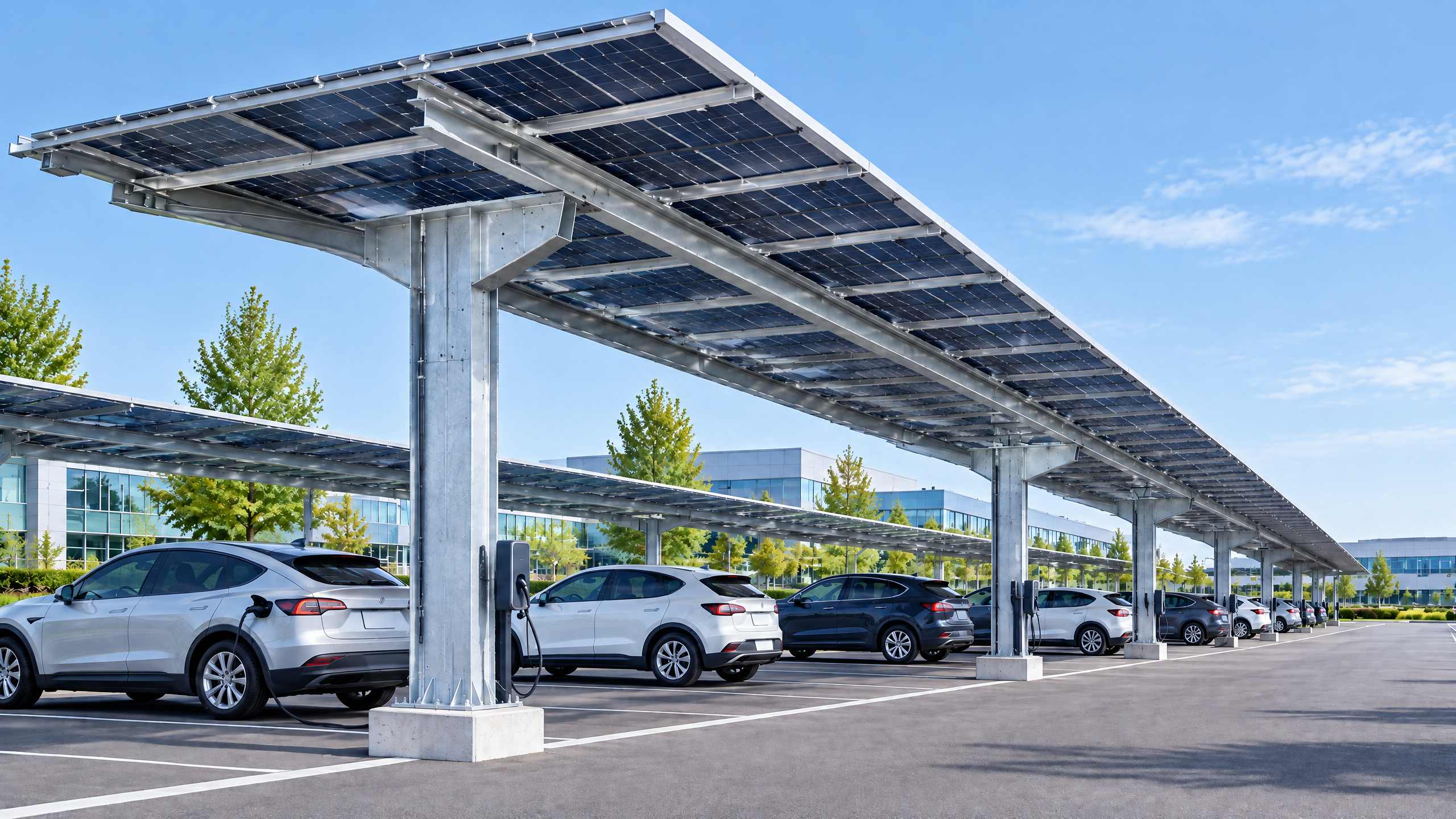
Direct answer — what to confirm (150 words) Confirm four categories of information before committing: technical fit, delivery and installation responsibilities, contractual protections, and site-specific constraints. Ask the supplier for detailed structural drawings and PV layout concepts, a clear split of responsibilities (who supplies the canopy, PV modules, inverters and balance of system), an installation and commissioning plan tied to local authority and utility milestones, and a written list of excluded items (permits, geotechnical works, civil upgrades, on-site safety). Verify logistics capacity for prefabricated aluminium elements and whether the proposed controls and cabling will integrate with your site’s electrical and traffic management. Require evidence of past installations with comparable scale, defined lead times for engineered drawings and long-lead components, and a staged progress payment schedule. For final decisions on structural capacity, permits, interconnection, energy yield or code compliance, engage local qualified professionals, authorities, utility providers and installers.
Why these confirmations matter
Selecting a commercial rooftop or ground-mounted PV supplier is different from selecting a carport designer. A canopy is a combined architectural, structural and electrical system that affects parking operations, fire access, drainage, and grid interaction. The principal procurement risk is mismatch between what the supplier assumes they will deliver and what your project actually needs on site. Confirmations reduce surprises that drive delays, cost increases and disputes during installation and commissioning.
What to request from any prospective supplier
Request the following deliverables (in writing or as part of a bid package):
- Scope of supply and what is expressly excluded.
- Engineering drawings at permit and fabrication stages.
- PV layout and single-line electrical diagram sufficient for utility and interconnection review.
- Bill of materials with preferred manufacturers for modules, inverters, racking and fasteners.
- Installation sequencing and interface responsibilities (civil, electrical, traffic control).
- Risk allocation: who accepts responsibility for site surveys, ground conditions, and third-party damages.
- Factory inspection and QA checkpoints, plus final performance acceptance criteria.
Do not accept vague statements such as “supplier will coordinate permits.” Require clarifications on which permits, inspections and approvals are buyer responsibilities versus supplier’s.
Key confirmations vs who typically answers (decision table)
| What to confirm | Typical party to provide the answer |
|---|---|
| Engineered drawings and stamped calculations | Supplier’s engineering team or nominated engineer; final sign-off by local structural engineer retained by buyer |
| Electrical interconnection and single-line diagrams | Supplier with electrical subcontractor; utility/authority for interconnection requirements |
| Delivery and site logistics plan | Supplier and transport partner; buyer provides access timing and traffic controls |
| Scope breaks (what is excluded) | Supplier (documented in contract) |
| Quality control and factory checks | Supplier’s QA; buyer may reserve right to third-party inspection |
Site and design confirmations to prioritise
Before you accept a layout, confirm:
- Clearances for vehicle types, emergency access and signage.
- Roofline and slope tolerances for water run-off and snow shedding (where applicable).
- Module tilt and azimuth constraints that affect energy yield (ask for a simple yield estimate from the supplier but rely on independent modeling for investment decisions) [1][2].
- Drainage, stormwater run-off and fall management when canopies alter impervious area.
- Any location-specific restrictions such as airport glare policies, historical-zone requirements or local fire authority setbacks.
For layout options, obtain at least two alternatives that show axis orientation, aisle widths, and column positions. If you need a reference system, review the SolarGrid commercial solar system and explore other hardware options on all systems.
Contract and commercial confirmations
Ensure the contract explicitly covers:
- Scope of supply and who pays for civil works, foundations, and utility upgrades.
- Milestone definitions tied to drawings, fabrication release, delivery, installation start and commissioning.
- Retention or performance security and a clear payment schedule aligned to deliverables.
- Change-order procedures and an hourly or unit rate schedule for variations.
- Insurance requirements for transit, erection and commissioning phases, and who carries them.
Be wary of lump-sum bids that omit clear definitions of exclusions. Insist that payment milestones do not precede delivery of critical design documentation.
Installation and commissioning confirmations
Installation is typically the most coordination-heavy phase. Confirm:
- A detailed installation plan with site hours, crane requirements, temporary traffic management, and staging areas.
- Interface points: who will provide onsite temporary power, trenching, conduits, and ground restoration.
- A testing and commissioning checklist that covers mechanical, electrical and communications tests.
- A commissioning witness and acceptance procedure, including how performance will be verified once interconnected.
Document which party is responsible for reconciling as-built drawings and for delivering O&M documents to the asset owner.
solar parking canopy project cost drivers
Below are the primary cost drivers buyers should evaluate and verify with bidders.
| Cost driver | How it affects price | Buyer action |
|---|---|---|
| Foundations and groundworks | Range of soil conditions can change foundation type and cost dramatically | Obtain geotechnical survey and ask suppliers to price standard and alternative foundation types |
| Structure complexity | Longer spans or architectural features add fabrication and erection costs | Request simplified options; compare span vs column cost trade-offs |
| Electrical balance of system | Inverter choice, cabling length and combiner equipment vary by site | Request BOM pricing for multiple inverter platforms |
| Logistics and site access | Tight urban sites or multi-level parking add lifting and traffic management costs | Require a logistics plan and local transport quotes |
| Utility upgrades/interconnection | Upgrades can add transformer or protection equipment costs | Engage utility early and request provisional utility upgrade estimates |
| Permitting and inspection timelines | Extended permit processes increase holding costs and may require temporary works | Map permit milestones and include contingency in schedule |
commercial solar carport manufacturer vs commercial solar carport supplier
Determine whether the party in contract is a commercial solar carport manufacturer (product and fabrication originator) or a commercial solar carport supplier (reseller/installer). Each role implies different responsibilities for design authority, factory QA and spare-part support. Ask for a single point of responsibility for warranty claims and post-installation service, and clarify escalation paths.
commercial solar carport layout planning
Good layout planning reduces cost and operational friction. Confirm aisle widths, column grid alignment with traffic flow, EV charging allocation if planned, and future expandability. Request a phased layout plan showing how to add modules or chargers without disrupting operations.
Decision table — who is typically responsible for what at procurement
| Item | Supplier usually provides | Buyer usually provides |
|---|---|---|
| Manufactured canopy modules/fabrication | Yes | No |
| Site geotechnical report | No | Yes |
| Civil works for foundations | Sometimes (priced separately) | Often buyer or subcontracted by buyer |
| Utility interconnection applications | Assistance or documentation | Buyer or buyer’s EPC (may be required by utility) |
| As-built drawings and O&M manuals | Yes (on completion) | Receives and files; arranges maintenance |
Five-step buyer workflow (named)
- Discovery & objectives: Define capacity goals, parking function, EV readiness and budget constraints.
- Site due diligence: Order geotech, survey, utility service sketch and any environmental clearances.
- Design & vendor selection: Issue an RFP with required deliverables and evaluation criteria; shortlist vendors based on technical and logistical fit.
- Contracting & fabrication release: Finalise scope, payment milestones, and approve stamped permit drawings before fabrication release.
- Delivery, install & commissioning: Oversee delivery, coordinate with civil and electrical contractors, witness commissioning and accept as-built documentation.
This workflow clarifies decision gates where you must hold the supplier to produce specific deliverables.
Mid-article CTA If you are ready to request a detailed scope and preliminary layout, submit project basics through our inquiry path: /inquiry.
How to evaluate technical proposals
Score proposals against objective criteria:
- Completeness (does the bid include drawings, BOM, installation plan?)
- Interface clarity (are responsibilities and exclusions explicit?)
- Logistics realism (are delivery and crane needs documented?)
- Schedule credibility (are milestones tied to deliverables?)
- Risk allocation (who assumes site condition risk?)
- Post-installation support (spare parts, on-call service response times)
Use a weighted scoring matrix to rank proposals. Keep one column in the matrix for “clarifications required” to capture ambiguities you need the supplier to resolve before award.
Practical red flags and mitigation
Red flags:
- Absence of stamped drawings before fabrication release.
- Vague responsibility for foundations and utility upgrades.
- No clearly defined installation sequence.
- No contactable references for similar scale installations.
Mitigations:
- Require a conditional fabrication release tied to receipt of a site geotech and local structural engineer review.
- Include provisional sum allowances for utility upgrades and civil works.
- Add a hold point requiring buyer approval before concealed works are installed.
Scope boundaries — what this guide does not promise
This guide does not promise, guarantee, or determine structural capacity, permit approval, code compliance, lead time, price, energy yield or warranty coverage for any project. Final, site-specific decisions on structural engineering, permits, local code compliance, interconnection and energy yield modelling must be made by licensed local professionals, utility providers and the installing contractor.
Selecting hardware and systems
For integrated commercial solutions, review product choices with an emphasis on compatibility, serviceability and lifecycle cost. See the SolarGrid commercial solar system for an example of a commercial-grade offering and compare options across all systems. For procurement best practice, consult additional Carportiva sourcing guides.
Closing CTA
To start an inquiry with project details and receive a checklist-based response, begin here: /inquiry — or email project basics to info@carportiva.com.
Related sourcing terms
In project research, these connected terms should be reviewed against the same live brief: solar parking canopy installation planning. They are search phrases, not separate technical guarantees.
FAQ
Q: Who ultimately certifies that a carport design meets local codes? A: Local licensed structural and electrical engineers, and the local permitting authority, make the final determination on code compliance and structural adequacy.
Q: Can a supplier guarantee interconnection will be approved? A: Suppliers can assist with documentation but cannot guarantee utility approval; interconnection outcomes depend on the utility and regulatory processes. See interconnection resources for process context [4].
Q: Should I require a geotechnical report before selecting a supplier? A: Yes. Geotechnical information materially affects foundation type and cost; require it to get accurate fixed-price bids.
Q: What is a reasonable level of detail in early-stage PV yield estimates? A: Early estimates should use standard irradiance data and simplified shading models as a guide. For financial decisions, obtain independent yield modelling using established tools [2][1].
Q: Who arranges traffic management and site safety during installation? A: Responsibility must be clarified in the contract. Typically the installing contractor arranges on-site safety, while the buyer or site owner may need to approve traffic plans.
Conclusion
A disciplined procurement process reduces surprises. Require explicit deliverables (stamped drawings, clear scope breaks, logistics plans, and installation sequencing), assign responsibility for uncertain items (geotech, permits, utility upgrades), and use a structured buyer workflow to gate fabrication and payments. Use the contract to align expectations and reserve final technical approvals to local licensed professionals.
References
- National Laboratory of the Rockies PV resources: https://www.nrel.gov/solar/
- PVWatts Calculator: https://pvwatts.nrel.gov/
- U.S. Department of Energy Alternative Fuels Data Center: https://afdc.energy.gov/
- Federal Energy Regulatory Commission interconnection resources: https://www.ferc.gov/electric-transmission/generator-interconnection
Keep the project brief connected.
Bring the actual project brief to the engineering table.
Share your location, layout, target application and available technical inputs. Carportiva can help identify the relevant product-interface information before a project-specific commercial discussion.
Request a project discussion