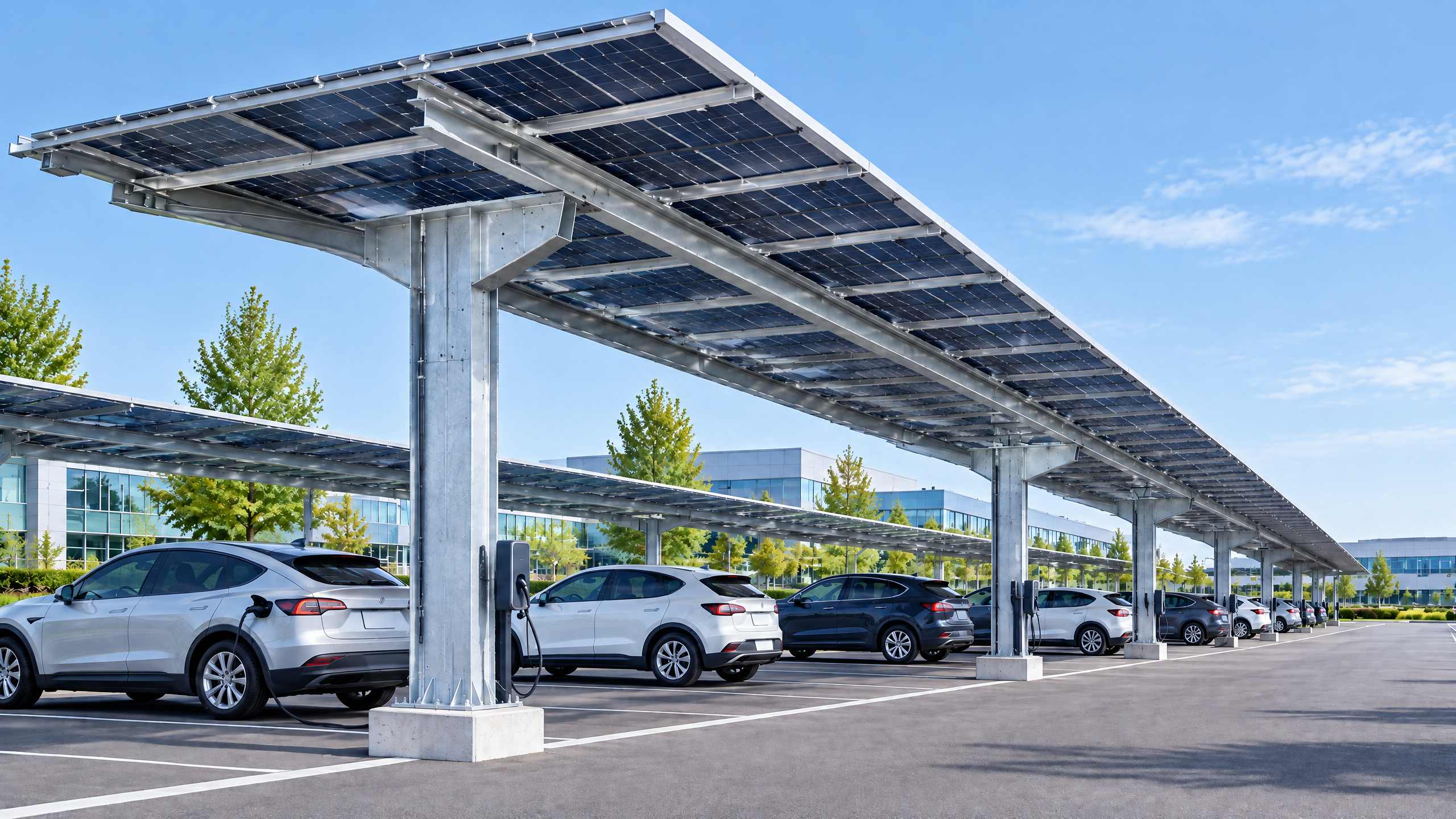
Selecting a solar parking canopy manufacturer is a procurement decision that touches engineering, commercial feasibility and long-term operations. The right manufacturer delivers more than a set of parts: they provide a documented structural and electrical interface to the site, tested manufacturing and logistics processes, coordination with PV and balance-of-system equipment, and verifiable handover and warranty procedures. This guide explains the minimum evidence you should insist upon, the technical interfaces that define scope, common implementation risks, and a practical six-step buyer workflow that keeps risk and cost predictable. It is aimed at distributors, architects, contractors, developers, solar EPCs and large fleet operators evaluating suppliers globally; the focus is the solar parking canopy manufacturer as the primary point of responsibility within a commercial solar procurement. For energy yield modelling, interconnection and EV integration you should use a documented project basis and local qualified professionals and authorities; sources such as NREL and PVWatts are recommended for initial yield estimates [1][2].
Buyer context and scope boundary
Who is this guide for, and what scope does "solar parking canopy manufacturer" cover?
- Primary audience: commercial buyers — distributors, architects, contractors, developers, solar EPCs, facility/fleet operators and owners.
- Manufacturer scope (typical): structural canopy frames, module mounting, roof membrane/fasteners if applicable, integrated cable raceways/trays, interface points for inverters and combiner boxes, foundation anchor details, standard finish/coating, and factory QA documentation.
- Manufacturer limits (typical): site foundations executed by local civil contractor, electrical mains work and final grid interconnection often supplied by specialized electrical contractors or the utility, permitting usually handled by the developer or EPC, and PV module/inverter procurement may be the buyer’s or manufacturer’s responsibility depending on contract.
Defining the boundary between what the manufacturer supplies and what remains the buyer or EPC’s responsibility is essential. Ambiguity on structural scope, electrical connections, access for maintenance and who supplies PV and EV equipment commonly drives change orders and delays.
Important note: site-specific structural capacity, foundations, permits, electrical design, approvals, lead time, price, energy yield and warranty require a documented project basis and review by relevant local qualified professionals, installers, utilities and authorities.
Core decision principle
A single decision principle should guide vendor selection: choose the manufacturer whose documented deliverables and evidence-based processes reduce project uncertainty across these four buckets—structural conformity, PV and electrical compatibility, supply-chain reliability, and lifecycle operations.
- Structural conformity: stamped structural calculations, load cases, and a clear solar carport structural interface that describes anchor sizing, uplift resistance, and tolerances.
- PV and electrical compatibility: clear PV equipment coordination and electrical pathway planning details including trays, conduit entries, raceway capacity, and combiner/inverter placement.
- Supply-chain & factory evidence: factory acceptance testing (FAT) protocols, material traceability, lead-time guarantees and logistics planning.
- Lifecycle operations: maintenance access planning, spare parts strategy, clear warranty boundaries and O&M handover.
If a supplier cannot demonstrate competence and evidence across these four buckets, budget extra contingency or move to alternate bidders. Evidence trumps marketing claims: insist on documents, not slides.
Planning inputs every buyer must compile
Before engaging detailed proposals, compile a planning dossier the manufacturer and bidders can use to price and design accurately. This reduces scope uncertainty.
Minimum planning inputs:
- Site survey pack: topographic plan, survey grid, existing utilities, property lines, and access routes.
- Structural data: geotechnical report, soil bearing capacity, groundwater level, and any existing shallow utilities or obstructions.
- Climatic design criteria: site wind and snow cases (as required by local code), seismic zones.
- Electrical interface: point of interconnection (POI), service voltage and capacity, location of main switchgear, and utility interconnection requirements.
- Energy objective: annual target kWh, peak reduction objectives, incentive or tariff constraints, and EV charging load profile if relevant.
- Parking usage: vehicle bay layout, circulation, clearances, lighting needs and pedestrian flows that inform canopy span and column placement.
- Permitting list: local permit types, required approvals, fire department or zoning constraints.
- Timeline and phasing: target installation window, staging constraints, operational deadlines.
- Budget envelope and financing: capital budget, expected ROI or IRR targets, tax or incentive assumptions.
Use PV yield tools and public databases such as NREL resources and PVWatts to provide consistent energy estimates for bidders to use in their commercial offers [1][2].
Technical specification and interface checklist
This is where technical rigor separates competent manufacturers from risky ones. The checklist below focuses on the interfaces that commonly cause scope disputes.
Key interface areas and buyer questions:
- Structural / architectural
- Has the vendor provided a complete solar carport structural interface package including stamped calculations and a column/foundation interface drawing?
- Do canopy spans and clearances match your parking layout, headroom and pedestrian routes?
- Are materials specified (grade of aluminium or steel, protective finishes, anti-corrosion detail) compatible with local environment?
- PV mechanical integration
- Does the manufacturer include module clamp details and module string layout documentation?
- Is module overhang, tilt and drainage considered to avoid ponding?
- PV electrical integration
- Is there a defined PV equipment coordination plan showing inverter/combiners location, DC/AC routing, cable tray sizes and combiner box mounting?
- Does the design specify access for testing and replacement of inverter and combiner components?
- Electrical pathway planning
- Has the manufacturer documented electrical pathway planning including conduit penetrations through columns, raceway routes, junction box locations and troughs for EV chargers and lighting?
- Are cable lengths and voltage drop calculations provided or estimated for bidder pricing?
- Utility and permit interface
- Does the scope identify responsibility for interconnection applications, utility inspections and metering equipment?
- Are required permit submissions (structural, electrical, site) listed and who prepares them?
- Maintenance and operations
- Are maintenance access planning details documented — walkway routes, fastening torque points, access panels and safe working clearances for module cleaning and inverter servicing?
- Is there a spare parts list and recommended preventative maintenance schedule?
- Integration with EV and site equipment
- Are EV charger locations and power allocation specified? Has the manufacturer coordinated physical mounting or dedicated cable routing where required?
- Is lighting, signage and CCTV integration accounted for in structural loading and wiring routes?
Include these exact terms in vendor communications where appropriate: solar carport structural interface, PV equipment coordination, electrical pathway planning, utility and permit interface, maintenance access planning. Clear language reduces interpretation differences.
Decision table — Scope & responsibility (example)
| Item / Responsibility | Typical Manufacturer Deliverable | Typical Buyer/EPC Deliverable |
|---|---|---|
| Structural frame, members, canopy | Fabricated frame, module mount rails, anchor plate drawings, corrosion finish | Foundation construction, anchor bolts installed per drawings |
| Module attachment & clamps | Module clip details, torque spec, module layout | Module procurement (if buyer-supplied) and on-site mounting |
| Cable trays and raceways up to POI | Routed trays, entry glands, DC combiner mount points | AC cable to main switchgear, final utility meter connections |
| Inverter / transformer | Optionally supplied; location and clearance | Final electrical connection, commissioning if third-party inverter |
| Permitting support | Package drawings, load calculations | Submission, fees, permit responsibility (depending on contract) |
| Maintenance access | Access openings, catwalk mounts, designated clearances | O&M execution and any special access equipment |
Procurement evidence and factory acceptance
Commercial solar procurement demands documentary proof. Ask for, and verify, the following factory and procurement evidence before contract award.
Factory and QA evidence checklist:
- Shop drawings and BOM: fully itemised bills of materials, rated loads for key members and anchorage details.
- Stamped engineering: structural calculations stamped by a licensed engineer for the governing jurisdiction or a statement of intent to supply stamped paperwork prior to shipment.
- Material traceability: mill certificates for critical members and finish/coating specifications.
- Factory Acceptance Testing (FAT) protocol: what tests will be performed, pass/fail criteria and third-party witness options.
- Welding and fabrication standards: applicable codes (e.g., ISO or EN standards) and welder qualifications.
- Packing and logistics plan: packaging for modules, frames, crate sizes, lifting points and unloading requirements.
- Lead-time schedule and critical path: single-point lead-time commitments and a calendar showing major milestones.
- QA/QC inspection records: sample reports from past production runs or a structured inspection plan for your lot.
- Commercial terms: payment milestones tied to deliverables (e.g., engineering sign-off, FAT, shipment, site acceptance), and explicit definitions for warranty start and scope.
Decision table — Minimum procurement evidence
| Evidence item | Why it matters | Acceptable buyer action |
|---|---|---|
| Stamped structural calculations | Confirms design meets local code loads and tolerances | Require prior to fabrication; hold shipment until provided |
| FAT protocol | Ensures components meet functional and dimensional requirements | Include witness rights and remediations in contract |
| Material mill certificates | Verifies material grade and strength | Require traceability for primary load-bearing members |
| BOM & shop drawings | Prevents on-site surprises during installation | Approve shop drawings before fabrication |
| Packing & logistics plan | Reduces risk of damage and site handling issues | Review routes, crane needs and storage capacity |
If a manufacturer resists providing these items or provides them only after contract award, treat that as a red flag and seek escrow or staged payment terms.
Site installation, commissioning and operations
A good manufacturer’s written responsibilities should include clear handover boundaries and commissioning support. Execution at site is where design intent is validated.
Installation sequencing and practical considerations:
- Foundation coordination: foundations and anchor bolt positioning must be installed per the approved anchor template. Include tolerance bands for bolt positions and require confirmation surveys before steel erection.
- Lifting and staging: produce a method statement for lifting operations, crane capacity and required lift zones; identify temporary storage and protection for finished parts.
- Torque and bolting: supply torque specifications for all structural and electrical connections and ensure the installing contractor documents torque checks and bolting pattern sequencing.
- PV installation sequence: module unloading, stringing, DC cable routing, combiner and inverter mounting, AC interconnection and labeling. Modules should not be installed until canopy integrity and drainage are confirmed.
- Commissioning and testing: define acceptance tests—continuity, insulation resistance, inverter commissioning, AC commissioning and performance baseline measurement. Agree who provides instruments and meters.
- Handover documentation: as-built drawings, completed test reports, maintenance manual, spare parts list, warranty certificates and training records.
- Maintenance procedures: require a maintenance access planning document to confirm safe access for cleaning modules, replacing inverters and performing routine inspections.
Operations and O&M:
- Define a minimum O&M package or schedule (e.g., annual inspection, biennial torque checks). If the manufacturer offers an O&M contract, verify personnel qualifications and response SLAs.
- Clarify warranty claims process, who is liable for removed or replaced components, and what is regarded as installation-caused damage versus manufacturing defect.
Permitting and utility interaction:
- Coordinate commissioning dates with utility inspection windows and ensure the supplier’s commissioning scope includes any pre-energization checks required by the utility.
Caveat: final electrical interconnection, meter installation and utility approvals normally require licensed electrical contractors and local utility coordination. Confirm responsibilities in contract documents.
Implementation risk register — common risks and mitigations
Identify typical implementation risks tied to solar parking canopy procurement and practical mitigations.
Key risks and mitigations:
- Ambiguous scope causing change orders
- Mitigation: detailed scope matrix and signed shop drawings prior to fabrication.
- Foundation or geotechnical surprises
- Mitigation: carry out geotech early, specify contingency for pile vs spread footing, or require adjustable base plates in design.
- Module and inverter compatibility issues
- Mitigation: early PV equipment coordination; vendor to provide interface dimensions and stringing diagrams.
- Long lead times and logistics delays
- Mitigation: stagger procurement, include supplier lead-time guarantees, and define penalties or liquidated damages if appropriate.
- Permitting and utility delays
- Mitigation: pre-application meetings with authorities and clarity on utility and permit interface responsibilities.
- Assembly or fitment mismatch on site
- Mitigation: FAT, 3D shop drawings, and early site check of anchor positions.
- Warranty gaps and ambiguous responsibility lines
- Mitigation: contractually define warranty start/end, include manufacturer and installer obligations and require proof of insurance.
Decision table — Risk severity vs buyer action
| Risk | Likely impact | Recommended buyer action |
|---|---|---|
| Ambiguous scope | High: change orders, delays | Require detailed scope matrix + signed shop drawings |
| Geotech surprises | High: potential redesign | Commission geotech before final design; include contingency |
| Lead-time slippage | Medium–High | Stage orders; request lead-time bonds or alternative suppliers |
| Permitting delays | Medium | Early engagement with authority; define permit owner |
| Component mismatch | Medium | Require interface drawings and FAT prior to shipment |
| Lifecycle O&M disputes | Medium | Define maintenance access planning, O&M terms and SLA |
Six-step buyer workflow (named and actionable)
A repeatable workflow reduces surprises. Use these six steps as a template for each procurement.
- Define Project Baseline
- Deliverables: planning dossier (site survey, geotech, POI, load and parking layout), initial energy target using NREL/PVWatts [1][2].
- Action: internal approvals for budget and timeline.
- Issue Request for Information / Pre-Qualification
- Deliverables: pre-qual form asking for company credentials, factory location, past project types (non-confidential), welding/fabrication standards, FAT capability.
- Action: shortlist vendors based on demonstrated procedures and capacity.
- Issue Detailed Request for Proposal (RFP)
- Deliverables: RFP includes scope matrix, required documents (shop drawings, stamped calculations), timeline and milestones, FAT requirements, packing plan and acceptance criteria.
- Action: set an RFP timeline with mandatory deliverables and questions deadline.
- Technical Evaluation and Clarifications
- Deliverables: side-by-side technical comparison, review of structural interface and electrical pathway planning documents.
- Action: seek clarifications, request sample FAT reports, require manufacturer to provide mock-up or 3D model where possible.
- Contracting and Pre-Fab Approvals
- Deliverables: signed contract with staged payments, shop drawing approval, FAT schedule, logistics plan and insurance certificates.
- Action: withhold final milestone payments until FAT and shop drawing approvals are complete.
- Site Coordination, Installation and Commissioning
- Deliverables: installation method statements, torque logs, commissioning reports, as-built drawings, O&M manual and formal handover.
- Action: ensure utility and permit interface is closed, verify performance baseline and accept or reject per agreed criteria.
This workflow assigns clear gating points where design is locked and contingencies can be controlled.
Frequently asked questions (FAQ)
Q: Do manufacturers typically include PV modules and inverters? A: Practices vary. Some manufacturers supply turnkey carports including modules and inverters; others supply only the structural system and electrical mounting points. Clarify in RFP whether the PV equipment is buyer-supplied or manufacturer-supplied and require manufacturer-supplied equipment to include datasheets and warranty transfer provisions.
Q: How important are stamped calculations? A: Crucial. Stamped calculations provide legal and engineering assurance that the design meets local code loads. If the manufacturer proposes to provide stamped calculations after fabrication, consider that a contractual risk; require them prior to shipment where possible.
Q: How should we model energy yield? A: Use validated tools such as PVWatts or NREL resources for preliminary yield and then request manufacturer/EPC detailed modelling as part of their proposal. PVWatts and NREL provide credible baseline assumptions for irradiance and system losses [1][2].
Q: Who handles utility interconnection? A: Responsibility should be contractually defined. Utility interconnection applications and final meter installation are often handled by the EPC or the buyer’s electrical contractor but may require manufacturer input on metering locations or AC termination points. Reference FERC interconnection resources for interconnection frameworks in applicable jurisdictions [4].
Q: What maintenance should we budget for? A: Budget for periodic cleaning if soiling is expected, annual inspections for structural bolts and electrical terminations, inverter replacement at end of life, and ad-hoc repairs after severe weather. Formalize maintenance intervals and responsibilities in the contract and in maintenance access planning.
Q: Can these canopies support EV chargers? A: Yes, but EV chargers require coordination: additional load studies, conduit capacity, and potentially HVAC or climate-controlled enclosures for power electronics. Reference AFDC resources for EV infrastructure planning for a high-level understanding of requirements [3].
Q: Are aluminium carports better than steel? A: Choice depends on local conditions and project constraints. Aluminium offers corrosion resistance and lower maintenance in some climates; steel can provide lower initial cost and higher stiffness. Require comparative life-cycle costing and finish specifications from bidders.
Q: What are typical lead times? A: Lead times vary by manufacturer capacity, customization and current demand. Instead of relying on generic figures, require a firm lead-time schedule tied to contractual milestones.
Mid-article call to action
If you want a project-specific review of supplier deliverables or a pre-procurement checklist aligned to your local code and energy targets, contact us via /inquiry or email info@carportiva.com. You may also review product options like SolarGrid commercial solar system and see examples across all systems or our sourcing guides for RFP templates.
Implementation case considerations (practical details)
Practicalities to address in contract and on-site coordination:
- Anchor bolt tolerances and remedial plates: specify acceptable tolerance bands and remedial options if anchors are out of tolerance.
- Coating and galvanization standards: define environmental class (e.g., corrosive coastal or industrial) and appropriate protective systems.
- Module fixation under wind uplift: require uplift attachment calculations for extreme wind events and specify product tests used to qualify clamps (ask for independent lab tests where available).
- Drainage and clearance: canopy designs should manage rainwater runoff without directing water onto parked vehicles and respect guttering/overhang to minimize splash.
- Lighting and night-time safety: integrate lighting layout into canopy design or provide load, structural and routing allowances for third-party lighting.
- Snow and hail considerations: ensure design includes local snow loads and hail-resistant details for modules and glass.
Procurement tip: request 3D BIM models where the project complexity requires it. BIM reduces clashes with site utilities and circulation patterns.
Warranty, insurance and contractual language to include
When drafting contracts, include explicit language on:
- Warranty scope: parts, labor, finish, structural integrity, corrosion and PV module/inverter warranties (if supplied by manufacturer).
- Warranty start date: tie to final acceptance and commissioning, not shipment date.
- Remedies: repair, replacement, prorated warranty or other remedies and timelines for responses.
- Insurance requirements: builder’s risk during installation, product liability and professional indemnity for stamped calculations where applicable.
- Acceptance tests: list commissioning tests and criteria for commercial acceptance and practical completion.
Always have local legal counsel and technical experts review warranty and warranty-transfer provisions to ensure enforceability in the project jurisdiction.
Closing considerations and vendor evaluation scorecard
Create a scoring rubric to compare bidders on objective criteria such as technical completeness, documented QA processes, lead times, price, warranty terms, and references. Weight each category according to project priorities (e.g., structural certainty highest weight for high-wind regions).
Example weighted criteria (buyer to adapt):
- Structural documentation & interface completeness — 25%
- PV and electrical interface completeness — 20%
- Factory QA and FAT capability — 15%
- Lead time and logistics plan — 15%
- Price and commercial terms — 15%
- Warranty & O&M offering — 10%
Use the scoring to shortlist and then perform deep-dive due diligence with contractor references and factory visits where feasible.
Conclusion
A disciplined procurement process that centers the solar parking canopy manufacturer’s documented structural and electrical interfaces, PV equipment coordination and lifecycle obligations will reduce project cost overruns and operational surprises. Insist on stamped calculations, FAT protocols, clear electrical pathway planning and maintenance access planning as contractual deliverables. Coordinate early with your utility and permitting authorities to close the utility and permit interface before committing to fabrication. For energy-yield assumptions and preliminary modelling, use NREL and PVWatts resources [1][2], and for interconnection frameworks consult applicable regulatory guidance [4]. Remember: site-specific structural capacity, foundation design, permits, electrical design, approvals, lead time, price, energy yield and warranty MUST be based on a documented project basis and verified by relevant local qualified professionals, installers, utilities and authorities.
For a project-specific assessment, procurement support or to review product options including the SolarGrid commercial solar system, contact us via /inquiry or email info@carportiva.com. You can also browse all systems and consult our sourcing guides for downloadable RFP templates and checklists.
References
- National Laboratory of the Rockies PV resources: https://www.nrel.gov/solar/
- PVWatts Calculator: https://pvwatts.nrel.gov/
- U.S. Department of Energy Alternative Fuels Data Center: https://afdc.energy.gov/
- Federal Energy Regulatory Commission interconnection resources: https://www.ferc.gov/electric-transmission/generator-interconnection
References
- National Laboratory of the Rockies PV resources: https://www.nrel.gov/solar/
- PVWatts Calculator: https://pvwatts.nrel.gov/
- U.S. Department of Energy Alternative Fuels Data Center: https://afdc.energy.gov/
- Federal Energy Regulatory Commission interconnection resources: https://www.ferc.gov/electric-transmission/generator-interconnection
Keep the project brief connected.
Bring the actual project brief to the engineering table.
Share your location, layout, target application and available technical inputs. Carportiva can help identify the relevant product-interface information before a project-specific commercial discussion.
Request a project discussion