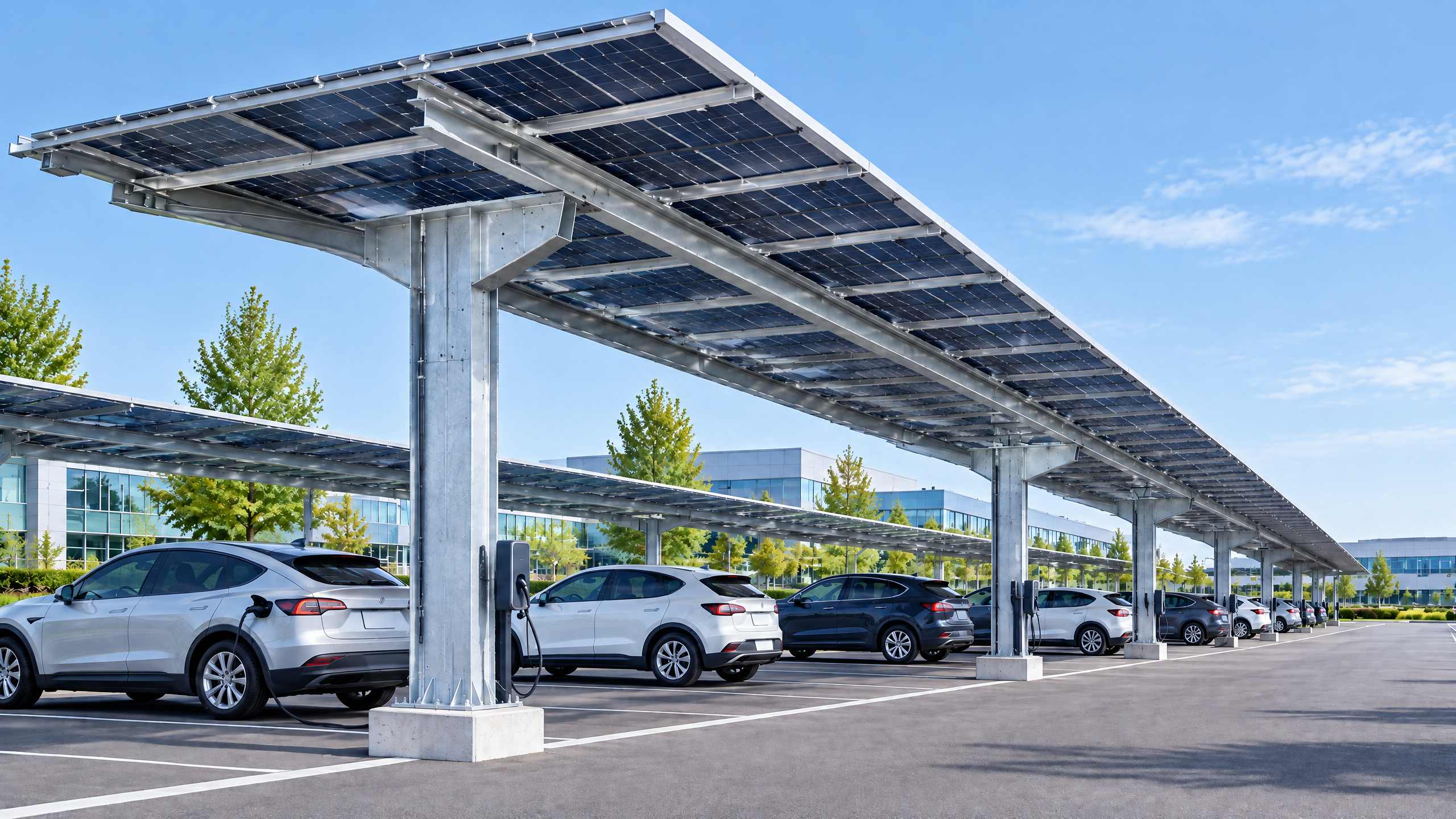
Deciding on a solar carport system supplier starts with defining the project outcomes your organisation needs—capacity target, energy yield, vehicle clearance, EV integration, and long-term maintenance scope—and then translating those outcomes into measurable technical and contractual requirements. The right specification balances structural and electrical interfaces, procurement evidence, factory QA, and site execution capability. This guide explains what to demand from a solar carport system supplier at each procurement stage: scope boundary and risk allocation; the single-line and structural interfaces to resolve up front; verifiable factory and supply-chain evidence; on-site erection and commissioning expectations; and the governance items you must retain (warranties, lead-time contingencies, and approval dependencies). Use this guide to draft an objective tender, evaluate competing bids, and convert commercial priorities into the technical questions that expose real supplier capability.
Buyer context and scope boundary: define what “supplier” includes
A clear scope boundary reduces ambiguity around who supplies what, who obtains permits, and who carries interface risks.
- Supplier role definitions you can choose:
- Full-supply EPC model: supplier provides structure, PV modules, inverters, DC and AC BOS (balance of system), site works, foundations, installation, testing and commissioning, and grid interconnection support.
- Supplier-as-product: supplier provides structural carport systems and mounting hardware only; buyer or EPC supplies PV modules, inverters, wiring, and commissioning.
- Hybrid model: supplier provides structure and PV modules plus mechanical installation; buyer or separate EPC provides electrical BOS, interconnection and commissioning.
- Who typically owns what on contract award:
- Supplier: project-specific drawings for the carport, bill of materials (BOM) for carport framing, module mounting details, structural calculations for the supplied structure, factory quality evidence, and installation supervision.
- Buyer/EPC: site civil works, foundations (unless included), utility applications, final electrical design and protection settings, and operations contract unless the supplier offers O&M.
Clarify at tender whether the solar carport system supplier is expected to manage the full interconnection and permitting process or only to provide technical input. This affects lead times, pricing and risk allocation.
Note: site-specific structural capacity, foundations, permits, electrical design, approvals, lead time, price, energy yield and warranty require a documented project basis and qualified local professionals, installers, utilities and authorities to verify and approve.
Core decision principle: align commercial priorities to measurable technical criteria
Choosing the right solar carport system supplier is not about the lowest unit price. Use a decision matrix that prioritises the outcomes that matter to your organisation:
- Life-cycle cost vs. capital cost (CAPEX vs. OPEX)
- Energy yield per site footprint and expected yield certainty
- Structural compatibility with site-specific load cases (wind, seismic, snow)
- EV charging integration flexibility and future-proofing
- Warranty allocation and service responsiveness
Establish weighted scoring for tender evaluation. Example weighting (adjust to your priorities): technical conformity 35%, factory and QA evidence 20%, project management & delivery track record 15%, commercial terms & warranties 20%, total cost of ownership 10%. The aim is to convert subjective impressions into repeatable, evidence-led scoring.
Decision table: Example priority-weight matrix
| Priority factor | Buyer priority (1–5) | Tender evaluation metric |
|---|---|---|
| Structural compliance for local loads | 5 | Verified site-specific structural calculations; local engineering stamp |
| Energy yield | 4 | Modeled annual yield with PVWatts or equivalent; assumptions noted [2] |
| Delivery & lead time certainty | 4 | Contracted milestones and liquidated damages options |
| Warranty & spare parts | 4 | Manufacturer warranties and spare part lead times |
| O&M / service model | 3 | Response SLA and local service partner coverage |
Use this matrix as the basis for supplier shortlisting.
Planning inputs: what you must provide the supplier and what you should require from them
Accurate planning inputs reduce scope creep and change orders. As buyer, provide:
- Site survey pack: geotechnical report, topo, utilities, existing structures and clearance constraints
- Electrical single-line and point of connection information (if known)
- Site access, crane or lifting constraints, and staging area limits
- Local code references and grid interconnection requirements
- EV charging strategy and load management expectations
What to require from the supplier:
- Preliminary structural concept for the carport, showing clearances and module tilt options
- Interface drawing for modules and inverters (the solar carport structural interface)
- Preliminary electrical layout and DC/AC routing recommendations (electrical pathway planning)
- High-level schedule with key milestones: engineering, factory manufacture, shipping, installation, commissioning
- Evidence of previous projects or case studies with matching scope (preferably with contactable referees)
Be explicit about the information you will accept as “design-basis” and the change-management procedure for late variations. This prevents vendors from pricing to different assumptions.
Planning note: use PV production calculators such as PVWatts [2] and regional solar resource data [1] to validate energy yield assumptions early in procurement conversations.
Technical specification and interfaces
This section provides the technical checklist that turns outcomes into verifiable specifications for tender documents.
Key technical areas to specify and validate:
- Structural design and code compliance
- Required clearances for vehicles including roof height and ingress/egress envelope.
- Design wind speed, snow load and seismic basis as per local codes. Request stamped calculations from a local licensed engineer for the final design.
- Anchor and foundation design: indicate whether the supplier or buyer supplies foundation design. If the supplier provides foundation design, require soil-envelope limits and a geotechnical basis.
- Solar carport structural interface
- Specify module dimensions, weight, and mounting method compatibility.
- Describe any glass or bifacial module application and required edge clearance, backsheet materials, and corrosion protection levels.
- Lighting, signage, or EV charger mounting points and load caps.
- PV equipment coordination
- Require the supplier to provide rack-to-module compatibility information, clamping details, BOM with torque values, and module grounding methodology.
- Define responsibilities for module warranty transfer and module acceptance testing at receipt.
- Electrical pathway planning
- Provide target AC collection points, main distribution location and conduit entry points.
- Clarify who supplies cable trays, tray supports, junction boxes and DC combiner boxes.
- Specify conduit routing requirements through columns and where penetrations to the utility side occur.
- Inverter and BOS interface
- Specify inverter location preference (under canopy, on pad), ventilation needs and access.
- Communication and SCADA interface requirements for remote monitoring and EMS/DERMS compatibility.
- Protection settings and transformer requirements if needed.
- Drainage, lighting, and safety integration
- Clarify rooftop water run-off management, integration with site drainage and requirements for slip-resistant walkways if needed for maintenance access.
- Define emergency egress, fall-protection anchor points and integrated lighting load.
Technical checklist table: Required deliverables from supplier
| Deliverable | Minimum content required | Buyer acceptance criterion |
|---|---|---|
| Structural drawings | General arrangement, member sizes, connection details, load assumptions | Stamped by a local engineer or accepted via design-review process |
| Electrical layout | DC and AC single-line, conduit schedules, cable sizing | Match to buyer single-line and point of interconnect |
| BOM and traceability | Material list with source, surface treatment, and certificates | Factory material certificates and shipment packing list |
| Installation method statement | Erection sequencing, crane lifts, safety plan | Method accepted by buyer site manager and safety officer |
| Testing & commissioning plan | Pre-commission tests, commissioning checks, witness points | Tests completed and recorded before handover |
Make sure the supplier confirms that the carport frame does not create adverse shading patterns that materially reduce annual energy yield.
Procurement and factory evidence: what to ask for and how to evaluate claims
A supplier’s documentation should be objective and auditable. Demand the following documentary evidence as part of any tender response:
- Factory quality system description (ISO 9001 or equivalent) and evidence of routine internal QC processes.
- Material certificates for structural aluminium and fasteners (e.g., alloy grade, temper and surface treatment).
- Welding or connection quality processes and NDT evidence if appropriate.
- Component traceability: batch numbers for critical elements such as modules, inverters, and fasteners.
- FAT (Factory Acceptance Test) scope for electrical components where applicable.
- Sample drawings of packaging and shipping methods to verify handling for long lead items.
Evaluation guidance:
- Look for supplier willingness to include witnessed FAT and certified test records.
- Ask for a sample project submittal package early to evaluate the clarity of deliverables you will receive.
- If warranties are marketing‑led (e.g., “industry leading”), ask for written warranty terms and exclusions to be included in the contract.
Decision table: Supplier documentary evidence scoring
| Evidence item | Weight | Pass criteria (yes/no) |
|---|---|---|
| Factory/QC system description | 15 | QC system documented and demonstrable |
| Material certificates | 20 | Certificates for all structural materials provided |
| FAT/Test records | 15 | FAT scope and willingness to witness |
| Traceability | 15 | Batch numbers traceable to delivery |
| Sample submittal package | 20 | Complete structural and electrical submittals |
| Warranty terms | 15 | Written and contract-ready warranty clauses |
In commercial solar procurement scenarios, assign a higher weight to traceability and FAT for projects with long service expectations or critical uptime requirements.
Link to product: if you need an example of a commercial offering that integrates structure with electrical design, see Carportiva’s SolarGrid commercial solar system for a starting reference on typical scope and deliverables. Also consult our all systems overview and sourcing guides for procurement templates.
Mid-article CTA: ready to discuss a specific scope? Submit a project summary and requirements via /inquiry.
Site installation, commissioning and operations: practical expectations
A supplier’s ability to perform on site is where many contracts succeed or fail. Define clear expectations:
- Site mobilisation and access controls. Require a baseline site readiness checklist before factory dispatch.
- Lifting plans and crane requirements. Supplier should provide lift diagrams for any heavy prefabricated components.
- Installation tolerances and acceptance criteria for column plumbness, module alignment and torqueing of fasteners.
- Electrical cable routing acceptance: require continuity testing, insulation resistance testing and DC string verification at completion.
- Commissioning acceptance: include a witness list of key tests, and pass/fail criteria tied to payment milestones.
- O&M handover: specify as-built drawings, O&M manuals, spare parts list and training for on-site maintenance staff.
- Maintenance access planning: include module and inverter access clearances, walkway requirements and safe working zones for servicing.
Operations note: require a minimum set of as-built documentation at handover: stamped structural drawings, single-line diagram, SCADA access credentials, spare parts inventory and troubleshooting guides.
Emphasise that maintenance access planning must be designed in from the start; retrofits can be costly and may void warranties.
Implementation risks and how to allocate them
Identify and quantify the likely risk categories and allocate responsibility clearly in the contract.
Common risk categories:
- Design basis mismatch (e.g., geotech or utilities data incomplete) — allocate to buyer if data not provided; to supplier if they commission surveys.
- Permitting and approvals delays — allocate to party responsible for permits; for shared responsibility clearly define timeline allowances.
- Lead-time and supply chain disruption — require supplier to provide lead-time guarantees and alternative sourcing plans.
- Weather and force majeure affecting installation windows — define force majeure clauses and options for rescheduling.
- Interface failures between structural and electrical teams (the solar carport structural interface and PV equipment coordination failures) — require an integration plan and designate a single technical coordinator.
Risk allocation example (high-level)
| Risk | Typical allocation | Mitigation |
|---|---|---|
| Foundation unknowns | Buyer | Provide geotech; allocate contingency and change order terms |
| Permit delays | Buyer or shared | Supplier provides permit package input; buyer holds application responsibility unless supplier agreed to manage |
| Supply chain delays | Supplier | Contractual lead-time and alternative vendor clauses |
| On-site installation delays | Supplier | Agreed critical path, liquidated damages, resource escalation |
| Electrical interconnection | Buyer/EPC | Utility liaison by buyer, supplier provides technical package for interconnection application |
Contractual clarity on risk reduces claim disputes in delivery.
Regulatory and utility interface: approvals and interconnection
Grid interconnection and local approvals can be a critical path item. Early engagement with the local utility and permitting authority avoids late surprises.
- Utility and permit interface: require suppliers to provide technical packages suitable for utility interconnection applications (single-line, earthing, transformer details and protection settings). Confirm which party will prepare and submit grid applications and who pays for interconnection study fees.
- Interconnection studies: many utilities require studies that can change upgrade scope and cost; ensure procurement timelines allow for study completion and potential upgrade options.
- Compliance with local safety codes and electrical standards must be validated by a locally qualified engineer and approved by the authority having jurisdiction (AHJ).
Public resources: use national and regional guidance for interconnection procedures as appropriate, including FERC resources where jurisdictional [4] and national resource tools for solar planning [1], [2]. For EV charging and alternative fuels integration guidance, consult Department of Energy resources [3].
Reminder: final approval requires documented design submission to the utility and AHJ with signatures and permits. Do not assume permit issuance is automatic.
Six-step buyer workflow to select and onboard a solar carport system supplier
A named workflow you can follow for consistent procurement outcomes.
- Define outcomes and produce the design basis
- Produce a one-page buyer outcomes document: energy target, vehicle clearance, EV interface, expected warranty period and overall budget ceiling.
- Prepare an informed RFQ/RFP
- Provide baseline data: topo, geotech, electrical point of connection, site constraints and procurement milestones. Specify mandatory deliverables (structural calculations, BOM traceability, FAT).
- Shortlist and clarify
- Evaluate bids against your weighted decision matrix. Shortlist 2–3 suppliers and conduct technical clarifications with a standard Q&A log.
- Validate factory and references
- Visit or request live virtual factory walkthroughs, get sample submittal packages and verify traceability documents. Conduct reference checks focused on delivery and warranty claims.
- Execute contract with clear change management
- Include milestones, acceptance tests, risk allocation and escalation procedures. Set payment linked to tangible deliverables and witness points.
- Commission & hand over
- Witness final testing, secure as-built documentation, training, and spare parts. Establish O&M agreement and response SLAs.
Use this workflow to reduce subjectivity and ensure repeatable supplier selection.
Cost drivers and lead-time considerations
Understand the factors that most influence cost and delivery time:
- Custom vs. standard canopy geometry
- Foundation complexity (deep piles vs. shallow pads)
- Local certification and testing requirements
- Shipping distances and import licensing
- Module and inverter lead times beyond structural components
- Seasonality and local labour availability for installation
Ask suppliers for a clear lead-time breakdown: engineering time, fabrication time, shipping, customs clearance, on-site assembly. Contractually require notice of long-lead delays and mitigation plans.
Two decision tables to use in tender evaluation
Table 1 — Technical compliance pass/fail
| Technical item | Pass criteria | Supplier evidence required |
|---|---|---|
| Structural compliance | Calculations match local code load cases | Stamped structural calculation or conditional acceptance |
| Module mounting compatibility | Rack accommodates specified modules and torque values | Mounting details, clamp drawings, BOM |
| Electrical routing and containment | Pathways avoid mechanical conflicts and meet conduit fill | Routing drawings and conduit schedules |
| Wind and uplift mitigation | Connection details for uplift and lateral loads | Connection detail drawings and test reports (if available) |
| Maintenance access | Meets specified clearance and safe access | Maintenance plan and access drawings |
Table 2 — Commercial risk and contract clauses
| Clause category | Typical buyer position | Suggested contract language |
|---|---|---|
| Lead-time & delivery | Buyer needs guaranteed windows | Milestone dates with remedies for missed milestones |
| Change orders | Limit open scope | Unit rates for variations and a clear change-order approval process |
| Warranty & liability | Balanced protection | Manufacturer warranty plus minimum supplier warranty and defined remedies |
| Performance security | Buyer protection | Performance bond or retention schedule |
| Acceptance tests | Define pass/fail | List of witness tests and documented acceptance criteria |
Use these tables in your procurement pack for consistent bid scoring.
Practical checklist for tender documents
- Clear deliverable list (drawings, calculations, BOM, FAT records)
- Defined responsibilities for foundations, permits and utility applications
- Acceptance testing and witness schedule
- Warranty terms: structure, modules, inverters and workmanship
- Spare parts list and lead times
- Insurance requirements and insurance coverage limits
- Dispute resolution and liquidated damages clause
Frequently asked questions (FAQ)
Q: How do I compare energy yield claims between suppliers? A: Ask for the energy model inputs and re-run using a common tool such as PVWatts [2] or a validated irradiance dataset [1]. Ensure identical assumptions for module type, tilt, orientation, soiling losses and inverter efficiency are used.
Q: Should the supplier provide foundations? A: Only if your contract explicitly includes foundation design and supply. Foundations are site-specific and often require local engineering stamps; expect extra cost for soils-driven designs.
Q: Can the carport structure include EV chargers? A: Yes. Define EV load profiles and whether chargers will be AC or DC fast chargers. Ensure the carport design includes cable routes, mounting points and ventilation for charger enclosures. PV equipment coordination is essential to ensure DC strings and charger loads are integrated safely.
Q: Who applies for grid connection? A: This must be specified in the procurement documents. For many buyers the utility and permit interface remains the buyer’s responsibility, but some suppliers will provide application support if engaged early.
Q: What warranties should I expect? A: Common warranties include structural (workmanship), module manufacturer, and inverter manufacturer warranties. Require written warranty documents and clarify exclusions for site conditions or unauthorised modifications.
Q: How much contingency should be included in budgets? A: Contingency varies by project maturity. For early-stage projects without full geotech or utility data, allow a higher contingency (e.g., 10–20%). For mature, fully surveyed projects, contingency can be reduced. Always validate with your finance and risk teams.
Q: Can I change module brands after awarding contract? A: Only under strict change-control. Module changes affect the solar carport structural interface, module clamps, grounding and electrical performance. Define approval steps and pricing impacts for any substitution.
Closing considerations and legal‑technical reminders
- Do not award on price alone. Verify documentary evidence and on-the-ground capability.
- Require a documented project design basis before finalising warranties and acceptance criteria.
- Confirm local AHJ and utility requirements early; they commonly drive design changes and delays.
- Ensure your procurement contains an explicit maintenance access planning clause to avoid future serviceability problems.
- Retain a local, qualified structural engineer and electrical designer to review supplier submissions and to stamp final drawings where local regulation requires it.
Remember: site-specific structural capacity, foundations, permits, electrical design, approvals, lead time, price, energy yield and warranty require a documented project basis and relevant local qualified professionals, installers, utilities and authorities.
Conclusion: specify to control outcomes
Specifying a solar carport system supplier for a commercial carport project is a discipline of translating commercial outcomes into precise technical deliverables and verifiable evidence. Focus on the interfaces—the solar carport structural interface, PV equipment coordination, and electrical pathway planning—and use objective documentary checks to mitigate execution and warranty risk. Use the six-step workflow in this guide to ensure consistent procurement decisions. If you need aligned design-and-procurement support or a tailored supplier evaluation package, our team can review your design basis and tender requirements.
For a product-led starting point and typical deliverables, see Carportiva’s SolarGrid commercial solar system. For broader options, view our all systems page and consult our sourcing guides for templates and sample RFP language.
Closing CTA: for project enquiries and to start a technical dialogue, contact info@carportiva.com.
References and further reading
- NREL: solar resource and technical guidance [1]
- PVWatts Calculator for preliminary yield estimates [2]
- U.S. Department of Energy AFDC — EV infrastructure context [3]
- FERC interconnection guidance and jurisdictional resources [4]
References
- National Laboratory of the Rockies PV resources: https://www.nrel.gov/solar/
- PVWatts Calculator: https://pvwatts.nrel.gov/
- U.S. Department of Energy Alternative Fuels Data Center: https://afdc.energy.gov/
- Federal Energy Regulatory Commission interconnection resources: https://www.ferc.gov/electric-transmission/generator-interconnection
Keep the project brief connected.
Bring the actual project brief to the engineering table.
Share your location, layout, target application and available technical inputs. Carportiva can help identify the relevant product-interface information before a project-specific commercial discussion.
Request a project discussion