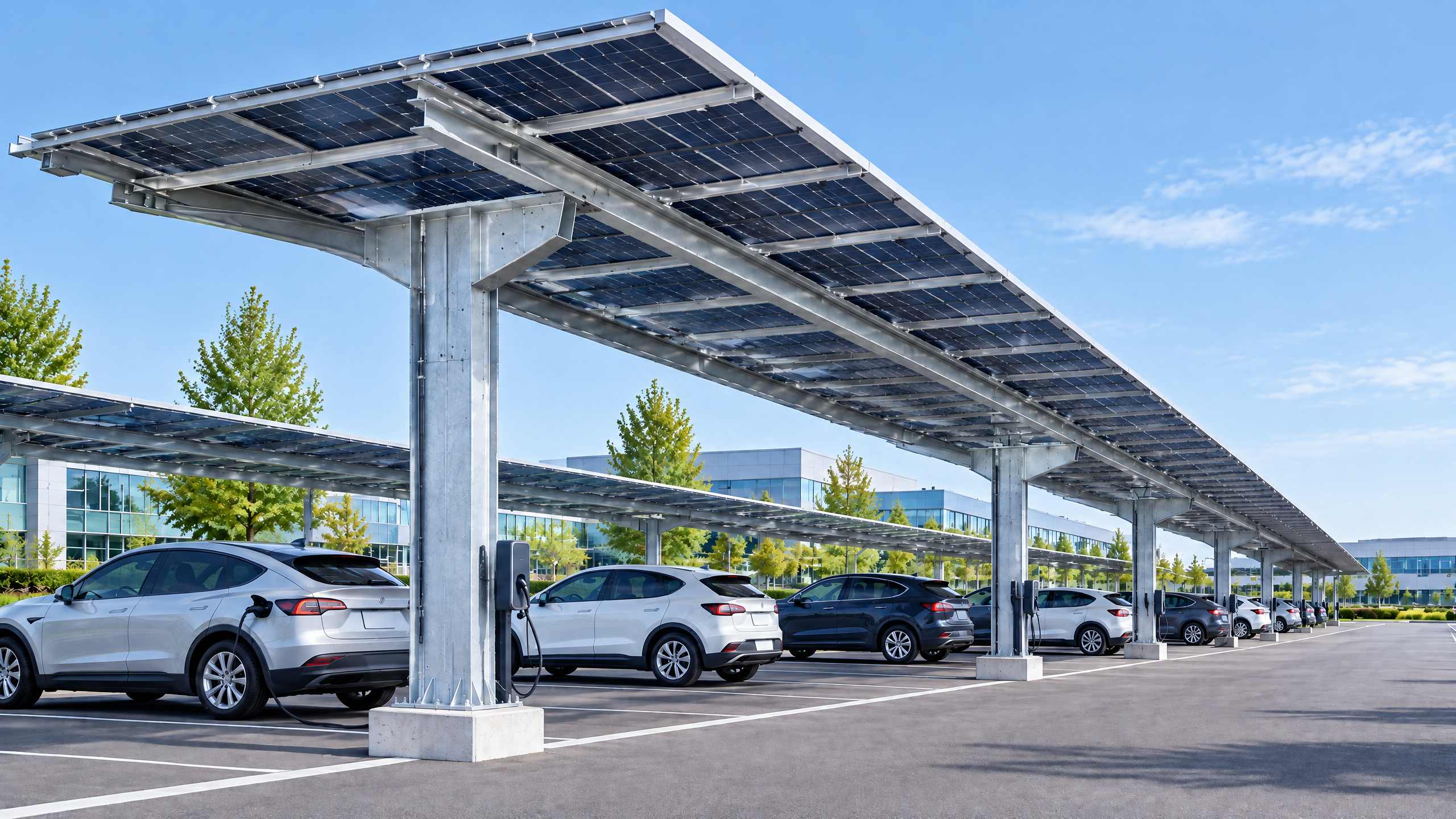
A project team should confirm that the chosen solar carport system manufacturer can deliver engineered, documented, and auditable outcomes that match the project’s technical, commercial and regulatory requirements. At minimum, this means the manufacturer must demonstrate clear responsibility boundaries (structure vs PV), provide factory and site evidence (drawings, materials reports, FAT records), coordinate PV equipment and electrical interfaces, and have a tested supply and installation workflow that matches the project programme. The team must verify interface points such as the solar carport structural interface, PV equipment coordination needs, electrical pathway planning and maintenance access planning, and understand how the manufacturer will manage utility and permit interface. Finally, contractual clarity on warranties, spare parts, change control and performance acceptance reduces implementation risk and simplifies commercial solar procurement decisions.
Buyer context and scope boundary
Who this guide is for
- Distributors, architects, contractors, developers, solar EPCs, fleet operators and procurement teams evaluating a solar carport system manufacturer for commercial or industrial projects.
- Projects where the carport is both an architectural shelter and a primary PV support system (shared structural and electrical responsibilities).
What this guide does and does not cover
- Covers procurement criteria, technical interfaces, installation and operational considerations, procurement evidence and buyer workflow for selecting a solar carport system manufacturer.
- Does not replace site-specific engineering, local permitting, utility interconnection engineering, or final commercial/legal advice. Site-specific structural capacity, foundations, permits, electrical design, approvals, lead time, price, energy yield and warranty require a documented project basis and relevant local qualified professionals, installers, utilities and authorities.
Scope boundary: responsibilities you must define up-front
- Structural scope (manufacturer supplies canopy, posts, connections) versus PV scope (modules, inverters, DC/AC combiner design) must be explicitly allocated in specification and contract.
- Who supplies foundations, anchor bolts, geotechnical investigation, on-site welding or post-install civil works.
- Who provides final electrical design, metering, and utility interconnection application.
Why scope clarity matters
- Minimises interface disputes, reduces change orders, and ensures the project schedule aligns with manufacturing and installation lead times.
Core decision principle
Make the manufacturer accountable for measurable interface outcomes rather than vague deliverables.
Decision principle explained
- Avoid accepting "supply and install" without measurable, auditable deliverables and acceptance criteria. Require outputs the manufacturer can commit to: stamped shop drawings, material certificates, factory acceptance test (FAT) records, connection details, and documented handover procedures.
- Evaluate the manufacturer on their ability to own and deliver the structural and electrical interfaces that directly affect schedule, safety and yield. For example, ask for evidence they can coordinate module layout with the carport geometry and routing of DC cable trays to meet inverter locations and planned electrical pathways.
What to prioritise in selection
- Interface competence (ability to coordinate with the PV designer, civil/structural engineer, and utility).
- Repeatable production processes (standard shop drawings, consistent quality control).
- Demonstrable supply chain stability and capacity matching your programme.
Planning inputs every buyer must secure before manufacturer selection
Checklist of planning inputs
- Project brief and performance objectives (annual energy target, on-site consumption profile, EV charging requirements).
- Site survey and geotechnical report (bearing capacity, groundwater, existing utilities).
- Structural wind/snow/seismic design criteria based on local codes.
- Shading analysis and solar access study (to inform module placement).
- Electrical single-line diagram and interconnection requirements from the local utility.
- Permitting timeline and approval milestones.
- Logistics constraints (on-site crane access, road access, staging areas).
- Programme milestones for procurement, factory production, delivery, and site installation.
- Budget envelope and procurement model (turnkey, supply-only, design-assist).
Why these inputs matter
- They shape the carport configuration, foundation design, module row spacing, string topology, inverter siting and cable routing. Without them, manufacturer proposals will include conservative allowances that increase price and risk.
Useful modelling references
- Use solar resource and yield tools early to test scenarios; consult public PV resources and calculators for preliminary yield estimation [1][2]. These outputs should then be validated by a detailed system model.
Technical specification and interfaces
This is the section where the primary technical interface risks live. Use precise wording in your technical specification to avoid ambiguity.
Key interface topics to confirm with the manufacturer
- Solar carport structural interface — confirm who is responsible for the structural canopy design, loadings (dead, wind, snow, live), connection details to foundations, galvanic isolation between dissimilar metals, and the design life assumption for structural elements.
- PV equipment coordination — confirm how modules, module clamps, optimisers or microinverters, and module replacement procedures integrate with the carport. Agree on module row spacing, tilt (if any), and module orientation that matches the energy yield model and maintenance needs.
- Electrical pathway planning — confirm DC and AC cable routing, tray supports on the carport, location and support of string combiner boxes and inverters, AC distribution, metering and the point of common coupling to the utility. Define who supplies and installs cable trays, conduit, junction boxes and conduits from roof level to ground.
- Utility and permit interface — define responsibilities for preparing interconnection application packages, submitting to utilities, and attending utility technical reviews. Confirm who prepares drawings required for permits (electrical, building, fire) and whether stamped engineering calculations are included.
- Maintenance access planning — define clear access routes for PV maintenance, module replacement, inverter servicing, and roof/gutter access if present. Confirm the location of safe working areas and fall-protection tie-in points.
Technical detail checklist
- Structural: design codes and load cases referenced, corrosion protection specification (material and finish), connection details, tolerances and allowable as-built deviations.
- Foundations: geotechnical inputs, type (pile, spread footing), embedment details, anchor bolt patterns, and foundation inspection points.
- PV: module specification limits for temperature, cell technology, glass and frame material compatibility with mounting system.
- Electrical: maximum string length, maximum DC input to inverter, fusion or connector type, grounding system, surge protection device locations.
- Fire and safety: access for emergency services, cable routing to avoid obstructing egress, and labeling/identification.
How to use the manufacturer as an interface manager
- Ask for coordinated drawings (structural + PV + electrical) and a single responsibility matrix that shows “who does what” for each discipline.
- Require the manufacturer to run at least one coordination workshop with the PV designer, civil engineer, electrical contractor and the local authority representative (if required) before finalising shop drawings.
Reference planning tools
- Preliminary energy yield and layout should be validated by PV modelling tools referenced earlier [1][2]. Use these outputs to set inverter and string sizing parameters for electrical pathway planning.
Decision table: Structural vs PV responsibility allocation
| Responsibility | Typical supplier | Buyer checks |
|---|---|---|
| Canopy primary members and connections | Solar carport system manufacturer | Stamped structural drawings; material certificates; connection details |
| Foundations and site-specific anchor design | Geotechnical/ civil contractor (may be supplied by manufacturer if local) | Geotech report; foundation drawings; as-built verification |
| Module mounting interface and clamps | Manufacturer | Detailed module clamp details, BOM, module compatibility table |
| Cable tray and DC routing on canopy | Manufacturer or electrical contractor (clarify) | Routing drawings, attachment details, clearances |
| Inverters, string combiner boxes, electrical equipment | EPC / electrical contractor | Single-line diagrams, heat dissipation plan, equipment cut-sheets |
Procurement and factory evidence you should require
Evidence that demonstrates repeatable, auditable production
Factory documentation and QA/QC
- Shop drawings: fully dimensioned, stamped where required for permitting.
- Bill of Materials (BOM): material grades, finishes, required spares, consumables.
- Material certificates and mill test reports (MTRs): traceability to aluminium/steel batches.
- Welding procedure and welder qualifications: records showing welders certified to the applicable standards.
- Surface treatment reports: anodising, powder coating specifications, salt-spray test procedures where applicable.
- Factory test records and FAT: dimensional checks, assembly tests, pre-shipment inspections, packaging records.
Supply chain and lead time transparency
- Lead-time matrix by key item (primary members, modules, inverters, fasteners), with realistic procurement windows for long-lead items.
- Sub-supplier lists for critical components and contingency plans for alternative sources.
- Clear change-order pricing mechanism for novelties or late design changes.
Examples of procurement evidence to request (decision table)
| Document type | What it proves | Buyer acceptance criteria |
|---|---|---|
| Stamped shop drawings + BOM | Design readiness and producibility | All critical dimensions; interface points defined; revision controlled |
| Material certificates (MTRs) | Materials meet specified grades | Traceable batch numbers; origin; corrosion spec |
| Factory Acceptance Test (FAT) checklist | Manufacturing and assembly quality | Full checklist passed; photographic evidence; witness options |
| Packing and transportation plan | Handling and on-site delivery safety | Crate sizes, lifting points, sequencing |
| Sample component inspection report | Dimensional and coating compliance | Measured vs drawing tolerances; coating thickness readings |
Commercial and contractual evidence
- Standard warranty language (for structure and coatings) and performance warranty (PV equipment typically supplied by module/inverter manufacturers; manufacturer should clarify handover and support).
- Liability and insurance: confirm the manufacturer’s product liability coverage and whether installation-related liabilities are covered.
- Spare parts and lifecycle support: lead times for spare parts and any recommended O&M contract offerings.
Factory visit checklist
- Observe production processes for repeatability: consistent welds, surface finishing lines and jigs/fixtures.
- Check storage and packing practices for corrosion control.
- Request to observe a FAT or obtain video evidence if travel is impractical.
Site installation and operations considerations
Installation sequencing and logistics
- Delivery phasing should match site crane capacity and storage area constraints. Confirm the manufacturer’s delivery schedule against your site programme.
- Pre-install checks: foundation layout, anchor set tolerances, utilities clearance checks and site access for large components.
- On-site assembly instructions, including lifting points, torque values for critical fasteners and connection procedures, must be documented.
On-site QA and commissioning
- Use hold points: foundation inspection, anchor bolt torque checks, canopy alignment verification before module installation.
- Electrical commissioning: inverter commissioning, string verification, insulation resistance tests and earthing continuity checks. Confirm who conducts the tests and who provides the final commissioning certificate.
Maintenance and operations
- Maintenance access planning must be part of the technical offer. Confirm locations of service walkways, clearances to modules for cleaning, and fall protection tie-in points.
- O&M manuals: provide procedures for module replacement, inverter servicing, routine cleaning, and emergency isolation.
- Spare parts kit: recommend a list of critical spares to keep on site (fasteners, clamps, glass breakers, connectors). The manufacturer should provide lead-time for spares.
Hand-over package
- As-built drawings, test reports, authority approvals, warranty documents and an agreed snag list with resolution timelines.
- Training sessions for owner's operations team covering safe work procedures and emergency response for electrical faults.
Operational safety
- Ensure electrical pathways and equipment are labelled and lockable where necessary.
- Confirm fire brigade access, location of disconnects and any local code requirements affecting rooftop PV on carports.
Implementation risk: common failure modes and mitigations
This section lists common implementation risks and proven mitigations. Use it to build contractual acceptance criteria.
Risk vs Mitigation decision table
| Risk | Likely impact | Mitigation |
|---|---|---|
| Undefined structural-electrical interface | Delays, rework, cost increase | Require coordinated shop drawings and one responsible party for interface coordination |
| Late changes to foundation or site conditions | Schedule slip, extra cost | Early geotechnical survey; contingency budgets; hold points before fabrication |
| Supply chain disruption for long-lead items | Delivery delays | Multiple sourcing, firm lead-time commitments, phased deliveries |
| Incorrect cable routing or insufficient tray capacity | Rework and safety non-compliance | Confirm electrical pathway planning and reserve spare capacity in trays |
| Insufficient maintenance access | Higher O&M cost, longer outages | Insist on maintenance access planning in the technical offer |
| Permit or utility interconnection delays | Project hold | Early utility and permit interface, documented permit owner and timeline |
| Quality defects discovered on site | Warranty disputes | FAT, pre-shipment inspection, and third-party inspection if required |
Contractual clauses that reduce risk
- Acceptance criteria: include measurable tests (e.g., alignment tolerances, torque values, insulation resistance thresholds) as contract milestones.
- Retention and performance bonds: use retention mechanisms tied to defect liability periods.
- Change control: a defined process with pricing timetables and approval flows.
- Liquidated damages and schedule incentives: aligned with critical milestones where appropriate.
Insurance and liabilities
- Confirm product liability and installation-related insurance limits; check whether the manufacturer provides installation supervision and its scope.
- Ensure responsibilities are aligned with local contractor licensing and permits.
Six-step buyer workflow for commercial solar procurement
A practical, named workflow a buyer can follow to evaluate and appoint a solar carport system manufacturer.
Step 1 — Define: Project Baseline
- Deliverables: project brief, site survey, geotechnical report, energy target, budget envelope and programme windows.
- Actions: define scope boundaries, acceptance criteria and key milestones.
Step 2 — Shortlist: Technical and Commercial Pre-Qualification
- Deliverables: request for information (RFI) responses that include manufacturing capacity, reference processes (not claims about completed jobs), and sample shop drawings.
- Actions: verify factory capability, quality systems, financial stability indicators, and supply chain notes.
Step 3 — Technical Clarify: Issue RFP with Specific Interface Requirements
- Deliverables: RFP with explicit technical specification including solar carport structural interface, PV equipment coordination and electrical pathway planning expectations.
- Actions: require proposed shop drawings, BOM, lead times and QA procedures as part of the bid.
Step 4 — Legal & Commercial: Review Contracts and Warranties
- Deliverables: draft contract with acceptance tests, warranty obligations, spare parts commitments, and change-order procedures.
- Actions: align insurance, liability, and performance obligations. Ensure permit and utility responsibilities are explicit.
Step 5 — Prototype, Shop Drawings and FAT
- Deliverables: production of final shop drawings, sample components, and FAT schedule.
- Actions: agree inspection and FAT witness plan; finalise logistics and packing plans.
Step 6 — Contract, Delivery and Handover
- Deliverables: signed contract, production schedule, delivery and installation plan, commissioning test plan.
- Actions: confirm hold points, on-site QA, commissioning responsibilities and final handover criteria including as-built documentation and training.
This workflow keeps the buyer in control of risk while allowing the manufacturer to demonstrate reproducible processes and accountability.
Frequently asked questions (FAQ)
Q: What distinguishes a "solar carport system manufacturer" from an integrator or EPC? A: A solar carport system manufacturer typically supplies the engineered canopy structure, mounting system and associated structural components. An integrator or EPC supplies or installs PV modules, inverters, electrical balance of system and may manage design, permitting, and commissioning. Roles overlap; confirm the contractual division of responsibilities.
Q: How should a buyer confirm module compatibility with the carport? A: Ask for a module compatibility matrix showing framed module dimensions, clamp force limits, and wind load allowances. Require mock-up or sample clamp tests and documented limits for module weight and effective area.
Q: Who should supply foundations and anchor bolt layouts? A: This should be defined in the contract. Foundation design often requires local geotechnical input; the manufacturer may supply anchor bolt templates and embedment details but the buyer should ensure a stamped foundation drawing from a local engineer.
Q: What evidence should I request for quality assurance? A: Stamped shop drawings, material certificates (MTRs), weld procedure and welder qualification records, surface treatment reports, factory inspection reports and FAT documentation.
Q: How are utility interconnections typically managed? A: Interconnection is often handled by the electrical designer or EPC; however, the manufacturer must coordinate the physical route to the POI. For complex connections, early engagement with the utility is essential; refer to publicly available interconnection resources for process guidance [4].
Q: Can a manufacturer guarantee energy yield? A: Energy yield depends on site resource, module performance, shading, inverter losses and operational factors. A manufacturer can provide a predicted layout that supports an energy model, but energy yield guarantees should come from parties willing to take performance risk (e.g., EPC with a performance guarantee). Use public modelling tools as a baseline and verify with project-specific simulations [2].
Q: Are there standard warranty items I should request? A: Typical warranty topics include structural integrity, coating adhesion, and workmanship. Photovoltaic modules and inverters carry manufacturer warranties from their own suppliers; ensure the carport manufacturer clarifies handover and interfaces for warranty claims and spare part availability.
Q: How do I ensure maintenance access for EV charging integration? A: Require maintenance access planning that includes space for cable routing, charging station locations, safe work areas for electricians, and physical clearance from vehicle zones. Confirm these in the shop drawings and O&M manual.
Mid-article call to action
If you’d like a focused technical checklist or an initial coordination template tailored to a specific project, contact us at /inquiry or info@carportiva.com. For product options, see the SolarGrid commercial solar system and review all systems and our sourcing guides for procurement templates.
Procurement scoring matrix (example)
Use this simplified scoring matrix for initial bid evaluation. Weight as appropriate for your project.
| Criteria | Weight | Manufacturer A (score × weight) | Manufacturer B (score × weight) |
|---|---|---|---|
| Technical completeness (shop drawings, interface clarity) | 25% | ||
| Quality evidence (MTRs, FAT, QA process) | 20% | ||
| Lead time and supply chain transparency | 15% | ||
| Commercial clarity (warranties, spare parts) | 15% | ||
| Installation and commissioning support | 15% | ||
| Maintenance planning and O&M support | 10% | ||
| Total | 100% |
Scoring guidance: use a 1–10 scale per criterion and multiply by the weight. This is a template—adapt weights and scoring rules to your procurement policy.
Conclusion
Selecting a solar carport system manufacturer is a technical-commercial decision that should be driven by measurable deliverables and tight interface management. Prioritise manufacturers who provide coordinated shop drawings, transparent factory evidence, clear responsibility matrices for the solar carport structural interface and electrical pathway planning, and documented procedures for PV equipment coordination and maintenance access planning. Ensure utility and permit interface responsibilities are explicit in the contract and that lead times, O&M support and spare parts are confirmed before award. Remember: site-specific structural capacity, foundations, permits, electrical design, approvals, lead time, price, energy yield and warranty require a documented project basis and relevant local qualified professionals, installers, utilities and authorities.
For a confidential discussion about your project requirements and procurement options, contact us at /inquiry or info@carportiva.com. Explore the SolarGrid commercial solar system, our full set of all systems and practical sourcing guides to start your procurement process.
References and further reading
- National Laboratory of the Rockies solar resources and technical guidance [1].
- PVWatts calculator guidance for preliminary yield estimation [2].
- Federal Energy Regulatory Commission interconnection resources for U.S. grid interface process details [4].
References
- National Laboratory of the Rockies PV resources: https://www.nrel.gov/solar/
- PVWatts Calculator: https://pvwatts.nrel.gov/
- U.S. Department of Energy Alternative Fuels Data Center: https://afdc.energy.gov/
- Federal Energy Regulatory Commission interconnection resources: https://www.ferc.gov/electric-transmission/generator-interconnection
Keep the project brief connected.
Bring the actual project brief to the engineering table.
Share your location, layout, target application and available technical inputs. Carportiva can help identify the relevant product-interface information before a project-specific commercial discussion.
Request a project discussion