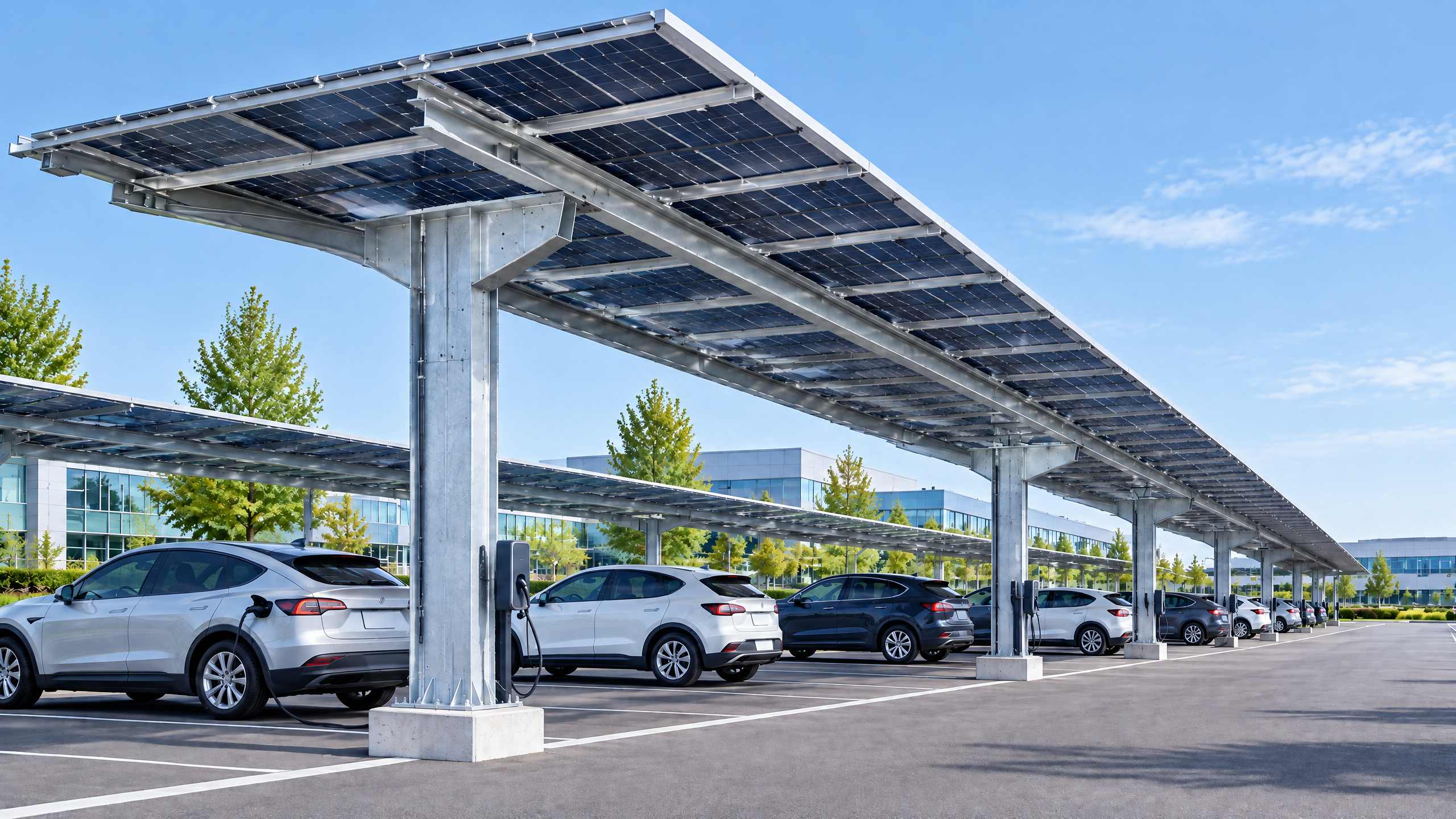
Direct answer (120–180 words) A rigorous evaluation of a solar carport structure manufacturer centers on technical fit, documented production and supply-chain evidence, and demonstrable integration capability with PV, electrical and site systems. Prioritize manufacturers that can deliver a clearly scoped structural solution with measurable design load data, transparent factory QA/QC records, and a tested approach to the solar carport structural interface with PV racking, cable trays and roof membranes. Verify capacity for PV equipment coordination, electrical pathway planning and on-site installation support, and confirm how the manufacturer will manage the utility and permit interface and maintenance access planning for the operational lifetime. Require a project-specific proposal with foundation designs, lead-time milestones, quality assurance plans and warranty terms, and involve local qualified professionals (structural engineer, electrical designer, installer) early. Use procurement evidence, factory documentation and reference-site learnings to compare total installed cost, schedule risk and lifetime operability.
Buyer context and scope boundary: who this guide serves and what it covers
Audience: This guide targets B2B buyers — distributors, architects, contractors, developers, solar EPCs and fleet operators — evaluating a solar carport structure manufacturer for commercial or industrial PV and vehicle-shade projects. It focuses on architectural aluminium carports, commercial solar carports and industrial/fleet vehicle shelters where the structural supplier is a primary long-lead vendor.
Scope boundaries:
- Scope includes structural design capability, interface engineering with PV modules and electrical systems, manufacturing and factory evidence, logistics and site installation support.
- Scope excludes final electrical design, site-specific structural calculations, utility interconnection approvals and permitting decisions that must be handled by local licensed professionals and authorities.
- This guide assumes PV modules, inverters and electrical balance-of-system (BOS) will be procured either by the carport manufacturer, an EPC partner, or the buyer; it emphasizes coordination points.
Important: site-specific structural capacity, foundations, permits, electrical design, approvals, lead time, price, energy yield and warranty all require a documented project basis and review by relevant local qualified professionals, installers, utilities and authorities.
Cluster: Solar, PV and EV infrastructure — the recommendations balance structural engineering, PV integration and operational maintenance across common commercial project typologies.
Core decision principle: what separates acceptable from preferred manufacturers
The single most important procurement principle is traceable, project-specific evidence. For any credible solar carport structure manufacturer, the buyer should be able to validate each of these five things as a minimum:
- Project-specific structural design documentation (loads, material specifications, connection details, foundation reactions).
- Factory-level QA/QC evidence and manufacturing traceability (material certificates, weld and anodizing records, inspection plans).
- Clear coordination deliverables for PV equipment coordination and electrical pathway planning.
- Demonstrated process for utility and permit interface, and maintenance access planning tied to the buyer’s operations model.
- Transparent commercial terms including lead times, warranty scope and acceptance tests.
Why evidence matters: structural components are long-lived capital assets; PV performance and safety depend on resilient interfaces. A good manufacturer mitigates procurement and construction risk by producing documentation and a workflow that integrates with the buyer’s EPC, site engineers and local authorities.
Decision rule (simplified): Accept proposals that provide all five evidence areas; prefer suppliers who supply sample project dossiers, factory visit protocols, and an integration plan aligned with your contract milestones.
Planning inputs: what you must prepare before requesting quotes
Preparation reduces ambiguity and enables apples-to-apples comparison. Provide or obtain the following planning inputs before you solicit firm proposals:
- Project brief and site survey: site coordinates, topography, prevailing wind and snow loading zones, existing utilities and site constraints.
- Structural design basis: target design codes (national/local), required service life and corrosivity class; if you have a structural engineer, include their contact.
- PV system scope: module layout intent (single/multi-row, tilt), expected module type and frame dimensions, inverter location strategy, anticipated DC string lengths.
- Electrical design envelope: intended AC point-of-interconnection, transformer/power room location and cable routing constraints.
- Foundation constraints: subsurface report (geotechnical) or at minimum soil strata overview and any depth limitations (e.g., buried utilities or frost depth issues).
- Operational requirements: required maintenance access patterns, clearance needs for vehicle types, signage, lighting and EV chargers.
- Project schedule and milestone windows: key dates for delivery, on-site storage limits and required installation windows.
Use standard forms: Request-for-proposal should include required deliverables (see table below) and become the baseline for supplier comparison.
Decision table — Required proposal deliverables
| Deliverable | Must-have evidence | Who certifies |
|---|---|---|
| Structural design package | Load calculations, connection drawings, foundation reaction diagrams | Licensed structural engineer (project-specific) |
| Bill of materials | Material specs, finish, weights, part IDs | Manufacturer QA/QC |
| Factory QA/QC plan | Inspection checkpoints, non-conformance process, test records | Manufacturer quality manager |
| PV interface drawings | Module layout, rail/clip details, penetration/fastener data | Manufacturer and PV supplier |
| Electrical pathway plan | Cable tray/raceway routing, junction locations, conduit penetrations | Electrical designer |
| Logistics & lead times | Production schedule, shipping method, handling needs | Manufacturer logistics |
| Warranties & terms | Structural warranty terms, coatings, exclusions | Manufacturer legal/commercial |
Planning note: Energy yield estimates should be prepared using established tools (PVWatts, NREL resources) for climatology and system-sizing inputs [1][2]. For site-level EV integration context consult public resources on fueling/infrastructure planning [3].
Technical specification and interfaces: detail the contract-level requirements
A successful procurement dissects interfaces and allocates responsibility. The following subsections identify technical points that should appear in the contract, and where responsibility typically sits.
- Structural capacity and loads
- Require design codes and load combinations (e.g., dead + live + wind + snow + seismic per local code). The manufacturer should supply a structural model with reaction forces and full connection detail.
- Specify serviceability requirements (deflection limits under live load, vibration criteria if relevant).
- Foundations and substructure
- If the manufacturer supplies foundation drawings, they must explicitly state soil design parameters; final foundation design usually requires local geotechnical input and structural engineer sign-off.
- Define whether the supplier provides anchor bolts, sleeves or full cast-in-place drawings.
- PV mechanical and electrical interfaces
- Solar carport structural interface: specify how modules attach to the structure, clip/rail details, torque specs, and module grounding methodology.
- PV equipment coordination: include inverter pads, combiner box locations, module layout, and access for replacement or module-level monitoring devices.
- Electrical pathway planning: define cable tray sizes, conduit penetrations through columns, separation distances, and secure routes to minimize DC run length and optimize thermal performance.
- Drainage, waterproofing and rooftop interfaces
- For designs that interface with building roofs or gutters, clarify waterproofing strategies and warranty implications.
- Architectonics and finishes
- Aluminium finish (anodized, powder coat) standards, color matching tolerances, and expected life/corrosivity class.
- Safety and maintenance
- Maintenance access planning: include clear drop-throughs, service platform locations, fall-arrest anchor points, and recommended procedures for module replacement.
- Access routes for lifts, crane pick points and laydown areas during maintenance or emergency replacement.
Decision table — Interface responsibility matrix (example)
| Item | Typical supplier responsibility | Typical buyer/EPC responsibility |
|---|---|---|
| Structural frame design & manufacturing | Manufacturer | Buyer verifies via structural engineer |
| Foundation design & permitting | Manufacturer provides loads; buyer arranges local design & permit | Local structural engineer & authority |
| Module mounting & racking design | Manufacturer or racking supplier | PV designer verifies compatibility |
| Cable trays & electrical raceways | Manufacturer provides pathways & penetrations | Electrical contractor designs conductors and terminations |
| Utility interconnection paperwork | Manufacturer supports with technical drawings | Buyer or EPC and utility handle application |
| Maintenance access features | Manufacturer designs anchor points & clearances | Buyer defines operational procedures |
Include these interface allocations in the contract with explicit acceptance tests and sign-off milestones.
Procurement evidence: what to ask to verify manufacturer capability
A named supplier can make claims; procurement-grade evidence proves them. Ask for the following tangible materials and processes before awarding a contract.
Documentation and traceability
- Material test reports (MTRs) for structural-grade aluminium and fasteners where applicable.
- Weld records and inspection protocols for any steel-to-aluminium interfaces or hybrid components.
- Finish process records (anodizing or powder-coat batch numbers) and corrosion testing protocols used in-house or by partners.
Factory and process transparency
- Factory layout and production route maps (showing fabrication, surface treatment, assembly lines).
- Non-conformance logs and corrective action histories (summary acceptable; redacted sensitive data permissible).
- Production testing and load-testing protocols (describe test type and frequency — do not require or publish proprietary test data).
Quality certifications and management
- Quality management documentation (quality manuals, ISO-level processes if held — ask to inspect relevant sections rather than requiring a specific certification).
- Supplier sub-tier management program (how the manufacturer qualifies raw material suppliers).
Logistics and supply-chain evidence
- Proven lead-time records for similar-volume projects (delivery milestones from purchase order to FOB port or site).
- Packaging, handling and shipping plans for long-span structural elements and large assemblies.
References and site visits
- Project dossiers for completed projects that the manufacturer is permitted to disclose (drawings, photographs, lessons learned).
- Offer and schedule of an on-site or factory visit protocol with named contact and deliverables.
Commercial and contractual evidence
- Standard warranty documents with clear exclusions.
- Change-order procedures and price adjustment mechanisms for material cost escalation.
Procurement tip: require a pre-award delivery schedule tied to liquidated damages or milestone-based payments, and insert acceptance criteria referencing the proposal deliverables.
Site installation, commissioning and operations: verify end-to-end capability
A manufacturer’s scope often goes beyond painted metal parts. Evaluate their approach to on-site installation, commissioning and operational handover.
Installation scope clarity
- Define whether manufacturer provides site assembly supervision, full site installation crews, or only shop-fabricated components. Require a manpower plan.
- Specify crane/hoisting requirements and who provides this equipment.
Commissioning protocol
- Establish mechanical acceptance tests: frame plumbness, torque verification on module fastenings, and alignment checks.
- Confirm as-built documentation package to be delivered at practical completion: as-built drawings, torque logs, material certificates, and maintenance manuals.
Coordination with PV installer
- Clarify PV equipment coordination responsibilities during installation: in many projects the PV installer handles module installation while the carport supplier handles rails and structural elements; define gap/responsibility for clip compatibility and grounding continuity.
Operational handover
- Maintenance access planning must be explicit: schedule for periodic inspections, recommended inspection intervals for structure and PV interfaces, and part-replacement lists.
- Spare parts handling: confirm availability of replacement parts, expected lead time and minimum recommended spares inventory.
Safety and training
- Insist on site-specific safety plans (lift plans, edge protection) and training for owner/maintenance staff on module replacement and fall protection.
Commissioning checklist (sample)
- Mechanical: confirm all bolted connections torqued to spec; verify module clamp engagement and clearance.
- Electrical: continuity of module and rack grounding checked by electrical contractor.
- Documentation: receipt of as-built structural drawings, certificate of compliance from manufacturer representative, and maintenance access plan.
Operational note: commissioning does not substitute for the electrical commissioning and utility approval; interconnection follows separate utility processes and may require additional documentation [4].
Implementation risk: common failure modes and mitigation strategies
Identify risks early and allocate responsibility to reduce time and cost overruns.
Risk: insufficient structural documentation
- Failure mode: vendor submits generic drawings not suitable for local code review.
- Mitigation: require project-specific stamped calculations and connection details from the supplier as part of the bid.
Risk: interface mismatch with PV modules or electrical systems
- Failure mode: rails/clamps incompatible with selected module frame; inadequate conduit penetrations cause rework.
- Mitigation: require PV equipment coordination workshops and a mock-up panel test where possible.
Risk: underestimating site foundation constraints
- Failure mode: geotechnical surprises lead to foundation redesign and delays.
- Mitigation: insist on a geotechnical report and allocate design responsibility for foundations clearly — typically manufacturer provides reactions, local engineer finalizes foundations.
Risk: logistical damage to long-span components
- Failure mode: long members deform during transport.
- Mitigation: validate packaging and shipping method; require handling plans and acceptance inspection on delivery.
Risk: maintenance access conflicts with operations
- Failure mode: inability to safely access modules without disrupting parking/fleet operations.
- Mitigation: include maintenance access planning early, confirm clearances for lifts and define scheduled maintenance windows.
Risk: warranty disputes due to mixed responsibility
- Failure mode: structural vs. PV failures lead to finger-pointing between suppliers.
- Mitigation: clearly delineate warranties in contract; specify who handles through-life issues and escalation protocols.
Operational risk matrix (sample)
| Risk | Likelihood | Impact | Owner | Primary mitigation |
|---|---|---|---|---|
| Design non-compliance with local code | Medium | High | Manufacturer & Buyer | Require stamped calculations, early peer-review |
| Module/rail incompatibility | Medium | Medium | Manufacturer & PV supplier | Prototype mock-up; interface sign-off |
| Foundation redesign required | Low–Medium | High | Local engineer | Early geotech, contingency in schedule |
| Logistics damage | Medium | Medium | Manufacturer/logistics | Packaging plan, delivery inspection |
| Delays in utility approval | Medium | High | Buyer/EPC | Early utility engagement, complete interconnection package [4] |
Note: always quantify schedule contingency and hold points in the contract to manage high-impact risks.
Six-step buyer workflow: a named procurement process you can adopt
Adopt a structured workflow — "CARPORT-VET" — to manage procurement from initial shortlist to operational handover.
- Capture and define (C)
- Produce a project brief and site dossier: layout, geotech, PV assumptions, operational constraints and target schedule.
- Ask and shortlist (A)
- Issue a Request for Information (RFI) to capture manufacturing capability, typical project menus, and high-level lead times. Shortlist 3–5 manufacturers based on evidence and financial terms.
- Review and validate (R)
- Request detailed proposals (RFP) with the proposal deliverables table. Validate structural assumptions with your local structural engineer.
- Pilot and test (P)
- Where risk dictates, require a prototype, sample connection assembly or factory inspection. Include PV mounting mock-up to validate solar carport structural interface.
- Offer and contract (O)
- Compare total installed cost, schedule and risk allocation. Finalize contract with milestone payments, acceptance tests and warranty terms.
- Transition and train (T)
- Ensure factory to site transition plan, installation supervision schedule, commissioning acceptance tests and maintenance access training are in the contract. Schedule a lessons-learned review at project closeout.
Workflow checklist (to adapt into project management tools)
- Project brief and site files uploaded (yes/no)
- Shortlist verified (3–5 suppliers)
- Structural stamp requirement added to RFP
- Mock-up or factory visit scheduled (if required)
- Acceptance test matrix included in contract
- Maintenance handover plan confirmed
This workflow enforces early technical clarity and assigns checkpoints for decision-makers.
FAQ (procurement and technical questions commonly asked by B2B buyers)
Q: How do I ensure the carport structure will carry the PV system and comply with local loads? A: Require project-specific stamped structural calculations from the manufacturer showing load combinations and reactions; your local licensed structural engineer must review and approve foundations. The manufacturer provides member strengths and connection details, but foundation design and local code compliance are the buyer’s responsibility to approve on a documented project basis.
Q: Who should design the electrical cable routing and conduit penetrations through columns? A: Electrical pathway planning must be coordinated: the manufacturer should provide reserved penetration locations, cable tray runs and routing clearances; final conductor sizes, protection devices and terminations are the electrical designer’s responsibility. Make electrical deliverables a contract milestone.
Q: Are aluminium carports suitable in coastal or corrosive environments? A: Aluminium offers good corrosion resistance, but finish selection (anodized vs. powder-coat) and sacrificial design details should align with the site’s corrosivity class. Ask the supplier for finish life expectations and maintenance recommendations, and consult local corrosion standards.
Q: What warranty scope is typical for structural elements? A: Warranty terms vary. Require written warranty documents showing duration and exclusions. Clarify responsibility for coating failure, galvanic corrosion at dissimilar-metal interfaces, and damage from improper on-site handling.
Q: How can I reduce lead time risk? A: Negotiate a clear production schedule, confirm material sourcing routes, and include milestone penalties or incentives. Early commitment to long-lead items (e.g., custom extrusions) can secure production slots. Also evaluate factory capacity and alternative suppliers for critical sub-components.
Q: How should I approach the utility and permit interface? A: Early engagement with the utility is essential, especially for commercial interconnection. The manufacturer can provide technical drawings, but the buyer/EPC must prepare the interconnection application with the utility and manage permit submissions with authorities [4].
Q: What are acceptable acceptance tests at handover? A: At minimum: structural bolted torque verification, visual inspection of coatings and welds, documentation of material test reports, and delivery of as-built drawings and maintenance manuals. Electrical acceptance remains with the electrical contractor and utility.
Q: Where can I estimate site energy yield and system sizing? A: Use established tools (PVWatts, NREL resources) for preliminary yield and sizing [1][2]. For financial modelling, involve your PV designer for module selection, orientation and inverter sizing.
Mid-article call to action
For project-specific discussion, scoping support or access to our manufacturing evidence package, contact /inquiry or info@carportiva.com. Review product options including SolarGrid commercial solar system, and compare with other configurations on all systems and our procedural advice in sourcing guides.
Procurement checklist: contract clauses and acceptance criteria to include
Include these clauses in your RFP or contract to protect project outcomes:
- Deliverables and milestones: explicit list of documents and delivery windows.
- Stamped structural calculations: required prior to fabrication release.
- Factory inspection rights: schedule and acceptance criteria for third-party or buyer inspections.
- Packaging and delivery acceptance: condition at arrival inspect-and-accept protocol.
- Warranty and spares: coverage duration, corrective response times and recommended spare-parts kit.
- Change management: procedure for variations, pricing adjustments for material cost escalation and time-impact analysis.
- Safety and compliance: supplier must comply with applicable site health & safety requirements and provide method statements.
- Acceptance tests: mechanical and documentation-based acceptance prior to final payment.
Decision table — Bid evaluation scoring example
| Evaluation area | Weighting (%) | Scoring criteria (examples) |
|---|---|---|
| Technical compliance | 30 | Stamped design, interface drawings, maintenance access |
| Quality & factory evidence | 20 | MTRs, QA plan, factory inspection acceptance |
| Schedule & lead time | 15 | Production slots, logistics plan, contingency |
| Commercials & warranty | 15 | Total installed cost, warranty scope, payment terms |
| Interface & support | 10 | PV/electrical coordination, site supervision |
| References & risk | 10 | Reference projects, risk mitigation plan |
Use a weighted scoring model to compare bids objectively and document the evaluation rationale.
Integration with broader commercial solar procurement activities
This procurement sits inside a larger commercial solar procurement lifecycle. Coordinate the following external activities:
- PV module and inverter selection: confirm compatibility with mounting rails, expected string layouts and DC/AC ratios.
- Financial close and incentives: tax and incentive treatment may influence system scope and timeline.
- Interconnection and grid studies: earlier engagement avoids late-stage design revisions — follow utility processes and timeline [4].
- EV infrastructure and fleet operations: if carport integrates EV chargers, plan for conduit routing, transformer capacity and future load growth in collaboration with fleet operators and energy managers [3].
Use standard PV yield tools (PVWatts, NREL resources) for sizing and expected generation modeling during the procurement evaluation [1][2].
Conclusion: make the manufacturer selection a structured, evidence-led decision
Selecting a solar carport structure manufacturer should be a structured process that elevates project-specific documentation and interface clarity above marketing claims. Treat the manufacturer as a systems integration partner whose deliverables must align with PV, electrical and site engineering inputs. Require stamped structural designs, factory QA evidence, a clear approach to the solar carport structural interface, and defined responsibilities for PV equipment coordination and electrical pathway planning. Manage risk through contractual milestones, factory inspection rights and a documented acceptance test regime. Ensure maintenance access planning and utility and permit interface steps are included in the proposal and confirmed before fabrication begins.
Remember: site-specific structural capacity, foundations, permits, electrical design, approvals, lead time, price, energy yield and warranty require a documented project basis and review by relevant local qualified professionals, installers, utilities and authorities.
Final call to action: for tailored procurement support, drawings, factory inspection scheduling or to discuss the SolarGrid commercial solar system options, contact /inquiry or info@carportiva.com.
Sources and further reading
- NREL solar resources and technology overview [1]
- PVWatts for preliminary energy-yield estimation [2]
- U.S. Department of Energy AFDC for EV and parking infrastructure context [3]
- FERC interconnection resources and procedural guidance [4]
For additional procedural guidance, Carportiva’s sourcing guides and systems catalog all systems provide templates for RFPs, acceptance checklists and product comparison matrices.
References
- National Laboratory of the Rockies PV resources: https://www.nrel.gov/solar/
- PVWatts Calculator: https://pvwatts.nrel.gov/
- U.S. Department of Energy Alternative Fuels Data Center: https://afdc.energy.gov/
- Federal Energy Regulatory Commission interconnection resources: https://www.ferc.gov/electric-transmission/generator-interconnection
Keep the project brief connected.
Bring the actual project brief to the engineering table.
Share your location, layout, target application and available technical inputs. Carportiva can help identify the relevant product-interface information before a project-specific commercial discussion.
Request a project discussion