Direct answer (summary, 120–180 words)
When a project team defines the solar carport battery procurement scope they must treat the battery as a distinct technical and contractual subsystem that intersects structural, electrical and operational responsibilities. Confirm whether the battery is in-scope for the carport supplier, the EPC or the owner; whether it will be DC-coupled to the PV or AC-coupled at the distribution board; the physical envelope and interface points for the battery enclosure relative to the carport (including clearances, ventilation and fire separation); and the utility and permit interface for interconnection and export limitations. Also confirm required performance parameters (power, usable energy, cycle life, BMS features), factory evidence (FAT, type test data, warranty terms), logistics and lead times, and who certifies commissioning and acceptance tests. Finally, ensure maintenance access planning, spare parts, and an O&M responsibility matrix are agreed in contract and supported by local qualified professionals, installers, utilities and authorities.
Buyer context and scope boundary
Why a clear procurement scope matters
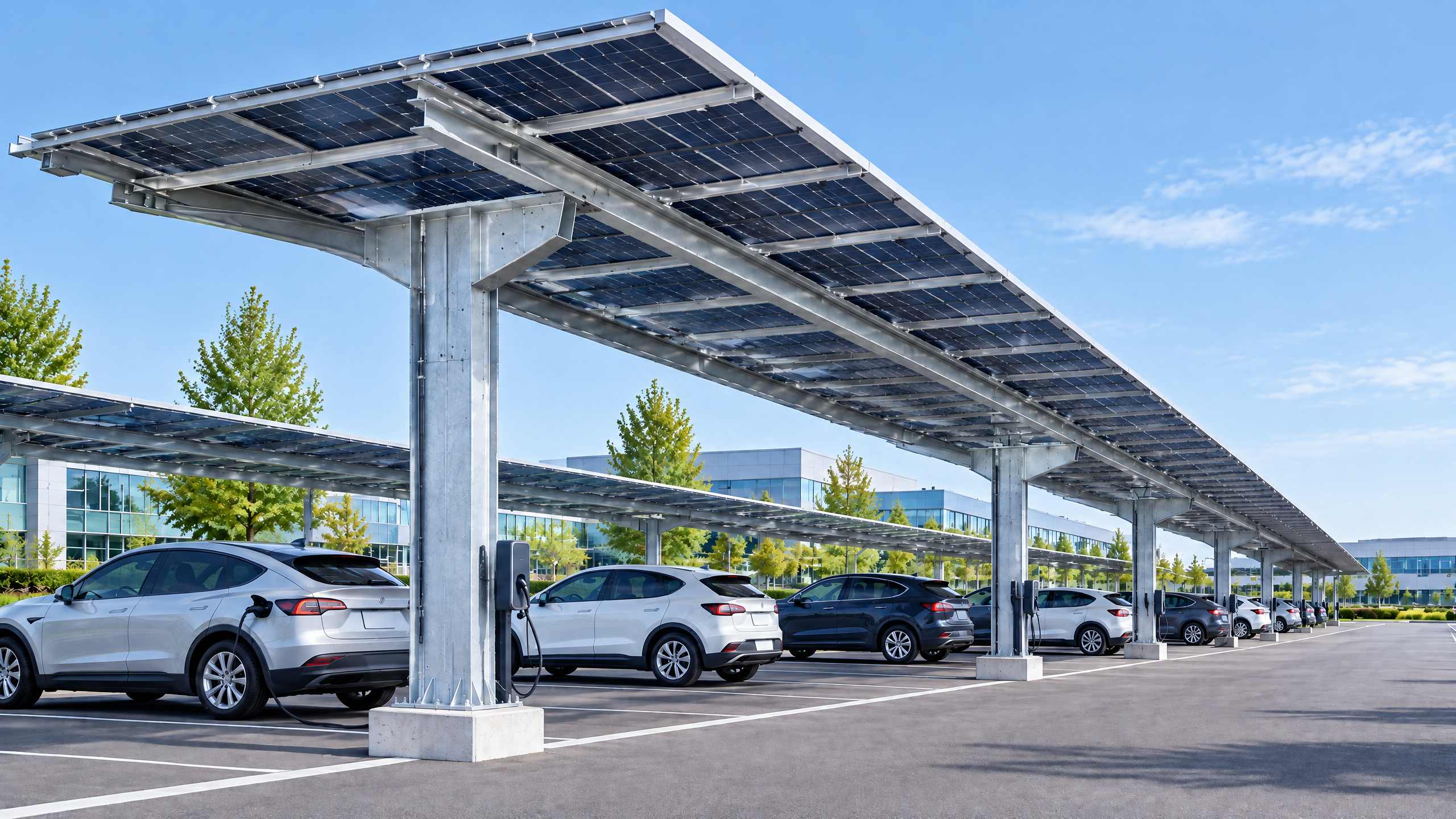
Defining the solar carport battery procurement scope at the start prevents late-stage design changes, schedule slips and cost re‑allocation. Solar carports blur lines between architecture, PV mounting and building services: a battery can be part of the carport vendor’s delivery, the PV EPC’s scope, a separate energy storage supplier package, or retained as owner-supplied equipment. Each choice shifts responsibilities for structural interface, electrical connections, commissioning, testing and warranty.
Who the typical buyers and stakeholders are
- Distributors and resellers evaluating suppliers and product lines.
- Architects specifying carport form, clearances and integration details.
- Contractors/fabricators responsible for foundations, anchors and site works.
- Developers and owners defining procurement strategy and finance.
- Solar EPCs and energy storage integrators delivering generation and BOS.
- Fleet operators and site managers who operate EV charging and energy assets.
Common boundary models
- Model A — Owner-provided battery: owner procures, installer integrates. Owner manages warranty and maintenance.
- Model B — EPC-delivered battery: integrated in single supply contract. Single point of commissioning.
- Model C — Carport vendor supplies battery as part of a bundled offering: simplifies structural interface but requires the carport vendor to manage energy storage compliance and electrical system coordination.
Be explicit in contract documents about who is responsible for: equipment selection, factory acceptance tests (FAT), transport and lifting, on-site installation, electrical termination, commissioning, export management, and lifecycle O&M.
Core decision principle: allocate interface risk to the party with design control
Primary principle Allocate each technical interface and associated risk to the party who designs it or controls permitting/installation decisions. If the carport vendor designs and certifies the structure, they should carry responsibility for the structural interface to the battery enclosure. If the battery supplier selects the inverter and BMS, they should carry responsibility for PV and battery control logic and safety interlocks.
Key contractual clauses to include
- Clear interface drawings and 3D models (Revit/CAD) showing mounting points, conduit routes and anchor positions.
- FAT and SAT criteria with pass/fail metrics.
- Lead-time and delivery milestones tied to payment and retention.
- Warranty demarcation for performance, workmanship and weatherproofing.
- A dispute-resolution flow for interface conflicts during installation or commissioning.
This principle keeps scope boundaries practical and auditable: the party who can change the design should accept the risk for that design element.
Planning inputs: data and evidence you must gather before procurement
What to collect early
- Site loads and energy profile: daily and seasonal consumption, EV charging profile if applicable.
- PV system sizing and panel layout: roof area, module tilt, shading analysis.
- Local insolation and yield estimates: use PV resource data and yield modelling tools for feasibility [1][2].
- Structural capacity and foundation data: design live loads, snow/wind zones, geotechnical report.
- Existing electrical service and distribution single-line diagrams.
- Local grid connection rules / interconnection pathway expectations [4].
- Permitting restrictions and fire code constraints affecting battery siting.
How to get credible estimates
- Use PVWatts or comparable modelling for early energy yield iterations [2].
- Obtain a geotechnical report and structural calculations from licensed engineers.
- Request a preliminary interconnection study or guidance from the local utility and reference federal/ national interconnection guidance where available [4].
- For EV and charging integration, consult local and national EV infrastructure guidance such as government alternative fuels resources [3].
Decision table — required planning inputs, who typically provides them, and acceptable evidence
| Planning input | Typical provider | Acceptable evidence |
|---|---|---|
| Site energy profile & EV load | Owner / fleet operator | Meter data, EV charging schedule, telematics export |
| PV layout & estimated yield | PV designer / EPC | PV layout drawings, PVWatts or equivalent yield report [2], module datasheets |
| Structural capacity | Structural engineer / carport vendor | Structural calculations, load tables, certificate of compliance |
| Geotechnical conditions | Geotech consultant | Borehole report, design soil parameters |
| Electrical service details | Utility / owner | Single-line diagram, service point capacity, service agreement |
| Permits & fire requirements | Local authority / fire engineer | Permit conditions, fire separation requirements, AHJ guidance |
Early alignment on these inputs minimizes rework. Where evidence is uncertain, specify allowable ranges and change-order mechanisms.
Technical specification and interfaces
What the specification must cover The solar carport battery procurement scope must be detailed in both functional and physical terms. Include:
- Performance parameters: rated power (kW), usable energy (kWh), depth of discharge policy, round-trip efficiency, continuous and peak power capabilities.
- Battery chemistry and thermal limits: preferred chemistry (e.g., LFP, NMC), operating temperature range and degradation expectations.
- Battery management system (BMS): required protection, telemetry, remote firmware update policy and SCADA/integration requirements.
- Grid behavior and controls: anti-islanding, voltage/ frequency ride-through, export limits, islanding capability and charge/discharge schedules.
- Physical and mechanical interface: mounting points, anchor loads, footprint, clearances, and cladding penetration allowances.
- Environmental protection: IP rating, flood elevation, corrosion protection for coastal or industrial sites.
- Fire, detection and suppression: detection systems, suppression strategy, and separation distances per local AHJ rules.
Include the phrase "solar carport structural interface" when assigning responsibilities for the physical marriage of the battery enclosure to the carport structure. If the carport vendor provides pre-formed openings or reinforcement details, those must be dimensioned and certified.
PV equipment coordination and electrical pathway planning
- PV equipment coordination: define how PV combiner boxes, inverter locations and DC cabling route to the battery or inverter. Identify AC and DC disconnect locations and who supplies them.
- Electrical pathway planning: specify conduit sizes, cable tray supports, and route elevations. This reduces clashes with other services and clarifies who installs and commissions each segment.
It is common to decide whether the battery will be DC-coupled to the PV string (connected ahead of inverter) or AC-coupled behind the inverter. Each topology has different requirements for PV equipment coordination and BMS integration; state the topology in the scope and require interface control drawings.
Decision table — typical interface responsibilities by contract model
| Interface area | Owner‑supplied battery | EPC‑delivered battery | Carport vendor supplied battery |
|---|---|---|---|
| Structural attachment details | Carport vendor | Carport vendor | Carport vendor |
| Battery enclosure supply | Owner | EPC | Carport vendor |
| DC/AC electrical integration | EPC | EPC | EPC or designated electrical supplier |
| BMS and control integration | Owner / battery supplier | Battery supplier | Battery supplier |
| Commissioning & SAT | EPC / owner | EPC | EPC / carport vendor |
| Warranty demarcation | Owner | EPC | Carport vendor or battery supplier |
Note: This table is a guideline; final allocation must appear in contract drawings and statements of work.
Safety and regulatory alignment
- Local codes and standards (electrical, fire and building) govern battery installations; always reference the applicable authorities having jurisdiction (AHJ) and require compliance.
- Utility and permit interface must be defined: who prepares and submits interconnection applications, who covers study costs, and who manages export limiting devices.
Cite federal interconnection resources for context where applicable [4].
Procurement and factory evidence: what to request and how to evaluate
Essential procurement documents
- Manufacturer datasheets and technical catalogues for battery modules, inverters, BMS and containers.
- Type test and qualification test reports (thermal, vibration, cycle-life) — request manufacturer-provided test protocols and dates.
- FAT protocol and witness options — define FAT acceptance criteria and whether a witness is required in contract.
- Electrical schematics and single-line diagrams showing AC/DC connections and protective devices.
- Certificates of conformity to applicable standards (where relevant) — request copies for verification but do not rely on unverified claims.
- Spare parts list, recommended spares and lead times for critical components (power electronics, BMS controllers, fuses).
Factory evidence and supplier due diligence
- Factory capability: site visits or independent factory audits can validate capacity and quality systems.
- Traceability: ask for serial number-based traceability and component sourcing declarations.
- Reliability evidence: ask for failure modes and response procedures, but do not accept unsubstantiated lifetime guarantees.
- Warranty and service: clarify warranty term, what constitutes normal wear vs manufacturing defect, and who is authorised to perform warranty service.
Evaluation criteria (commercial solar procurement perspective)
- Total cost of ownership, including expected replacement parts and anticipated degradation.
- Lead time and supply chain resilience documentation.
- Interoperability with your PV inverters and energy management systems.
- Local support network and authorised service partners.
- Contractual clarity on performance guarantees and remedies.
Document the procurement decision with a supplier scorecard that weights technical fit, commercial terms, delivery risk and local support.
Site installation and operations: practical coordination points
Foundations and anchorage
- Battery containers or plinths require foundations sized by geotechnical and structural engineers. Confirm anchor bolt layouts, embedment depth and tolerance stacks with the carport vendor and civil contractor.
- For light-weight battery cabinets, verify platform design for lifting points and service clearances.
Mechanical and thermal management
- Confirm ventilation or active cooling/heating needs; hot climates and tightly sealed enclosures change expected battery behavior.
- Design for maintenance access planning: allow clear working spaces for module replacement, electrical access to terminals and removal of components.
Electrical pathway and termination
- Pre-mark conduit routes and cable entry glands: coordinate DC, AC and communication cable routing to avoid electromagnetic interference and heat zones.
- Define who performs final terminations and torque inspection, and require a sign-off procedure.
Commissioning and acceptance
- Provide a commissioning plan with defined SAT tests, including BMS functional tests, charge/discharge cycles, protective device verification and communications validation with site energy management systems.
- Define performance acceptance: for example, a battery meets its usable energy and power specification under defined test conditions. Include ambient conditions and SOC baseline.
Operations and maintenance
- Provide O&M manuals that include periodic inspection checklists, data-logging expectations, alarm response procedures and spare parts lists.
- Agree SLA windows for remote diagnostics, on‑site response and spare replacement.
- Plan for lifecycle: schedule capacity checks, recalibration, and an end-of-life plan including recycling or repurposing.
Mid-article CTA If you need help aligning structural, PV and battery scope for a commercial or fleet project, contact our team for a scope review: /inquiry. For system context see our SolarGrid commercial solar system, all systems and sourcing guides.
Implementation risks, mitigation and procurement controls
Common risks and mitigations
- Interface misalignment
- Risk: Structural openings, conduit routes or cable tray positions clash with delivered equipment.
- Mitigation: Issue coordinated 3D models (Revit/CAD) at procurement stage; perform clash detection and require manufacturer interface drawings prior to fabrication.
- Lead time and supply-chain delays
- Risk: Battery components have long manufacture lead times; partial deliveries disrupt sequencing.
- Mitigation: Contractual milestone payments tied to early long‑lead items; consider buffer stock or alternative suppliers.
- Permitting and utility delays
- Risk: Interconnection approvals, export limits and fire authority conditions cause schedule slip.
- Mitigation: Start permit and utility engagement early; assign utility and permit interface responsibilities in the contract and budget contingency for studies [4].
- Warranty and performance ambiguity
- Risk: Overlap of system warranties; disputes on whether degradation is covered.
- Mitigation: Define warranty demarcation clearly; require written warranty matrix and processes for claims.
- Commissioning acceptance disputes
- Risk: Differing FAT/SAT interpretations lead to acceptance holdbacks.
- Mitigation: Use explicit, measurable test protocols and a mutually agreed witness schedule.
Risk matrix — likelihood, impact and mitigation priority
| Risk | Likelihood (Low/Med/High) | Impact (Low/Med/High) | Highest priority mitigation |
|---|---|---|---|
| Interface misalignment | Med | High | Early 3D coordination & interface drawings |
| Lead-time delays | High | High | Early procurement of long‑lead items, supplier alternatives |
| Permit/utility delays | Med | High | Early engagement & clear utility and permit interface role |
| Warranty ambiguity | Med | Med | Contractual warranty matrix and acceptance criteria |
| Site installation errors | Med | Med | Supervised installation, hold points and third-party inspections |
Address these risks in procurement documents and allocate contingency in schedule and budget.
Six-step buyer workflow: from brief to operations
A pragmatic six-step workflow that many commercial buyers use:
- Clarify objectives and performance targets
- Define energy goals, grid-services requirements (e.g., peak shaving, backup), EV charging needs and financial metrics (IRR, payback). Identify whether the battery serves resiliency, energy arbitrage or power quality objectives.
- Gather site data and run preliminary models
- Collect meter data, site geometry and insolation estimates. Use PVWatts or equivalent tools for initial yield estimation and system sizing [2]. Get a geotechnical baseline.
- Set scope and allocate interfaces
- Decide procurement model (Owner, EPC, Carport supplier). Document solar carport battery procurement scope, including structural, electrical and commissioning responsibilities. Require interface drawings and lists of deliverables.
- Issue RFQ/RFP with required evidence
- Include technical specification, FAT/SAT requirements, warranty matrix, lead-time expectations and commercial terms. Ask for factory audit reports, test reports, and spare parts lists.
- Award, monitor manufacturing and do pre-shipment validation
- Perform FAT (witnessed where necessary), verify transport and lifting arrangements, and confirm on-site readiness. Ensure alignment of foundations and anchor positions to final drawings.
- Install, commission and transition to operations
- Follow agreed SAT tests, check maintenance access planning and hand over O&M manuals. Ensure telemetry and SCADA are operational and that roles for ongoing maintenance are documented.
Each step should be recorded with deliverables, acceptance criteria and approval signatures to reduce later disputes.
FAQ
Q: Who should own the battery procurement: the carport vendor, the EPC or the owner? A: There is no universal answer. Assign ownership to the party best able to control the biggest risks. If structural design is critical and the carport vendor controls it, consider vendor-supplied battery or tightly coordinated interfaces. If electrical integration and controls are complex, the EPC or an energy storage specialist may be better placed to procure and integrate.
Q: Does the battery need to be DC-coupled to the PV modules? A: That depends on system goals. DC-coupling can increase efficiency in some configurations and reduce inverter counts; AC-coupling offers modularity and easier retrofit. Specify your topology early and require the supplier to demonstrate compatibility with the PV inverters and controls.
Q: What are the minimum documents I should request from a battery supplier? A: Datasheets, electrical schematics, FAT protocol, BMS functional description, spare‑parts list, warranty matrix and a list of authorised service partners. Do not accept verbal assurances; require written and dated documents.
Q: How do I verify expected energy yield and battery throughput? A: Use validated PV resource data and modelling tools for PV yield [1][2]. Combine yield models with planned battery dispatch profiles to estimate cycle counts. Remember actual yield and degradation require site-specific documentation and monitoring.
Q: Are there special requirements for fleet or EV charging sites? A: Yes. EV load profiles can create high peak demand; integrate charging management with battery controls and local demand response. Consult EV infrastructure guidance and assess upgrades to service capacity if needed [3].
Q: What role do utilities play? A: Utilities may require interconnection studies, set export limits and specify protective relays. Early utility engagement reduces late-stage schedule risk and clarifies who is responsible for application and study fees [4].
Q: How should warranties be structured? A: Create a warranty matrix that identifies period, scope (manufacturing vs performance), remedies, and authority for warranty work. Include response times and local authorised service partners. Confirm whether performance warranties are conditional on recommended operation and maintenance practices.
Final checklist before award
- Confirm whether battery procurement is included in the carport contract or separately procured.
- Verify that solar carport structural interface drawings have been issued and signed.
- Obtain PV equipment coordination drawings showing inverter, combiner and battery interfaces.
- Confirm electrical pathway planning drawings, conduit sizes and cable tray locations.
- Require FAT and SAT protocols and agree witness schedules.
- Confirm lead times, delivery windows and on-site storage/handling plans.
- Validate O&M handover deliverables including telemetry, spare parts and maintenance access planning.
Important compliance statement Site-specific structural capacity, foundations, permits, electrical design, approvals, lead time, price, energy yield and warranty require a documented project basis and relevant local qualified professionals, installers, utilities and authorities.
Conclusion
Defining the solar carport battery procurement scope is an early, high‑value decision with downstream effects on structural design, electrical integration, permitting and operations. A tightly specified scope that assigns interface responsibility to the party with design control, requires factory evidence and FAT/SAT protocols, and mandates early utility and AHJ engagement reduces risk and accelerates project delivery. Use coordinated 3D models, explicit contract deliverables and a six‑step workflow to turn the conceptual objective into a commissioned, operable asset. For practical support aligning the carport structure with PV and storage procurement options, contact our team: /inquiry. For product context, review our SolarGrid commercial solar system, browse all systems or consult our sourcing guides. For further technical resources on PV resource and yield modelling see NREL resources and PVWatts [1][2]; for interconnection context consult federal guidance and local utilities [4]; for EV integration reference governmental alternative fuels resources [3]. For site-specific decisions, engage local qualified professionals, installers, utilities and authorities. For procurement queries or to request a scope review, email: info@carportiva.com.
References
- National Laboratory of the Rockies PV resources: https://www.nrel.gov/solar/
- PVWatts Calculator: https://pvwatts.nrel.gov/
- U.S. Department of Energy Alternative Fuels Data Center: https://afdc.energy.gov/
- Federal Energy Regulatory Commission interconnection resources: https://www.ferc.gov/electric-transmission/generator-interconnection
Keep the project brief connected.
Bring the actual project brief to the engineering table.
Share your location, layout, target application and available technical inputs. Carportiva can help identify the relevant product-interface information before a project-specific commercial discussion.
Request a project discussion