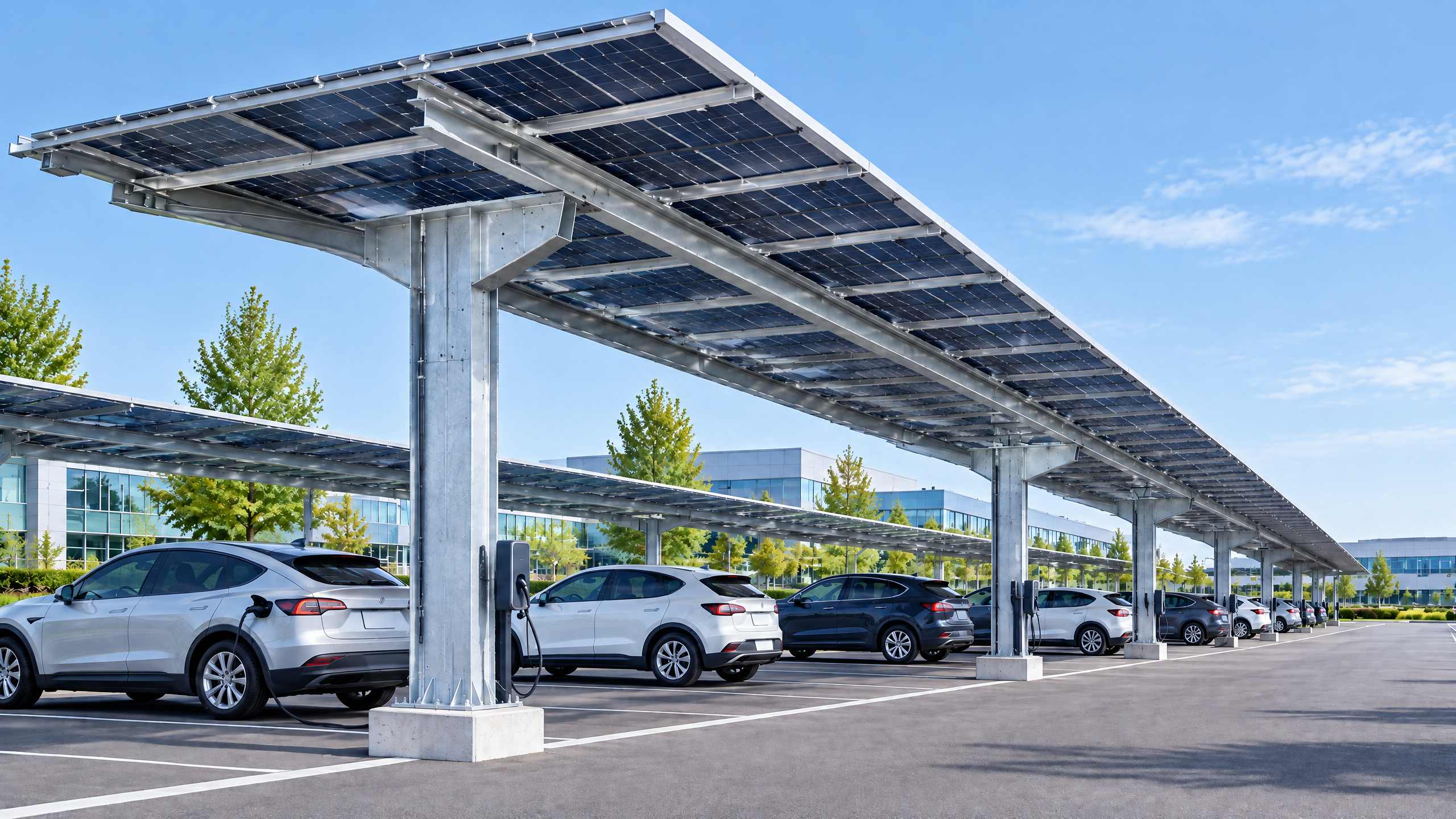
A solar carport battery operating plan defines how on-site energy storage will be controlled, dispatched and integrated with PV generation, building loads, EV charging, and the utility grid. For commercial carport projects the plan must deliver measurable project outcomes (peak demand reduction, energy cost minimisation, resilience, EV load management) while respecting structural, electrical and permitting constraints. Start with a clear statement of objectives, a short list of operating modes (e.g., peak shaving, time‑of‑use arbitrage, backup/resilience, EV support), and quantitative inputs: hour-by-hour load profile, PV generation estimate, tariff and demand charge structure, and acceptable state-of-charge and lifecycle targets. Translate those into a control specification (setpoints, priority rules, telemetry, fault response) that ties into the solar carport structural interface, PV equipment coordination and electrical pathway planning. All site‑specific structural capacity, foundations, permits, electrical design, approvals, lead time, price, energy yield and warranty require a documented project basis and engagement of relevant local qualified professionals, installers, utilities and authorities.
Buyer context and scope boundary
Purpose and audience
- This guide is written for distributors, architects, contractors, developers, solar EPCs and fleet operators procuring commercial solar carports with integrated battery energy storage systems (BESS).
- Focus: how to specify the solar carport battery operating plan as a procurement and technical deliverable that directly drives project scope, cost, performance and long‑term operations.
Scope boundary (what this guide covers)
- Defining operational objectives and performance metrics for on‑carport or adjacent battery systems.
- Interfaces with carport structure, PV arrays, inverters/chargers, EV loads and utility interconnection.
- Procurement evidence and factory acceptance considerations.
- Practical site installation, commissioning and operations pathways.
- Implementation risks, mitigations and a practical six‑step buyer workflow.
Out of scope
- Detailed civil structural design calculations; detailed electrical one‑line drawings; jurisdictional permit forms; and vendor-specific quoted pricing. These require a documented project basis and local qualified professionals.
Mandatory notice
- Site-specific structural capacity, foundations, permits, electrical design, approvals, lead time, price, energy yield and warranty require a documented project basis and relevant local qualified professionals, installers, utilities and authorities.
Core decision principle: define the operating objective first
The single most important decision is the operating objective — the business outcome the battery must deliver. Typical objectives for commercial carport projects:
- Maximise PV self‑consumption (reduce grid import during daylight).
- Reduce peak demand charges (controlled discharge during utility peaks).
- Time‑of‑use arbitrage (charge at low tariff, discharge at high tariff).
- Provide resilience/back‑up for critical loads (island mode).
- Support EV charging peaks (buffer EV loads or provide managed charging).
- Provide ancillary services where markets and interconnection allow.
Why the objective matters
- Battery sizing, chemistry, depth of discharge policy, battery management system (BMS) rules, inverter topology and communications are all driven by the chosen objective.
- An operating plan quantifies performance targets (e.g., reduce monthly peak demand by X kW, supply outage resilience for Y hours at Z% of load).
- The plan becomes the measurable basis of acceptance tests and warranty triggers.
Trade‑offs to consider
- Resilience (long duration, high energy) usually increases cost and impacts lifecycle cycles.
- Peak shaving typically benefits from high round‑trip efficiency and high‑power capability rather than long duration.
- EV support can require controlled discharge profiles and fast response; EV charging loads are stochastic and may demand integration with on‑site management systems.
- Regulatory and utility interconnection constraints may limit export or require specific control behavior.
Use this core decision to set the control hierarchy: what is first priority (e.g., safety and code compliance), second (e.g., resilience), third (e.g., cost savings via TOU arbitrage). The operating plan documents the hierarchy and failure/override rules.
Planning inputs — data and constraints you must gather
Before specifying control strategies, collect a concise, validated dataset and constraints package:
Essential quantitative inputs
- Hourly (preferably sub‑hourly) facility load profile for at least 12 months, or representative periods (weekday/ weekend/season) — drives sizing and dispatch models.
- PV generation estimate for proposed array layout (module spec, tilt, shading, soiling assumptions). Use PV modeling tools for production estimates [2].
- Tariff structure details: energy rates, demand charges, time‑of‑use windows, demand ratchets, minimums and standby rates.
- Grid interconnection rules and export limits from the local utility; interconnection queue requirements [4].
- Required resilience design point(s): critical loads list, required outage duration, automatic transfer switch (ATS) strategy.
- EV charging schedule and expected simultaneous plugs (if EV support is required). For EV charging demand profiling refer to EV infrastructure resources [3].
- Environmental conditions: ambient temperature ranges, solar irradiance, wind loads affecting carport structure.
Essential qualitative and site constraints
- Structural capacity of the carport and foundations; permitted roof load for additional equipment (inverters, battery racks). This is the solar carport structural interface.
- Location constraints for battery, inverters and switchgear (on carport, ground adjacent, utility rooms).
- Fire code and local authority having jurisdiction (AHJ) requirements for energy storage.
- Maintenance access planning: clearance, egress, lift access, and service vehicle access.
- Telecom and telemetry constraints (cell coverage, wired network availability) for remote monitoring and control.
Tools and references
- Use PV simulation resources such as PVWatts and NREL guidelines for production estimates and system modelling [1][2].
- Consult local utility interconnection guides and market rules early to avoid late-stage constraints [4].
Collecting these inputs enables a control‑strategy simulation that informs battery sizing, inverter specification and cost/benefit analysis.
Technical specification and interfaces
An operating plan must be translated into a technical specification that defines control logic, hardware interfaces and acceptance tests. Below are the key technical domains and recommended specification elements.
- Battery capacity and power rating
- Specify usable energy (kWh) and continuous / peak discharge power (kW). Define both nominal and guaranteed minimum usable capacity at warranty end‑of-life (e.g., 70% after X years or cycles).
- State required round‑trip efficiency and allowed depth of discharge (DoD) policy for the operating plan.
- Chemistry and thermal requirements
- Specify chemistry (e.g., lithium iron phosphate (LFP), NMC) only as a performance attribute (cycle life, thermal behavior) rather than brand. Include ambient temperature operating range and required HVAC or thermal management systems if installed in enclosures on or under the carport.
- Inverter / charger topology and integration
- Define whether the system is AC‑coupled, DC‑coupled, or hybrid. Clarify inverter grid‑forming/grid‑following capability for islanding/resilience scenarios.
- Define interface points: PV combiner, inverter AC bus, meter points for import/export limiting, critical load splitters, ATS connections.
- Control and communications
- Supply a controller functional specification: telemetry (SCADA/Open‑protocol like Modbus, SunSpec or IEC 61850), setpoints, scheduling, priority logic, state‑of‑charge (SoC) thresholds, frequency/demand response behavior, cybersecurity requirements and remote firmware update policy.
- Define requirements for PV equipment coordination and load/dispatch prioritisation among PV, battery and EV chargers.
- Electrical pathway planning
- Define cable routing, raceways, trenching, segregation of DC and AC runs, grounding/earthing, lightning protection, conduit sizes, and combiner box locations.
- Ensure the electrical pathway planning dovetails with structural anchoring and maintenance access planning.
- Structural interface for batteries and electronics
- For batteries mounted on carport structures, specify load concentrations, attachment details, vibration isolation and fire separation distances. This is part of the solar carport structural interface.
- Define required foundation details if batteries or transformer/gear are ground‑mounted.
- Fire, safety and egress
- List required fire protection measures (suppression systems if required), ventilation, smoke detection and AHJ notifications. Define access for emergency services.
- Metering and verification
- Specify metering points for energy accounting (PV production, battery charge/discharge, site import/export, critical load metering) and the minimum metrology accuracy class.
- Commissioning and acceptance tests
- Define FAT (factory acceptance test) scope, SIT (site integration tests), performance acceptance tests (e.g., controlled peak-shaving event, blackout island test), and measurement windows (e.g., 30 days of performance logging).
Decision table: Battery sizing by primary objective
| Primary objective | Typical battery sizing approach | Key technical driver |
|---|---|---|
| Peak demand reduction | Size kW ~ expected peak reduction; energy sized for daily peak duration (1–3 hrs typical) | Power rating and high C‑rate capability |
| PV self‑consumption | Energy sized to absorb midday surplus and discharge in evening (2–6 hrs) | Usable kWh and efficiency |
| Resilience/backup | Energy sized to sustain critical loads for required outage hours (4–24+ hrs) | Energy capacity and islanding capability |
| Time‑of‑use arbitrage | Energy sized for tariff windows; may be smaller if repeated daily cycles acceptable | Cycle life and DoD |
| EV charging support | High power; energy sized for expected simultaneous charging events | High kW power and fast ramp |
Decision table: Integration topology selection
| Integration type | Best when | Pros | Cons |
|---|---|---|---|
| AC‑coupled | Retrofit on existing inverters or when flexibility needed | Simpler retrofit; uses mature inverter tech | Slightly lower round‑trip efficiency vs DC |
| DC‑coupled | New builds seeking max PV+BESS efficiency | Higher efficiency; better co‑optimisation | More complex design; limited inverter choices |
| Hybrid inverters | Combined PV+BESS with integrated control | Simplifies communications and maintenance | Vendor lock‑in risk; sizing constraints |
Include the primary keyword "solar carport battery operating plan" in the plan header, control specification and acceptance criteria. Also include PV equipment coordination, electrical pathway planning and maintenance access planning in the technical interface checklist. Ensure each interface and component has a responsible party identified (EPC, structural engineer, electrical contractor, battery vendor).
Procurement and factory evidence requirements
Procurement documentation must translate the operating plan into verifiable deliverables. The buyer should request evidence that verifies both manufacturing quality and operational performance expectations.
Minimum procurement deliverables to request
- Functional specification (operating plan) as a contract appendix with measurable KPIs (kW peak reduction target, kWh throughput limit, SoC operating window, black‑start behavior).
- Bill of materials (BOM) with manufacturer part numbers and declared performance parameters (capacity, power, efficiency, inverter ratings).
- Factory Acceptance Test (FAT) protocol and results for BMS, power conversion systems, and control logic.
- Test data demonstrating power capability and round trip efficiency under representative temperatures.
- QA and ISO manufacturing evidence (factory audit reports rather than invented certifications).
- Warranty statements with clear definitions of end‑of‑warranty capacity guarantees and remedies.
Documentation and evidence to include in contract
- Clear performance acceptance test criteria and measurement method (e.g., metered kW/kWh over defined periods).
- Remedies for underperformance (repair/replacement, prorated credits).
- Agreed telemetry and reporting cadence for post‑commissioning verification.
Procurement route decision table: centralised vs componentised
| Procurement model | Best fit | Buyer control | Supply chain risk |
|---|---|---|---|
| Single‑vendor integrated system | Projects seeking single point of responsibility | Lower buyer management overhead | Vendor lead‑time and warranty dependence |
| EPC with component procurement | Large projects with in‑house integration expertise | High buyer control of component selection | Requires strong integration QA and coordination |
| Multiple suppliers (separate battery, inverter, controls) | When optimising cost/availability | High technical oversight required | Higher integration and commissioning risk |
Factory acceptance and inspection
- Request witness rights for FAT and sample testing or, at minimum, detailed FAT reports with timestamped logs for control sequences.
- Insist on firmware baselines and version control as part of delivery.
- Verify packaging and transport methods for batteries (UN transport rules compliance where applicable).
Supply chain and lead times
- Include lead‑time milestones in contract with consequential delay provisions if critical to project schedule.
- Plan for long lead items (inverters, transformers) and coordinate with carport structural delivery to avoid storage handling issues.
For procurement of integrated carport systems, consider referencing Carportiva’s SolarGrid commercial solar system as an example of a packaged approach that bundles structural and system planning. For broader product options consult all systems and procurement process references in sourcing guides.
Site installation, commissioning and operations
A clear division of responsibilities and an installation sequence tied to the operating plan reduces risk and avoids schedule conflicts.
Key installation sequence (recommended)
- Deliver and set out structural carports and foundations. Address solar carport structural interface with battery and equipment weight checks.
- Install PV arrays and rooftop cable trays. Perform PV equipment coordination activities with battery/inverter installation teams.
- Install battery enclosures, inverters, switchgear and internal wiring. Follow electrical pathway planning and maintain segregations.
- Connect metering, telemetry and utility interface equipment; pre‑commission internal communications network.
- Perform integrated commissioning: PV-BESS-inverter functional tests, protection settings, grid export limits, and operating plan acceptance scenarios.
- Execute site acceptance testing: performance tests aligned with contractual KPIs and operational scenarios (peak shave event, island test if required).
Commissioning and acceptance tests you should require
- Static functional tests: BMS alarm handling, SCADA telemetry, SoC reporting.
- Dynamic tests: Ramp response to dispatch signals, emergency trip tests, battery charge/discharge performance under load.
- Performance tests: Demonstrate ability to meet a peak reduction target under controlled conditions or show delivered kWh savings over a billing cycle.
- Islanding/resilience tests only after AHJ and utility approvals and with risk mitigation in place.
Operations and maintenance planning
- Define maintenance tasks, schedules and access requirements. Maintenance access planning should include panel and battery clearances, access for battery removal, and recommended PPE.
- Define remote monitoring dashboards, alarm thresholds, and who receives alerts (EPC, O&M, owner).
- Plan for firmware updates and an agreed process for change control to avoid unplanned shifts in operating behavior.
Handback to operations
- Provide an as-built package including one‑line diagrams, control logic diagrams, settings log, FAT/SIT reports, manufacturer O&M manuals, and spare parts list.
- Provide operator training sessions and role-based responsibilities for real‑time control vs vendor support.
Safety during operations
- Establish lock‑out/tag‑out procedures, battery emergency shutdown procedures, and clear signage for first responders.
- Maintain records of service and incidents for warranty and lifecycle management.
Implementation risk register and mitigations
Identifying common implementation risks and agreed mitigations in contract and planning reduces schedule and performance surprises.
Risk: Inadequate structural interface
- Impact: Delayed installation, retrofits, or load redistribution.
- Mitigation: Early structural survey, stamped engineer report for attachments, and integration of battery weight/load into carport design.
Risk: Mismatch between control logic and utility interconnection requirements
- Impact: Export blocking, failed interconnection, or penalties.
- Mitigation: Early utility and permit interface engagement; incorporate utility interconnection constraints into control spec; plan for anti‑islanding and export-limiting logic.
Risk: Insufficient electrical pathway planning
- Impact: Cable rework, voltage drop, protection coordination issues.
- Mitigation: Complete detailed conduit and cable sizing early; involve electrical contractor and inverter vendor in submittal review.
Risk: Fire and AHJ non‑compliance
- Impact: Rework, fines, delayed energisation.
- Mitigation: Engage AHJ early; specify fire safety measures and get pre-approval for battery locations.
Risk: Software/communications integration failure
- Impact: Loss of remote control or telemetry, inability to run operating strategies.
- Mitigation: Require communications and cybersecurity specs in contract; FAT includes communications acceptance tests.
Risk: Warranty and performance disputes
- Impact: Unplanned costs and downtime.
- Mitigation: Define measurable KPIs, acceptance tests and remedies; require factory testing evidence and clear warranty terms.
Risk: Supply chain delays
- Impact: Project schedule slip.
- Mitigation: Add lead‑time clauses, alternative suppliers, and phased commissioning where partial systems are accepted.
Risk: Safety incident during commissioning
- Impact: Injury, stoppage and reputational damage.
- Mitigation: Enforce safety plans, permit-to-work systems and qualified personnel only for live testing.
Include these risks and proposed mitigations in the project RACI (Responsible, Accountable, Consulted, Informed) matrix so each risk has an owner and an escalation path.
Six-step buyer workflow: from objective to operational handover
This named workflow converts the operating plan into a procurement-ready deliverable.
Step 1 — Define objectives and KPIs (Deliverable: Operating Plan Draft)
- Stakeholders: Owner, asset manager, energy manager.
- Output: Written objectives, prioritized modes (peak shave, resilience, EV support), KPI definitions.
Step 2 — Gather site and data inputs (Deliverable: Site Data Pack)
- Stakeholders: EPC, architect, electrical engineer.
- Output: Load data, PV model results, structural report, utility rules, AHJ constraints.
Step 3 — Translate to technical spec and acceptance tests (Deliverable: Technical Specification & FAT/SIT protocols)
- Stakeholders: Owner, EPC, battery vendor, inverter vendor.
- Output: Component ratings, control logic, communications protocol, FAT/SIT checklists.
Step 4 — Procurement and contract award (Deliverable: Procurement contract with evidence requirements)
- Stakeholders: Procurement, legal, project manager.
- Output: Contracts with performance acceptance criteria, FAT witness rights and delivery milestones.
Step 5 — Install, commission and accept (Deliverable: Commissioned system and acceptance report)
- Stakeholders: EPC, installation teams, local authority, utility inspector.
- Output: Commissioning reports, performance verification logs, as‑built documentation.
Step 6 — Handover to operations and continual optimisation (Deliverable: O&M plan and baseline performance report)
- Stakeholders: O&M team, vendor support, owner.
- Output: Training, monitoring dashboards, maintenance schedules, firmware change control.
Use this workflow as a checklist during procurement conversations and tie payments to acceptance milestones that reflect the operating plan’s KPIs.
Related B2B sourcing terms
For the same project brief, buyers may also encounter these connected search terms: commercial solar procurement. They must be interpreted against the actual project scope rather than treated as independent technical guarantees.
FAQ — practical answers for common buyer questions
Q: How do I size a battery for both peak shaving and resilience? A: Start with the highest priority objective. For combined objectives, treat resilience as a minimum energy reserve (e.g., maintain X kWh for backup) and allocate the remaining capacity for peak shaving. Model scenarios with representative load and PV data to verify performance. Document the blended operating rules in the solar carport battery operating plan and include acceptance tests.
Q: Should the battery be DC‑coupled or AC‑coupled? A: Choose based on project specifics: DC‑coupled can be more efficient when new PV systems are sized together with storage; AC‑coupled systems are often preferred for retrofits and where inverter flexibility is needed. Consider PV equipment coordination and long‑term upgrade paths.
Q: What telemetry and control standards should I require? A: Specify open protocols where possible (Modbus TCP, SunSpec, or IEC 61850 if available), a secure VPN/backhaul, defined uptime for telematics, and data retention policies. Include remote firmware update protocols and cybersecurity obligations.
Q: How do I handle utility interconnection and export limits? A: Engage the utility early. The operating plan must include export limiting strategies, frequency of export allowance, and response to utility curtailment signals. Utility interconnection resources provide guidance on processes [4].
Q: What are realistic acceptance tests for operational performance? A: Combine functional tests (BMS alarms, response times) with performance verification: controlled peak shave event(s) under monitored conditions, a multi-day observation period to validate energy shift targets, and verification that critical loads can be sustained for required resilience duration.
Q: What about EV charging integration? A: Define EV loads as part of the load profile. Decide whether EV chargers will be centrally managed by the BESS control (charge scheduling, power sharing) or locally managed with the BESS providing grid support. Refer to electric vehicle infrastructure resources for charging behaviors and planning [3].
Q: Where should I get PV production estimates? A: Use validated PV simulation tools such as PVWatts or other NREL resources for baseline production estimates and sensitivity analysis [1][2].
Q: Who signs off on structural changes to a carport to accommodate battery loads? A: A licensed structural engineer must assess and stamp any changes. This is part of the solar carport structural interface and must be coordinated with the carport supplier and civil contractor.
Q: Are there standard warranties or performance guarantees I should demand? A: Demand explicit end-of-warranty capacity guarantees (e.g., ≥X% at Y years) and clear remedies. Require vendor-provided projected cycle life under specified DoD and temperature. Ensure warranty covers components that affect operation (BMS, inverter) and define responsibilities for software/firmware defects.
Q: How do I model economic benefits? A: Use the collected tariff profiles, PV production estimates, and load data to model cash flows for different operating modes. PVWatts and NREL resources provide production inputs [2][1]; tariff rules and demand charge structures should be modelled with conservative assumptions.
Two decision tables for procurement and operations
Decision table: Acceptance test priorities based on objective
| Objective priority | Minimum acceptance tests required | Recommended monitoring window |
|---|---|---|
| Safety & code compliance | AHJ inspections, fire suppression checks, grounding continuity | Immediate pre‑energisation |
| Resilience | Islanding test for defined critical load duration | Single test + periodic verification yearly |
| Peak demand reduction | Controlled peak shave event under meter verification | 30 days logged data to confirm monthly benefit |
| PV self‑consumption | Metered energy flow verification showing reduced import during set windows | 30 days with representative weather |
| EV load support | Load coordination test with expected simultaneous plugs | Acceptance day + operational spot checks |
Decision table: Who signs off what (RACI simplified)
| Deliverable | Owner (R) | Accountable (A) | Consulted (C) | Informed (I) |
|---|---|---|---|---|
| Operating plan document | Owner/Asset manager | Owner | EPC, battery vendor, structural engineer | O&M |
| Structural attachment details | Structural engineer | Architect/owner | Carport supplier, EPC | Installer |
| Electrical one‑line and protections | Electrical engineer | EPC | Utility, inverter vendor | Owner |
| FAT & factory reports | Vendor | Vendor | EPC/owner | Owner |
| Commissioning & acceptance | EPC | Owner | Vendor, utility | O&M |
Mid‑article action: discuss your project specifics
If you are preparing tender documents or want a review of a draft solar carport battery operating plan, contact us to discuss practical specification alignment and phasing: /inquiry or info@carportiva.com. For structural-integrated solutions see Carportiva’s SolarGrid commercial solar system. For product overviews and comparative options see all systems and procurement checklists in our sourcing guides.
Conclusion — operational clarity prevents expensive rework
A robust solar carport battery operating plan turns a high‑level objective into a measurable, contractually verifiable deliverable. It connects the engineering (solar carport structural interface, PV equipment coordination, electrical pathway planning), procurement (evidence, FAT, warranties) and operational (maintenance access planning, telemetry, O&M) domains so the buyer gets predictable outcomes. Start with clear objectives, collect validated inputs, translate to a functional control specification, and embed measurable acceptance tests into procurement. Engage local qualified professionals early for structural, electrical and permitting matters — these elements are jurisdictional and require a documented project basis with local professionals, installers, utilities and authorities.
If you would like support developing a procurement package or reviewing an operating plan for a commercial carport project, contact us: /inquiry or info@carportiva.com. For product details consider SolarGrid commercial solar system, and see all systems and sourcing guides for procurement templates and checklists.
References and further reading
- National Laboratory of the Rockies PV resources and guidance on solar system modelling and best practice [1].
- PVWatts Calculator for production estimates and baseline energy yield modelling [2].
- U.S. Department of Energy resources on alternative fuel and EV infrastructure planning where EV integration is required [3].
- Federal Energy Regulatory Commission guidance on interconnection processes and applicable market rules [4].
References
- National Laboratory of the Rockies PV resources: https://www.nrel.gov/solar/
- PVWatts Calculator: https://pvwatts.nrel.gov/
- U.S. Department of Energy Alternative Fuels Data Center: https://afdc.energy.gov/
- Federal Energy Regulatory Commission interconnection resources: https://www.ferc.gov/electric-transmission/generator-interconnection
Keep the project brief connected.
Bring the actual project brief to the engineering table.
Share your location, layout, target application and available technical inputs. Carportiva can help identify the relevant product-interface information before a project-specific commercial discussion.
Request a project discussion