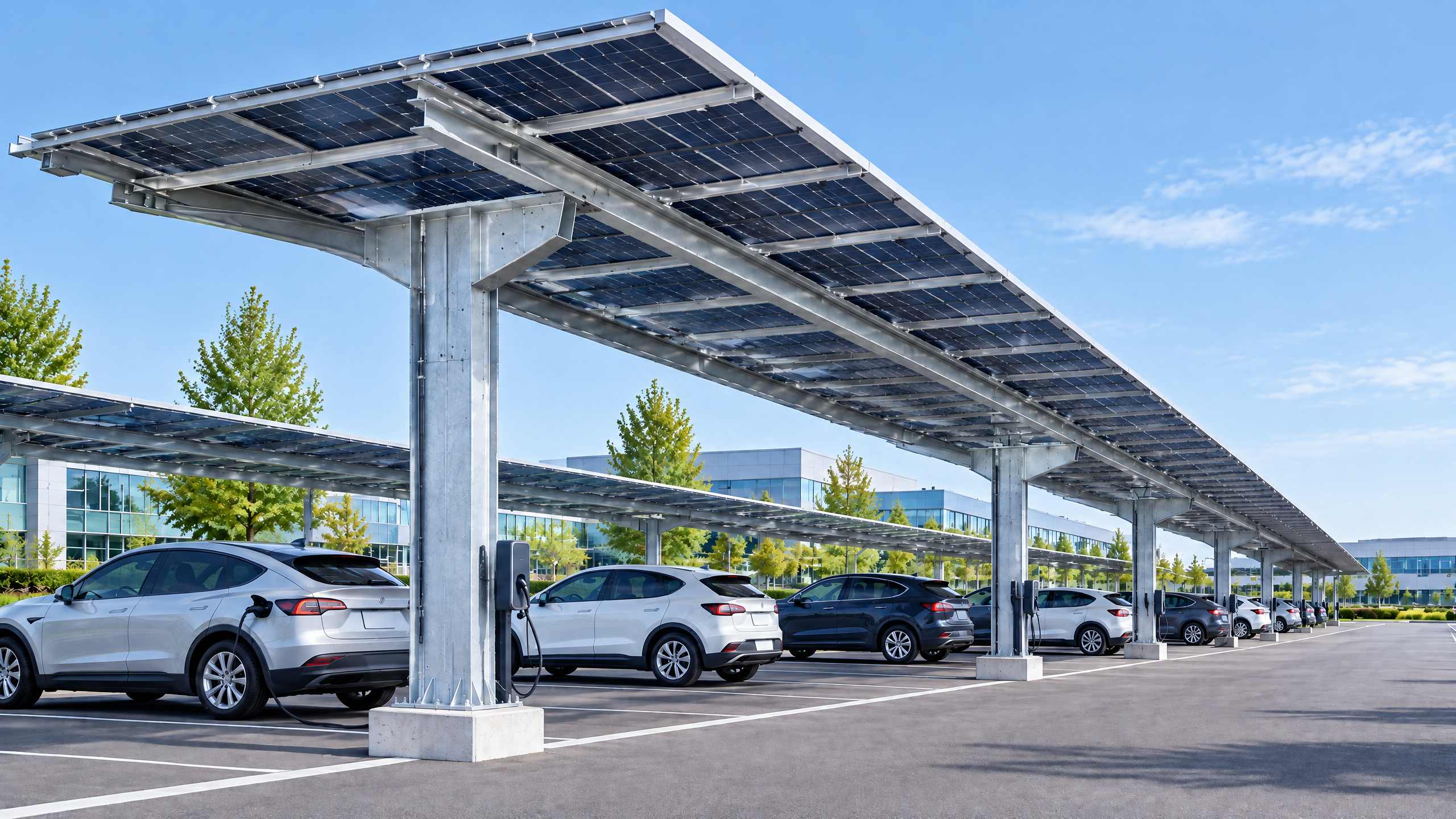
Short answer (120–180 words): The choice of commercial solar canopy manufacturer matters from the earliest project definition through long‑term operations because the manufacturer defines structural geometry, module mounting, electrical routing, warranty interfaces and factory QA processes that directly affect cost, schedule, energy yield, maintenance and regulatory compliance. For B2B buyers — distributors, architects, contractors, developers, solar EPCs and fleet operators — the manufacturer is not just a supplier of steel or aluminium: they are the owner of the solar carport structural interface and the party whose drawings, load assumptions, and factory testing determine foundation types, cladding choices, PV equipment coordination and on‑site installation sequencing. Select a manufacturer with demonstrable engineering documentation, repeatable production control, clear responsibilities for PV and electrical details, and the ability to work with your local permitting, utility interconnection and warranty requirements. Site‑specific structural capacity, foundations, permits, electrical design, approvals, lead time, price, energy yield and warranty always require a documented project basis and review by relevant local qualified professionals, installers, utilities and authorities.
Buyer context and scope boundary: who needs to care and why
Commercial solar canopy manufacturer selection is a procurement decision with technical, contractual and operational consequences. The typical B2B participants and their interests:
- Distributors: product availability, logistics, documentation, repeatable quality, spares and warranty handover.
- Architects: aesthetics, clearance heights, integration with building and landscape design, load and drainage details.
- Contractors / General Contractors: installation sequencing, tolerances, interfaces with foundations and siteworks, health & safety.
- Solar EPCs: PV equipment coordination, inverter and combiner placement, electrical pathway planning and commissioning acceptance.
- Developers / Asset owners: cost, schedule, energy yield, operability, lifecycle maintenance planning.
- Fleet operators / facility managers: vehicle clearance, maintenance access planning, thin‑ice or snow shedding risk, operability during peak fleet hours.
Scope boundaries for this guide: it focuses on the procurement implications of selecting a commercial solar canopy manufacturer for carport and fleet canopy projects where the canopy structure is the primary manufactured deliverable. This does not replace site‑specific structural calculations, photovoltaic system design, or final electrical interconnection design — those require local licensed engineers, licensed electrical installers and authority approvals.
Important project disclaimer: site‑specific structural capacity, foundations, permits, electrical design, approvals, lead time, price, energy yield and warranty require a documented project basis and relevant local qualified professionals, installers, utilities and authorities.
Core decision principle: manufacturer responsibilities that affect outcomes
A single decision principle should drive manufacturer selection: choose the manufacturer whose documented responsibilities and technical deliverables most reduce project risk and total lifecycle cost for your contract model. In practice that means evaluating manufacturers by five interlocking capabilities:
- Engineering and documentation: stamped drawings, load cases, tolerance data, interface details.
- Manufacturing quality and traceability: material certificates, welding procedures, factory QA records.
- Interface clarity: how the product defines and manages the solar carport structural interface and the handoff points for PV equipment coordination, electrical pathway planning and foundations.
- Supply and logistics: lead time transparency, spare parts and replacement policy, packaging and delivery coordination.
- After‑sales and warranty: warranty coverage limits, response times, availability of certified installers.
When these capabilities are explicit in tender documents and purchase orders, you transfer manageable and measurable risk off the buyer team and lower the likelihood of delay claims, rework or energy underperformance.
Planning inputs: what you must provide and what the manufacturer must deliver
Successful procurement begins by declaring responsibilities in advance. Split the inputs into what the buyer (client/EPC) supplies and what the manufacturer must deliver.
Buyer inputs (minimum, provided as part of invitation to quote):
- Project brief: location, orientation, expected system size (kW or approximate panel count), preferred module type, vehicle clearance and canopy length/width objectives.
- Site survey: geotechnical report or representative subsurface conditions, existing utilities, approximate foundation constraints.
- Permitting constraints: local building code requirements, required clearances, fire access lanes.
- Electrical strategy: point of interconnection, expected inverter/transformer locations, preferred single‑line diagram if available.
- Schedule constraints and milestones for production and site delivery.
Manufacturer deliverables (explicit in contract):
- Stamped structural drawings for the intended site or a clear scope for certified site adaptations.
- Bill of materials with material certificates and surface treatment specifications.
- Factory test plans: weld procedures, torque testing for bolted connections, coating adhesion tests.
- Interface drawings for PV equipment coordination and electrical pathway planning, including conduit routes, cable tray support points and PV module mounting details.
- Foundation layout and anchor bolt templates, and site load statements.
- Installation manual with crane and lifting points, torque sequences, and maintenance access planning guidance.
Make these deliverables contractual. Incomplete handoffs are a primary source of schedule drift.
Technical specification and interfaces: the five technical domains that depend on manufacturer choice
Manufacturers define the physical and documented boundaries that other parties design around. Pay attention to these domains and insist that the manufacturer's outputs match your project model.
- Structural system and the solar carport structural interface
- The solar carport structural interface is the contract boundary: who designs foundations, who verifies anchor bolts, and who certifies post‑installation load paths? Manufacturers may supply foundation drivers (anchor templates and loads) or limited design notes requiring a local engineer to adapt foundations.
- Important documents: design wind and snow loads assumed, fatigue details for cantilevers, concrete bearing pressures, anchor bolt patterns and allowable tolerances, and net clearances after installation.
- PV equipment coordination
- PV equipment coordination is a shared activity. The manufacturer must provide clear roof geometry, module tilt and spacing, racking attachment points and maximum allowable point loads. The EPC or PV supplier must provide module footprints, panel clamping areas, and in‑plane loading assumptions.
- Deliverables: a combined 3D model or clash‑checked BIM file that integrates module layouts, inverter pads and cable tray routing reduces field issues.
- Electrical pathway planning
- Electrical pathway planning starts with where the canopy manufacturer permits routing of conduits, cable trays and string combiners. Clarify whether cable trays attach to columns, or if dedicated rack or ladder supports are required.
- Specify conduit entry points to inverter/combiner cabinets, rooftop combiner locations (if any), and provision for lightning protection or earthing continuity.
- Ensure the manufacturer provides clear CB schemes for roof‑mounted hardware, including roof penetration details and weatherproofing methods.
- Utility and permit interface
- A manufacturer that supplies permit‑ready packages (stamped drawings, structural calculations and cut sheets) will accelerate authority approval. Utility studies (interconnection) require single‑line diagrams and site layout; the manufacturer must supply structural statements that utilities may request.
- Interconnection and net‑metering timelines impact procurement and commissioning; coordinate early with utilities and use standard interconnection resources where applicable [4].
- Maintenance access planning
- Maintenance access planning must be explicit for PV module replacement, string inverter access, combiner and DC/AC disconnects. The manufacturer should provide access platforms, clearances and fall‑protection tie‑offs where required.
- Define who maintains gutters, lighting, snow removal and module cleaning. Access routes for lifts and safety anchorage points must be part of the manufacturer's installation manual.
In delivering the above, insist that the manufacturer include the exact phrases of responsibility in the contract so there is no ambiguity about who supplies what at each stage.
Procurement evidence and factory transparency: what to ask for and how to verify
When evaluating manufacturers, request documentary evidence that demonstrates repeatable production quality and traceability. The following checklist is practical and verifiable.
Mandatory factory evidence (request copies where possible):
- Material certificates (e.g., aluminium alloy certification, galvanizing or anodizing reports).
- Welding procedure specifications (WPS) and welder qualifications.
- Factory inspection test plans and records (FTPs) including dimensional control and torque checks for bolted assemblies.
- Load test records or calculated capacity reports for sample cantilever assemblies (do not accept unverifiable claims).
- Packing and transport method descriptions, with handling instructions for pre‑assembled spans.
Supplier due diligence:
- Factory tour or independent third‑party QA reports. If a factory tour is not feasible, request recent independent inspection reports or in‑line quality photos and videos of the manufacturing and coating process.
- Production lead‑time history: ask for typical production weeks and reasons for schedule variation.
- Nonconformance and corrective action reports (NCR): a mature supplier will have documented NCR processes and histories of corrective measures.
Two decision tables to use during shortlisting
Manufacturer capability comparison
| Capability | Manufacturer A | Manufacturer B | Manufacturer C |
|---|---|---|---|
| Stamped structural drawings included | Yes / No | Yes / No | Yes / No |
| Factory test records available | Yes / No | Yes / No | Yes / No |
| Interfaces for PV equipment coordination | Detailed BIM / Partial / None | Detailed BIM / Partial / None | Detailed BIM / Partial / None |
| Warranty transfer and service network | National / Regional / None | National / Regional / None | National / Regional / None |
| Typical production lead time (weeks)* | [enter] | [enter] | [enter] |
Procurement responsibility matrix (sample)
| Responsibility | Manufacturer | EPC/Installer | Client / Owner |
|---|---|---|---|
| Stamped structural canopy drawings | Primary | Review | Approval |
| Foundations & geotech design | Provide anchor loads | Design & certify | Provide site data |
| PV module mounting details | Provide racking interface | Layout modules | Select modules |
| Electrical pathway planning | Provide conduit routes & penetration details | Design & wire | Coordinate utility |
| Commissioning acceptance | Provide installation & factory QA records | Perform commissioning | Final acceptance |
*Do not accept lead times as final without a site‑specific purchase order and production schedule; lead time can be constrained by raw material availability and seasonal demand.
Procurement contract clauses to insist on:
- Clear acceptance tests and hold points at factory and site.
- Spare parts list and delivery times for critical components.
- Liability split for rework caused by interface mismatches.
- Defined warranty start date and service level response windows.
Site installation and operations: sequencing, tolerances and handover
Installation strategy depends on how responsibilities were defined during procurement. Define installation milestones and acceptance criteria to avoid finger‑pointing.
Typical installation milestones:
- Foundations completed and certified (anchor bolt templates checked).
- Primary frames erected and bolted; alignment and elevation tolerances validated.
- Roof racking and module rails installed and inspected per manufacturer torque sequences.
- PV module installation and electrical pathway installation coordinated with EPC.
- Commissioning, including insulation testing, string verification and inverter start‑up.
Tolerance control and field verification:
- Use laser alignment checks for column plumb and beam elevation. The manufacturer should specify acceptable tolerances and provide a site inspection checklist.
- Anchor bolt templates must be checked prior to concrete pour and re‑checked after curing. The manufacturer should provide an anchor verification form.
Handover documentation:
- Complete as‑built drawings, torque witness records, component traceability and factory QA records.
- Maintenance manual with maintenance access planning, routine inspection checklist and spare parts list.
- Warranty certificates and transfer documentation.
Operational considerations:
- Snow and wind management: the manufacturer should provide guidance on snow shedding and wind deflection, but site‑specific operating procedures should be defined by the owner.
- Cleaning and module replacement: ensure safe access and module mounting features enable panel replacement without dismantling primary structure.
- Integrating EV charging infrastructure: coordinate cable routing, load sharing and space allocation early; consult public EV charging siting guidance where needed [3].
Implementation risks and mitigations
Risk management should be explicit in procurement documents. Common risks and mitigations:
- Interface mismatch between canopy and PV racking
- Risk: Racking clamps do not fit rails or mounting points obstruct module layout.
- Mitigation: Require BIM files and module layout verification early; define responsibility for remedial work in contract.
- Anchor bolt or foundation mislocation
- Risk: Anchor bolt positions or elevations outside manufacturer tolerances.
- Mitigation: Use manufacturer anchor templates and hold points before concrete pour; include rework rates and costs in contract.
- Lead time delays
- Risk: Manufacturer lead times exceed project schedule.
- Mitigation: Include staged delivery, milestone payments and liquidated damages; verify supplier production capacity and raw material sources.
- Warranty ambiguity
- Risk: Overlapping or gaps between structural and PV warranties.
- Mitigation: Contractually map warranties to components and activities; require a single point of contact for warranty claims where possible.
- Electrical routing conflicts
- Risk: Insufficient conduit space or incompatible entry points.
- Mitigation: Require detailed electrical pathway planning and early coordination meetings between manufacturer and electrical contractor.
- Regulatory or utility interconnection delays
- Risk: Approval delays affect commissioning.
- Mitigation: Pre‑submit permit and interconnection documents; use standard interconnection guidance and early utility engagement [4].
- Maintenance access shortfalls
- Risk: Panels or inverters inaccessible for routine service.
- Mitigation: Require maintenance access planning and inspection gates; include safety anchor points and clearances in deliverables.
- Environmental and corrosion issues
- Risk: Inadequate coating for coastal or industrial environments.
- Mitigation: Specify appropriate surface treatments and require material certificates and accelerated corrosion test data when needed.
For each risk, require a documented mitigation plan and predefined responsibility for costs associated with remediation.
Six‑step buyer workflow: a named, repeatable procurement process
Use the "CANOPY" six‑step workflow to align teams and reduce procurement ambiguity.
- Clarify site and system brief
- Compile site plan, geotechnical data, electrical point of interconnection, desired capacity and schedule milestones. This forms the documented project basis referenced by all parties.
- Assemble minimum technical package
- Buyer issues a minimum technical package to prospective manufacturers: acceptable module types, vehicle clearances, snow/wind design requirements and foundation constraints.
- Narrow to short‑list and request evidence
- Shortlist based on capacity, documentation, references and factory evidence (material certificates, WPS, QA records). Use factory inspection or independent reports where available.
- Integrate design coordination
- Create a coordination program: clash checks of BIM, PV equipment coordination sessions and electrical pathway planning workshops. Lock in responsibilities for unresolved items.
- Contract with explicit interfaces
- Draft commercial terms that document the solar carport structural interface, acceptance testing, deliveries, spare parts, warranty start and escalation processes. Include hold points for foundations and critical dimensions.
- Test, commission and capture lessons
- Ensure factory witness tests where practical, then execute site hold points, verify as‑built drawings, capture commissioning metrics and produce a lessons‑learned report for future procurement cycles.
Document each step and use opt‑in signoffs at milestone points so disputes can be avoided.
Decision tables for procurement contracting options
Contract type comparison
| Contract type | Manufacturer scope | EPC scope | Risk profile |
|---|---|---|---|
| Manufacturer-supplied structure only | Supply & drawings | All installation, PV & electrical | Higher EPC responsibility; lower manufacturer risk |
| Manufacturer + assembly (turnkey canopy) | Supply, partial installation, interface support | PV & electrical | Shared risk; manufacturer handles structural QA |
| Manufacturer full‑EPC (rare in canopies) | Supply, install, integrate PV and electrical | Owner oversight | Manufacturer centralizes risk; requires broad competency |
Responsibility split for common deliverables
| Deliverable | Typical responsibility (buyer model) | Contractual note |
|---|---|---|
| Anchor bolt templates | Manufacturer supplies | Buyer verifies templates before cast |
| Foundations design | Local structural engineer (buyer/EPC) | Manufacturer supplies loads & bearing pressures |
| Module mounting brackets | Manufacturer supplies or specifies | Check compatibility with chosen modules |
| Conduit entry seals & weatherproofing | Manufacturer supplies penetration details | EPC supplies field seals |
Related B2B sourcing terms
For the same project brief, buyers may also encounter these connected search terms: commercial solar procurement. They must be interpreted against the actual project scope rather than treated as independent technical guarantees.
Frequently asked questions (FAQ)
Q: How early should I involve the commercial solar canopy manufacturer? A: Engage the manufacturer during preliminary design. Early engagement reduces clashes in module layout, electrical routing and foundations. The manufacturer needs site inputs to produce stamped drawings and anchor templates.
Q: Can one manufacturer cover both structure and PV equipment? A: Some manufacturers partner with PV integrators to provide full canopy + PV solutions; verify competence in PV equipment coordination and ensure warranties cover integrated systems. Where the manufacturer does not supply PV, clarify responsibility boundaries.
Q: What documentation is essential from a manufacturer for permitting? A: Stamped structural drawings (local engineer as required), material certificates, anchor bolt templates, and a signed structural statement. Permit authorities may require additional local documentation.
Q: What tests should be performed at factory and on site? A: Factory QA should include dimensional checks, weld inspections and coating checks. On site, torque checks, anchor bolt embedment verification and alignment checks are typical. Commissioning tests for the PV system are performed by the EPC.
Q: How do I validate energy yield claims? A: Energy yield should be estimated through recognized modeling tools and site‑specific irradiance data (many projects use PVWatts or other validated tools) [2]. Confirm shading studies, module orientation and tilt with the PV designer, not the structure supplier alone. Refer to national irradiance resources for climate context [1].
Q: Who handles interconnection paperwork? A: Usually the owner or the EPC coordinates utility and permit interface, but the manufacturer must supply supporting drawings and structural statements needed by utilities [4].
Q: Are warranties transferable? A: Warranty transferability varies. Ensure transfer terms are spelled out in the contract and tied to registration processes and maintenance obligations.
Q: How should I assess long‑term maintenance? A: Require a maintenance access planning document, spare parts list, and recommended inspection frequency in the handover package.
Mid‑article CTA
For project‑specific guidance on structural interfaces and integrated systems, discuss your project with Carportiva’s technical team via /inquiry. Explore our product options including the SolarGrid commercial solar system, view all systems and consult our sourcing guides for procurement templates.
Procurement checklist and scorecard
Use this checklist during evaluation meetings. Score each item 0–5 (0 = none / 5 = complete).
- Stamped structural drawings included:
- Factory QA records available:
- Material certificates provided:
- BIM or 3D models for integration:
- Anchor bolt templates and foundation loads:
- Electrical pathway and conduit entry details:
- Maintenance access planning and spare parts list:
- Lead time transparency and production schedule:
- Warranty coverage and transferability:
- Installation manual and hold points:
Record weighted scores to drive procurement decisions objectively.
Integrating PV and EV infrastructure: practical notes
If the canopy will also support EV charging infrastructure, plan for electrical load management, cable containment and shared trenching early. EV charging locations influence where inverters, switchgear and transformer pads should be located. Public technical resources provide guidance on EV site planning and charging infrastructure; coordinate with the PV design and local utility for demand management and metering [3].
PV equipment coordination with EV chargers:
- Reserve space for DC/AC equipment near planned EV cabinets.
- Consider segregated cable containment for high‑voltage and EV power circuits.
- Design for future expansion: include spare conduits or oversized cable trays if anticipated growth is likely.
Contract negotiation tips and commercial levers
- Make documentation deliverables a condition precedent for payment milestones.
- Use acceptance tests and hold points tied to milestone payments for foundations and primary frame erection.
- Require a clear definition of “factory acceptance” versus “site acceptance.”
- Include spare bolt kits and critical spares in the initial supply package or as a priced optional item.
- Negotiate lead times tied to firm purchase orders and raw material commitments from the manufacturer.
Compliance, codes and third‑party approvals
Local building codes and electrical codes govern canopy structural design and the PV electrical system. Manufacturers may provide designs based on generic code assumptions — always verify with local code officials or a licensed engineer. For interconnection and grid compliance, consult utility requirements and interconnection guidance for your jurisdiction and any relevant regulatory body [4].
For energy yield and climate considerations, use validated solar resource tools such as PVWatts for preliminary yield estimates and NREL resources for irradiance and climatic factors [1][2].
Closing practical examples (non‑project specific)
- Integration clarity: If a manufacturer supplies detailed BIM files that incorporate conduit routing and module clamps, on‑site clashes typically fall by a measurable margin versus a supplier that only supplies 2D drawings.
- Warranty alignment: Projects with explicit warranty start dates tied to final commissioning and with a single warranty coordinator experience fewer disputes than those with ambiguous handoffs.
Do not use these examples as prescriptive design values; each project needs documented design and local professional oversight.
Final project caveats and professional responsibilities
Site‑specific structural capacity, foundations, permits, electrical design, approvals, lead time, price, energy yield and warranty require a documented project basis and relevant local qualified professionals, installers, utilities and authorities. This guide is an evidence‑led procurement framework but not a substitute for licensed engineering or legal advice.
Conclusion
The commercial solar canopy manufacturer matters whenever structural, electrical and operational outcomes depend on documented interfaces. Treat manufacturer selection as a systems engineering and procurement exercise: insist on defined deliverables, factory evidence, clear interface boundaries (including the solar carport structural interface), and coordinated PV equipment coordination and electrical pathway planning. Early alignment accelerates permitting, reduces field rework, improves energy yield certainty and simplifies long‑term maintenance access planning. Use the CANOPY six‑step workflow to structure decisions and lock responsibilities into contract documents.
For bespoke advice on integrating Carportiva’s canopy solutions with project procurement and design, contact our team at info@carportiva.com.
References and further reading:
- NREL solar resources and research [1]
- PVWatts solar energy estimator [2]
- U.S. Department of Energy EV and charging infrastructure guidance [3]
- Interconnection and regulatory resources [4]
References
- National Laboratory of the Rockies PV resources: https://www.nrel.gov/solar/
- PVWatts Calculator: https://pvwatts.nrel.gov/
- U.S. Department of Energy Alternative Fuels Data Center: https://afdc.energy.gov/
- Federal Energy Regulatory Commission interconnection resources: https://www.ferc.gov/electric-transmission/generator-interconnection
Keep the project brief connected.
Bring the actual project brief to the engineering table.
Share your location, layout, target application and available technical inputs. Carportiva can help identify the relevant product-interface information before a project-specific commercial discussion.
Request a project discussion