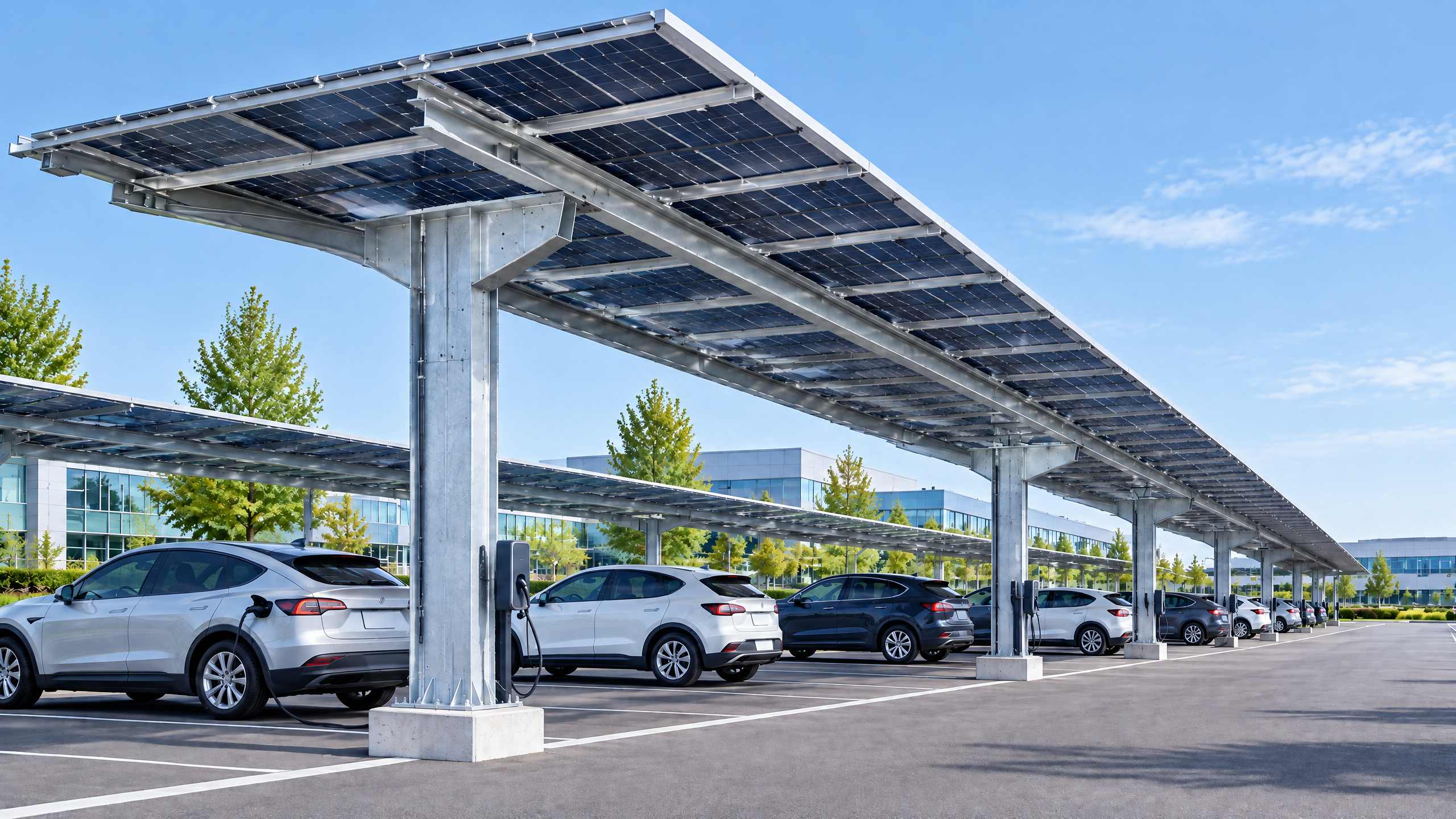
Direct answer (120–180 words) Confirm that the wind-load connection design for a commercial solar carport is fully coordinated across structural, architectural, electrical and foundation teams and validated for the project’s specific site wind map and exposure. Specifically, buyers must confirm: the design basis (reference wind speed, exposure category, importance factor and load combinations); connection types and their test or supplier documentation; interface loads passed to columns and foundations; attachment details to module rails and inverter pads; corrosion and fatigue considerations for fasteners and splice plates; erection and temporary-bracing procedures; and quality-control deliverables (shop drawings, calculations and as-built reports). Also verify how the wind-load strategy integrates with snow-load layout, drainage and maintenance access so loads do not combine unexpectedly on shared members. Local licensed structural engineers, permitting authorities, utility providers and installers must make final site-specific decisions; this guide explains the confirmations a buyer needs to require and verify during sourcing and procurement.
Why wind-load connection design matters for commercial carports
Wind load connections are the primary path that transfers lateral and uplift forces from PV modules and canopy cladding into the structure and down to foundations. Connection details determine whether those forces are concentrated or distributed, whether fatigue-critical components are protected, and whether erection or maintenance activities will temporarily change load paths. For buyers—distributors, architects, developers, EPCs and fleet operators—confirming connection design reduces contract risk, avoids rework in the field, and prevents schedule and insurance disputes during commissioning.
This guide focuses on confirmation and procurement actions; it does not replace structural design, permit review, or contractor scopes.
Scope boundaries and responsibilities
- This guide explains what buyers must confirm about design inputs, deliverables and interfaces for solar carport wind load connection design.
- It does not promise structural capacity, permit approval, code compliance, lead time, price, energy yield or warranty.
- Final, site‑specific decisions must be made by local licensed structural engineers, permitting authorities, utility providers and the installer responsible for erection and commissioning.
- Carportiva offers architectural aluminium carports and modular commercial solar carports—see the SolarGrid commercial solar system and our all systems and sourcing guides pages for platform information.
Key confirmations checklist (decision table)
Buyers should require suppliers and designers to provide the items below. Each row lists the confirmation item, the responsible party to deliver or verify, and the typical evidence to be supplied.
| Confirmation item | Responsible party | Typical evidence |
|---|---|---|
| Wind-load design basis (site wind speed, exposure, importance factor, code reference) | Structural engineer / supplier | Wind-load summary table, reference to applicable code clauses |
| Connection detail drawings and fastener schedules | Manufacturer / fabricator | Shop drawings with bolted/welded details, torque or weld specs |
| Uplift and shear load paths to primary columns and foundations | Structural engineer | Load path diagrams, reaction tables |
| Fatigue and corrosion mitigation for connections | Designer / supplier | Material spec, coating systems, anti-rotation details, fatigue check |
| Erection and temporary bracing procedure | Installer / erector | Method statement, temporary load limits, sequence plan |
| Integration with electrical supports and conduit penetrations | EPC / electrical designer | Coordination drawings, cut-outs, splice plate locations |
| Inspection and QA deliverables | Contractor / QA | Pre-install checklists, torque records, NDT reports if applicable |
Connection types, common details and procurement implications (decision table)
Different connection families require different procurement checks. The table below summarizes typical connection types, what to confirm when sourcing, and common procurement risks.
| Connection family | What to confirm when sourcing | Procurement risk to avoid |
|---|---|---|
| Bolted splice plates and shear connections | Bolt grade, thread class, required pre‑tension, anti‑corrosion treatment, access for torqueing | Under-specified bolts, inaccessible bolt heads, incorrect torqueing |
| Welded connections (shop or field) | Weld procedure spec (WPS), welder qualification, weld size/length, heat treatment if required | Uncontrolled field welding, lack of welder qualifications |
| Moment connections (if used) | Design moment capacity, continuity plates, check for stiffness compatibility | Transferring unanticipated bending into slender members |
| Mechanical anchors to foundations | Anchor type, embedment depth, concrete strength and cure time | Anchors failing due to incorrect embedment or early loading |
| Clip/rail to module attachments | Rail profile, clip spacing, module clamp footprint, torque spec | Module micro-movement, clamp crushing, water ingress at clamped joints |
Integrating wind connections with snow-load design and module layout
Wind and snow loads interact in both magnitude and location. Buyers must confirm the coordination so that neither design domain creates an unexpected overstress.
- Confirm the "solar carport snow load design basis" for the project—snow load map, ground snow load, exposure and drift assumptions—and ensure it is reconciled with the wind-load design basis.
- Require combined load envelopes and worst-case load combinations from the structural engineer rather than separate, isolated checks.
- Validate the "solar carport snow load module layout": module rows, cantilevers and end-of-row conditions change drift patterns and local loads on rails and support members.
- Confirm "solar carport snow load drainage coordination" so gutters, scuppers and slope orientations are integrated; blocked drainage under a snow event can add unexpected load or ponding.
- Require the structural engineer to provide "solar carport snow load structural engineering" checks for member continuity, bearing, and connection capacity where snow drifts accumulate.
When procuring, include module layout plan and drainage details as part of the supplier package so fabricated connections match the installed geometry.
Foundation inputs and transferred loads
Connections are only as reliable as the foundation system they load. Buyers must confirm the "solar carport foundation design inputs" provided to the foundation designer or piling contractor:
- Design reactions (vertical, shear, uplift) at each base plate for the full set of load combinations.
- Assumptions about backfill and surround conditions, groundwater and frost depth.
- Requirement for cast-in-place embeds versus mechanical anchors and the specified concrete maturity before loading.
- Tolerance budgets for as-built position of anchors relative to shop-drilled holes.
Specify who is responsible for field verification of foundation anchor locations and tolerances. Often the installer is responsible for shim and grout procedures; buyers should require mock-up or template verification before mass production of connections.
Electrical interface and rooftop attachments
Connections do not only carry structural forces; they also intersect with electrical supports:
- Confirm conduit and cable tray penetrations are located away from primary connections or detailed with reinforced cutouts to prevent weakening splice plates.
- Ensure inverter, transformer and combiner mounting pads have independent support or explicitly defined transfer points—electrical loads must not induce unanticipated bending or torsion in the carport canopy.
- Require that cable access routes and PV string layout align with the mechanical splice layout to avoid mid-span penetrations.
Include electrical interface drawings in the supplier’s responsibility matrix so bolt patterns and passthroughs are fixed early.
Fabrication, coatings and durability considerations
Connections exposed to weather need specification beyond strength:
- Specify material grades, surface finish and coating systems appropriate to the local environment (marine, industrial, urban). Corrosion allowance can change connection thickness and bolt selection.
- Confirm fastener type (stainless, galvanized, duplex) and supplier traceability for critical high-strength bolts.
- For aluminium carports, verify compatibility of dissimilar metals and required isolators or anodizing to prevent galvanic corrosion.
- Include acceptance criteria for shop and field joints (visual, dimensional, NDT if required).
Buyers should request manufacturer material certificates and sample mock-ups for high-value connections.
Erection, temporary bracing and commissioning impacts
Wind-load connections are sensitive during construction when the full load path may be incomplete:
- Require an erection sequence and temporary bracing plan that shows how loads are transferred at each stage and limits for wind during erection windows.
- Confirm responsibility for torque verification and the procedure for retorquing after initial settlement or thermal cycling.
- Include as-built record keeping, including torque logs, weld reports and non-destructive testing records where specified.
Procurement contract language should allocate risk for temporary loading and include hold points for inspection before progressing to the next stage.
Inspection, documentation and handover deliverables
Buyers must demand specific QA/QC deliverables:
- Complete shop drawings with connection detail stamps and markups for as-built changes.
- Structural calculations that show connection capacity and load paths (not just member checks).
- Site inspection reports, torque logs, weld reports and photographic records.
- A final "connection compliance pack" that lists all fastener batches, coating certificates, and deviations from the approved design.
These deliverables are necessary for commissioning and for insurer and owner records.
Procurement decision tables: responsibilities and approvals
Use the table below to assign responsibilities during procurement and to set approval gates.
| Deliverable / Check | Supplier / Fabricator | Structural Engineer | Installer / EPC | Owner / Buyer |
|---|---|---|---|---|
| Shop drawings for connections | Prepare | Review & stamp | Comment | Accept |
| Wind-load connection calculations | Provide design intent | Provide calculations & stamp | Review for constructability | Require and accept |
| Foundation as-built verification | Provide anchor templates | Confirm reactions supplied | Verify positions on site | Witness / accept |
| Erection & temporary bracing plan | Input | Approve | Execute | Monitor |
Define clear approval timelines in tender documents so shop fabrication doesn't start before critical stamps are in place.
Buyer workflow: six-step procurement path
- Project intake and risk list: Capture site wind and snow criteria, environment, and interfaces; list critical connections.
- Prequalification: Shortlist suppliers with aluminium carport and PV canopy experience; request connection detail catalogs and sample packs.
- Preliminary coordination: Share site wind map and the "solar carport snow load design basis" with shortlisted vendors; obtain preliminary connection options.
- Tender and evaluation: Request fixed documentation requirements (shop drawings, coatings, torque procedures, erection sequencing).
- Detailed design and approvals: Obtain stamped structural calculations and issue purchase only after approvals and templates/anchor checks are resolved.
- Delivery, erection and handover: Monitor torque logs, inspection reports and acceptance testing to complete the connection compliance pack.
This workflow assigns clear checkpoints for buyers to prevent surprises.
Mid-article CTA Ready to confirm wind and snow coordination for a bid or specification package? Start an inquiry with Carportiva: /inquiry or email our commercial team at info@carportiva.com. See product options including the SolarGrid commercial solar system and browse all systems or our sourcing guides for procurement templates.
Contracts, specifications and commercial terms to require
When you draft the procurement documents, include:
- A clear list of required deliverables (shop drawings, calculations, QA records) and who signs off.
- Performance thresholds for coatings, fastener torque and fatigue life where applicable (avoid vague language).
- Tolerance and tolerance remediation clauses for anchor locations and bolt hole patterns.
- Warranty responsibilities assigned to supplier for fabrication defects and to installer for installation workmanship.
- A change-order procedure that requires re-submission of connection calculations if module layout or load assumptions change.
Do not accept "to be determined" for critical connection details.
Common red flags during evaluation
- Shop drawings without bolt grades or torque figures.
- Connection details without corrosion protection specified for the project environment.
- Erection plans that omit temporary bracing during critical stages.
- Missing coordination drawings between structural and electrical teams.
- Foundation inputs that lack explicit transferred reactions from wind uplift or lateral loads.
If a supplier cannot provide standard checklists and template documents for these items, treat it as a gap that must be closed before award.
Maintenance planning and long-term performance
Long-term risks often stem from maintenance practices. Require the supplier and installer to provide:
- A "solar carport snow load maintenance planning" document that identifies where snow removal, de-icing, and access will interact with connection integrity.
- Inspection intervals and specific checks for fastener torque, corrosion and fatigue-prone details.
- Spare parts list for critical connection plates and fasteners.
Including maintenance planning in the contract ensures that connection performance is sustained through the asset life.
FAQ
Q: Who is ultimately responsible for approving the wind-load connection design? A: Final approval is the responsibility of the project’s licensed structural engineer and local permitting authority. Buyers must require stamped calculations and a design sign-off from those parties.
Q: Should I accept standard catalog connections without site-specific calculations? A: Only if the supplier provides documented limits and a statement that the catalog detail is valid for your site wind and snow conditions. Prefer stamped site-specific calculations for critical members.
Q: How do I ensure foundations are compatible with the connection design? A: Require "solar carport foundation design inputs" (reactions, embedment details, tolerance ranges) from the structural engineer and contract a template or survey procedure to verify anchor placement before mass fabrication.
Q: What should be included in the handover pack for connections? A: Shop drawings, stamped calculations, torque logs, weld reports, material/corrosion certificates, as-built drawings and an inspection checklist.
Q: How should snow and drainage be coordinated with connections? A: Confirm the "solar carport snow load module layout" and "solar carport snow load drainage coordination" early so that drifts and ponding are considered in the connection design and drainage details are integrated into the canopy.
Conclusion
For B2B buyers, confirming solar carport wind load connection design means requiring a coordinated, documented and responsibility‑assigned package covering wind and snow design bases, connection details, foundation transfers, fabrication, erection and maintenance. Use defined procurement checkpoints, require stamped calculations and QA deliverables, and ensure electrical and drainage interfaces are locked before fabrication. Local licensed engineers and authorities must make final decisions; this guide equips buyers to ask precisely the right questions and avoid common procurement pitfalls.
Closing CTA To request documentation templates, design-checklists or to start a procurement conversation, submit an inquiry: /inquiry or email info@carportiva.com. For product configurations see the SolarGrid commercial solar system and explore all systems.
References
- National Laboratory of the Rockies PV resources.
- PVWatts Calculator.
- U.S. Department of Energy Alternative Fuels Data Center.
- Federal Energy Regulatory Commission interconnection resources.
Keep the project brief connected.
Bring the actual project brief to the engineering table.
Share your location, layout, target application and available technical inputs. Carportiva can help identify the relevant product-interface information before a project-specific commercial discussion.
Request a project discussion