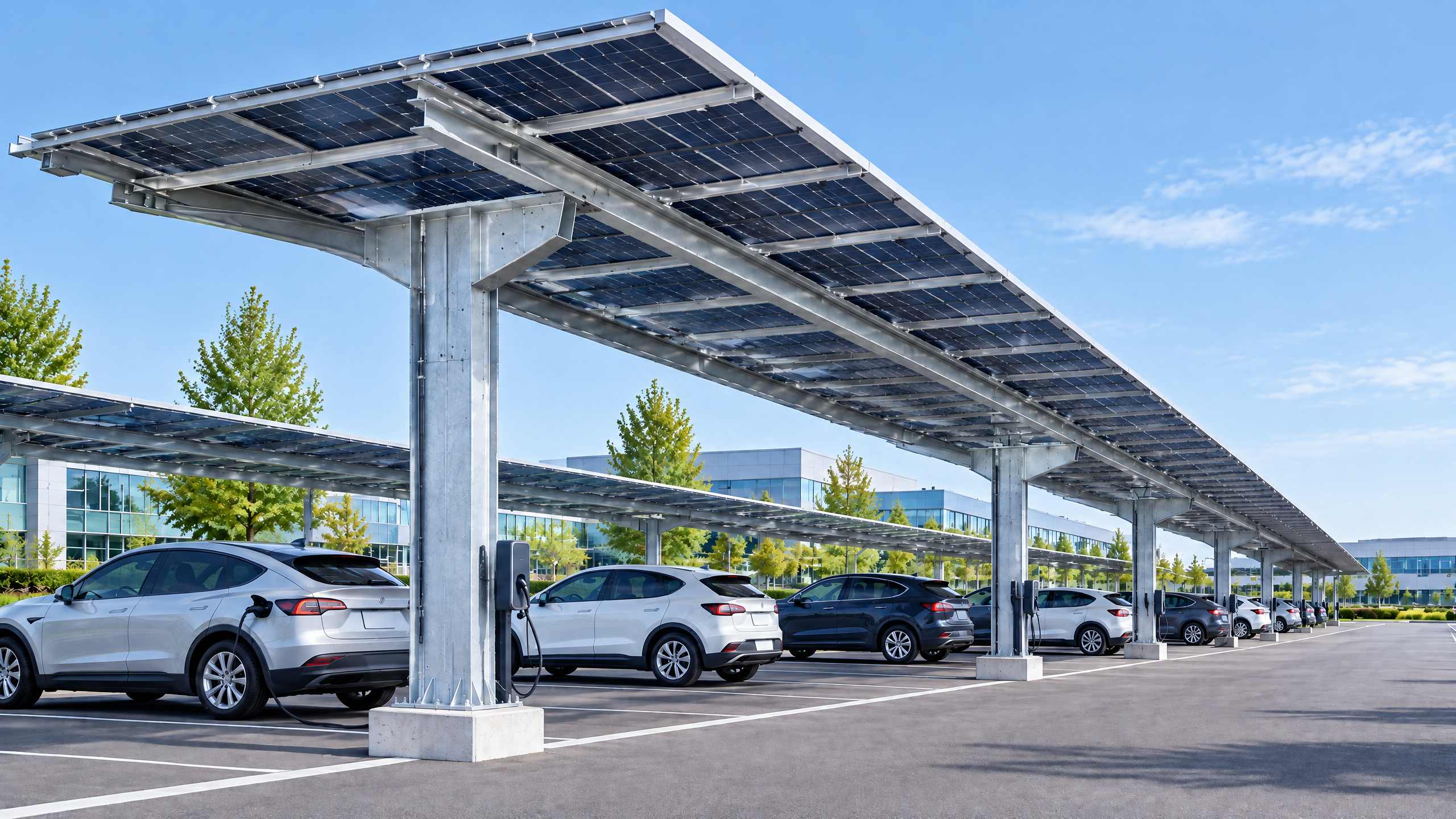
Direct answer (120–180 words)
B2B buyers must confirm that solar carport modules load coordination is defined and documented across structural, electrical and maintenance domains before contract award. Specifically, verify the structural load path from modules to carport columns (dead, live, wind, snow, seismic), module clamping and rail attachment details, roof-to-frame interface, and any grouping or string layouts that change panel loads. Confirm access lanes and safe working areas for solar carport modules maintenance access and planned module replacement procedures (spare modules, lift points, module replacement planning). For the electrical scope, confirm solar carport inverter location planning, equipment pad requirements (solar carport inverter equipment pad), maintenance clearances (solar carport inverter maintenance access) and cable routing routes (solar carport inverter cable routing). Require site-specific drawings, load schedules, responsibility matrix and installer sign-off. Local qualified professionals, authorities, utilities and installers make final site-specific decisions; this guide does not substitute for engineering, permitting, or code compliance.
Why load coordination matters for commercial carports
Load coordination governs how mechanical and electrical loads interact with a carport structure throughout design, construction and operations. Without explicit coordination, common risks arise: incompatible attachment methods, obstructed access for inverter or module service, underestimated cable lengths, or mismatches between the structural carrier and the PV array layout. For a commercial or fleet deployment the coordination task is primarily about defining where responsibility shifts—from architectural carport supplier to structural engineer, to electrical contractor, to the EPC—and documenting those handoffs.
This guide focuses on the coordination inputs buyers should confirm in procurement packages, not on issuing design capacity or permit approvals. Final, site-specific decisions must be made by licensed engineers, permitting authorities and the installing contractor.
Key confirmations to request from suppliers and bidders
- Structural attachments and load path documentation for the PV rails and modules (attachment types, fastener schedules, penetration details).
- Module layout plans with module counts per span and expected concentrated loads.
- Clear access and fall-protection strategies to enable solar carport modules maintenance access.
- Module replacement planning including spare module inventory, replacement procedures, and hoisting/lifting points.
- Inverter siting studies, including solar carport inverter location planning, access and ventilation.
- Specifications for a solar carport inverter equipment pad (dimensions, base type, embedment, anchor locations).
- Defined solar carport inverter maintenance access clearances and lockable access provisions.
- Solar carport inverter cable routing plans with raceway, tray and termination points.
- Responsibility matrix assigning permit, testing and commissioning tasks.
- As-built and O&M deliverables expected at handover.
Structural checks buyers should insist on
- Request stamped structural connection drawings that show how the PV rails and module clamps are integrated with the architectural aluminium carport. If the carport is supplied separately from the PV mount system, documentation must show the interface.
- Confirm rail-to-column load transfer, including fastener sizes, spacing and torque requirements. Ask for a connection schedule aligned with local codes.
- Verify clear span and tributary area assumptions used by bidders; these assumptions drive module layout and concentrated load locations.
- Specify module replacement planning details that avoid requiring temporary load redistribution or on-site structural modifications during maintenance.
Decision table — Structural responsibilities
| Confirmation item | Typical supplier responsibility | Typical buyer/EPC verification |
|---|---|---|
| Rail-to-carport connection detail | Carport supplier or racking vendor | Structural engineer verifies loads, signs connection drawings |
| Fastener schedule and torque | Racking vendor | Installer verifies torque & records inspections |
| Module clamp type and spacing | PV module/railing supplier | EPC verifies compatibility with module frame |
| Temporary works for module replacement | Installer | Owner verifies O&M plan and spare module storage |
Electrical and inverter coordination essentials
Electrical layout has equal influence on overall schedule and cost. Confirm solar carport inverter location planning early: inverters must be located to respect string lengths, ventilation, security and utility access for inspection. Confirm the required solar carport inverter equipment pad dimensions and ground preparation (concrete strength, anchorage, drainage) and ensure the civil scope is aligned.
solar carport inverter maintenance access is a frequent omission: specify minimum clearances on all sides for lift-out, routine service and safe-working envelopes. For cable routing, require a route map that shows raceways, routing across carport beams, penetration points and conduit sizes — solar carport inverter cable routing must account for voltage drop, bending radii and separation from power lines or vehicle pathways.
Decision table — Inverter siting tradeoffs
| Consideration | Locate under canopy center | Locate at perimeter near distribution | Notes |
|---|---|---|---|
| String length & voltage drop | Longer DC runs possible | Shorter DC runs | Check DC string sizing and combiner placement |
| Cooling & ventilation | Potential heat build-up | Better natural ventilation | May require forced ventilation in either case |
| Security & access | Secure but harder to access | Easier utility access | Ensure solar carport inverter maintenance access |
| Civil work / equipment pad | May require raised pad within parking bay | Pad outside vehicle flow | Define solar carport inverter equipment pad early |
Maintenance, replacement and lifecycle considerations
- solar carport modules maintenance access: specify clear, marked service aisles and access points that allow safe module handling, removal and hoisting. Confirm fall-protection tie-in points and whether maintenance can be performed from the ground or requires elevated access equipment.
- solar carport modules replacement planning: require a spare parts plan that enumerates spare modules, connectors and fuse/tracking devices. Define expected replacement durations and whether temporary generation curtailment is required.
- O&M deliverables should include as-built schematics, module serial number logs, inverter settings, torque records, and a documented replacement procedure for worst-case scenarios.
Include maintenance responsibilities in procurement contracts to avoid ambiguity—for instance, who schedules annual inspections, who supplies spare modules and who performs module-level warranty claims.
Site logistics, delivery and installation sequencing
- Early confirm crane or lift requirements for module placement and inverter installation, and ensure traffic management plans for customer facilities or fleet operations.
- Coordinate delivery window constraints with the carport erection schedule. Solar modules and inverters are sensitive to handling; ensure storage and staging areas are specified.
- Confirm that solar carport inverter cable routing plans are aligned with core drills, bond and grounding locations and with vehicle clearance envelopes.
- Request a site logistics plan from bidders showing laydown areas, lifting points, temporary protections and access routes that maintain business continuity for parking operations.
Procurement documentation checklist (decision table)
| Document | Purpose | Acceptable status at bid | Action before award |
|---|---|---|---|
| Structural interface drawing (stamped) | Verifies attachments and load path | Provided as draft | Require final stamped prior to manufacturing |
| Inverter siting drawing | Confirms pad, ventilation, access | Provided as concept | Finalize with utility/installer input |
| Cable routing diagram | Defines conduit paths and terminations | Provided at schematic level | Require final routing with cable schedules |
| Maintenance & replacement plan | Ensures future serviceability | High-level plan | Require SOPs, spare lists and access verifications |
| Responsibility matrix | Avoids scope gaps | Draft assignment | Finalize contractual responsibility and penalties |
Five-step buyer workflow (named)
"Confirm — Coordinate — Contract — Construct — Commission" workflow
- Confirm: Compile an initial requirements packet that lists structural constraints, module counts, desired inverter locations, maintenance access requirements and site logistics constraints.
- Coordinate: Hold a multidisciplinary coordination meeting (architect, carport supplier, structural engineer, electrical contractor, utility liaison) to reconcile interface drawings and draft the responsibility matrix.
- Contract: Include the resolved drawings, inspection and maintenance requirements, spare parts, and acceptance tests into procurement contracts. Require deliverables (as-built drawings, torque logs).
- Construct: Sequence carport erection with PV mounting, electrical infrastructure, inverter pad construction and cable routing as per the approved plan. Maintain daily log for handover.
- Commission: Complete testing, sign-offs and handover of O&M documentation. Verify solar carport inverter maintenance access and that module replacement planning is executable on site.
If you want assistance aligning these steps to a project, submit your project brief through our inquiry path: /inquiry.
Mid-article call to action
Ready to align technical responsibilities and drawings for your next commercial carport project? Share your project brief and constraints via /inquiry or email project details to info@carportiva.com. We can coordinate with your team to review compatibility with Carportiva architectural aluminium carports and commercial solar carports and check integration with SolarGrid commercial solar system.
Contract clauses and acceptance tests to include
- Acceptance tests for torque verification of rail and clamp fasteners.
- Verification of solar carport inverter cable routing continuity, labeling, and conduit fill inspection.
- Proof of clearances for solar carport inverter maintenance access and documentation of mechanical guards or barriers protecting inverters from vehicles.
- A module replacement drill: contractor performs a supervised module removal and replacement during punch-list review to validate replacement planning.
- As-built deliverables: final stamped drawings, single-line electrical diagrams, module serial logs and O&M manuals.
Common pitfalls and how to avoid them
- Late inverter location changes: avoid by confirming solar carport inverter location planning during the bid phase and including inverter pad requirements in civil scopes.
- Undefined maintenance zones: avoid by specifying solar carport modules maintenance access and marking access aisles on drawings.
- Cable routing conflicts with structural members or lighting: avoid by requiring a consolidated routing diagram early and coordination between electrical and structural trades.
- No spare module strategy: avoid by requiring a solar carport modules replacement planning clause with minimum spare inventory and storage conditions.
Scope boundaries and final decision authority
This guide outlines the confirmations buyers should secure for procurement and coordination. It does not provide structural capacity determinations, permit approvals, code compliance certification, lead time guarantees, pricing, energy yield estimates, or warranty commitments. Local qualified professionals, structural and electrical engineers, permitting authorities, utility providers and licensed installers must make final, site-specific decisions and sign the relevant drawings and permits.
Links to systems and sourcing resources
- See Carportiva SolarGrid commercial solar system for panel and inverter compatibility options.
- Explore our all systems to review modular options across carport and shelter types.
- Browse other procurement checklists and technical notes in our sourcing guides.
Frequently asked questions
Q: Who must approve the structural attachments for a solar carport? A: The site’s licensed structural engineer must review and stamp the connection drawings; the installer should validate torque and installation per the stamped plans.
Q: When should inverter location be finalized? A: Finalize solar carport inverter location planning before fabrication of the carport or racking to avoid costly rework of cable routing, ductbanks or pads.
Q: How do I ensure future module replacements are feasible? A: Require solar carport modules maintenance access and solar carport modules replacement planning in contracts, mandate a spare parts inventory and test a replacement during commissioning.
Q: What’s included in the cable routing verification? A: Confirm conduit sizes, raceway paths, penetration details, separation from lighting circuits, bending radii, and labeled termination points as part of solar carport inverter cable routing.
Q: Can Carportiva confirm the system will meet local code? A: Carportiva supplies carports and integration solutions; local code compliance and permit approvals require review and certification by local authorities and the project’s licensed engineers.
Conclusion
For commercial, distributor or fleet buyers, explicit and early confirmation of solar carport modules load coordination reduces risk, cost and schedule disruption. Require documented interface drawings, inverter siting and pad requirements, cable routing plans, and serviceability provisions in procurement packages. Use a structured buyer workflow—Confirm, Coordinate, Contract, Construct, Commission—and ensure the final decisions and stamped drawings come from licensed professionals. For project alignment or to start a bid package review, submit project details via /inquiry or email info@carportiva.com.
References
- National Renewable Energy Laboratory — PV resources: https://www.nrel.gov/solar/
- PVWatts Calculator: https://pvwatts.nrel.gov/
- U.S. Department of Energy Alternative Fuels Data Center: https://afdc.energy.gov/
- Federal Energy Regulatory Commission — interconnection resources: https://www.ferc.gov/electric-transmission/generator-interconnection
Keep the project brief connected.
Bring the actual project brief to the engineering table.
Share your location, layout, target application and available technical inputs. Carportiva can help identify the relevant product-interface information before a project-specific commercial discussion.
Request a project discussion