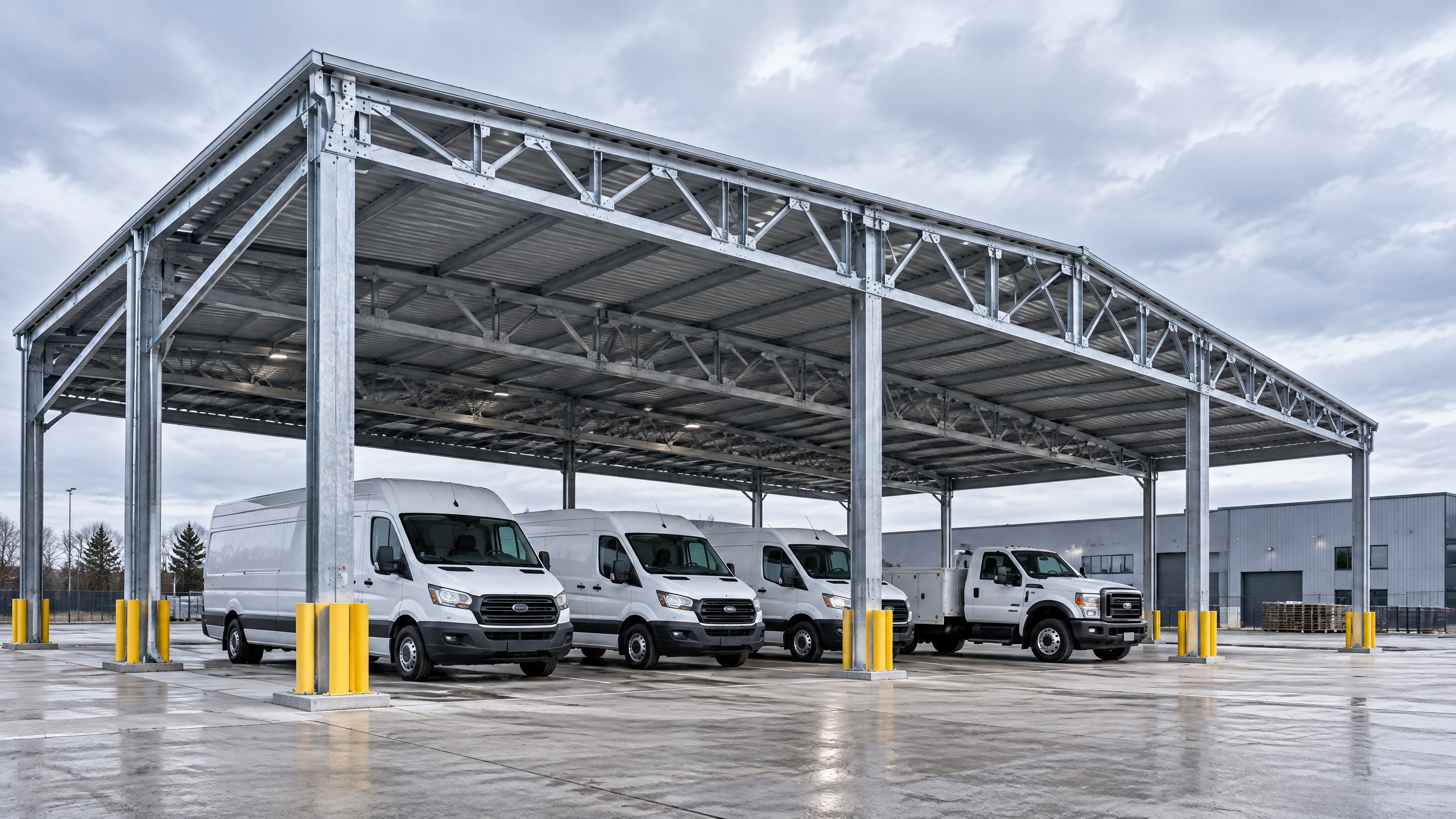
Answer — short (120–180 words) A university parking canopy manufacturer matters whenever project outcomes hinge on repeatable technical performance, integrated systems delivery, regulatory compliance and long-term operational fit. For campus projects these factors typically include complex stakeholder alignment, stringent accessibility and emergency access requirements, solar or utility interfaces, design life and maintainability, and coordinated phasing to avoid disruption. Selecting the right manufacturer reduces risk on structural canopy specification, installation readiness and warranty administration, while a poor match increases rework, permitting friction and lifecycle cost. Use manufacturer selection as a control point where design intent, evidence (drawings, calculations, factory quality records), supply-chain transparency and local installation capability converge. For commercial and industrial applications on campus—fleet shelters, visitor parking, or solar carports—the manufacturer is often the single most influential partner in turning procurement documents into an installed, serviceable asset.
Buyer context and scope boundary: when the manufacturer is the decision hinge
University projects bring distinct procurement drivers compared with generic commercial carports. The buyer group typically includes facilities management, campus planners, architects, sustainability teams, fleet operators and, in many cases, research compliance or heritage offices. This expanded stakeholder set raises the probability that the chosen supplier will need to supply more than the structure alone: detailed structural canopy specification; integration with campus electrical and metering systems; staged project phasing plan to keep campus functions running; and documented installation readiness to work around university semesters and events.
Situations where the university parking canopy manufacturer is critical:
- Custom architectural canopies aligning with campus heritage or streetscape design.
- Solar carports where module mounting, inverter and metering coordination affect performance.
- Industrial fleet shelters requiring higher vehicle clearances and heavy-duty load ratings.
- Sites with complex geotechnical or flood constraints that affect foundations.
When the canopy is a simple off-the-shelf covering for an off-site parking lot with minimal interfaces, the manufacturer choice is lower-risk. But in campus scenarios where safety, accessibility and operational continuity are priorities, manufacturer capability becomes central to project success.
Core decision principle: align manufacturer capability with project risk profile
The primary principle for any B2B buyer is to match manufacturer capability to the project's "risk surface": the combination of technical complexity, stakeholder interfaces, regulatory exposure and operational criticality. The university parking canopy manufacturer matters more as any of those dimensions increase.
Key dimensions to evaluate:
- Technical complexity (custom geometry, loads, solar integration).
- Regulatory complexity (accessible parking, utilities, local authorities).
- Operational criticality (fleet operations, emergency access, campus events).
- Delivery constraints (phased occupancy, semester schedules, tight lead times).
If two of these are high, the manufacturer must be able to demonstrate an established process for design coordination, documented engineering, and proven installation coordination. If none are material, suppliers that compete primarily on price and lead time may be acceptable.
Planning inputs: what you must define before engaging manufacturers
Before you solicit detailed proposals, create a documented project basis that captures all parameters the manufacturer will rely on. Without this, responses will be inconsistent and scope risk rises.
Essential planning inputs:
- Scope of works: number of bays, canopy type (architectural, solar, fleet), extent of landscaping or utilities to be moved.
- Site survey deliverables: topography, as-built services, tree protection zones, restricted access points, and existing foundation locations.
- Program constraints: required in-service date, phased delivery windows (aligned with semester dates), and blackout periods.
- Performance requirements: design life, maintenance access, expected wind/snow/seismic criteria, corrosion environment (coastal chloride, industrial atmosphere).
- Regulatory constraints: accessible parking layouts (consult guidance) [1], local building code interpretations, and any nature-conservation or heritage overlays.
- Interface definitions: electrical connection point(s), metering scope for solar, drainage changes, and traffic management plans.
Add “vehicle clearance planning” as a specific input: confirm the largest vehicle type (including service and emergency vehicles), any roof-mounted equipment (e.g., HVAC or cargo), and fleet characteristics. For large-vehicle or logistics uses, consider Titan industrial and logistics system as a purpose-designed solution within Carportiva’s product range.
Make sure the documented project basis explicitly states that site-specific structural capacity, foundations, permits, electrical design, approvals, lead time, price, energy yield and warranty require validation by relevant local qualified professionals, installers, utilities and authorities.
Technical specification and interfaces: what to require from the manufacturer
A focused set of technical deliverables reduces ambiguity and sets evaluation criteria that are verifiable.
Must-have technical deliverables:
- Structural canopy specification: stamped drawings and calculations for the local code jurisdiction, with load cases, material grades, connection details and corrosion protection strategy. Specify design standards and environmental inputs to be used.
- Foundation design basis: where the manufacturer supplies foundation designs, require soil-report-based calculations or clear allocation of responsibility between geotech and supplier.
- Electrical and solar interfaces: mechanical mounting details for modules, cable routing, inverter placement, metering, and grid interconnection responsibilities.
- Health and safety plan: construction-phase method statements and compliance with local construction safety standards (for example OSHA construction regulations where applicable) [3].
- Accessibility and vehicle access: dimensions, accessible bay counts and signage consistent with applicable guidance [1].
- Maintenance and access: roof access, guttering, drainage points and specification for permitted maintenance loads.
- Environmental resilience: flood-elevation considerations, particularly where FEMA flood maps indicate risk [2], and UV/corrosion performance for extruded aluminium finishes.
Interface protocols
- Single point of contact and BIM or drawing exchange standards (file formats, revision control).
- Clash-detection protocol for electrical and structural works.
- Site hoisting and crane exclusion zones, and a plan for operational access coordination for campus services during works.
Include a clear statement in contracts about manufacturer responsibilities versus buyer-delivered items (e.g., who supplies PV modules, who handles grid applications). This avoids later disputes.
Procurement and factory evidence: what to ask for and how to evaluate it
The procurement phase is where manufacturer capability is evidenced. Request specific, verifiable items and assess them against acceptance criteria.
Procurement evidence checklist (decision table)
| Required document | Why it matters | Acceptable evidence |
|---|---|---|
| Stamped structural drawings and calculations | Demonstrates code compliance and load design for local conditions | Engineer’s stamp from local-licensed engineer or local-council-accepted engineer |
| Material certificates | Confirms materials meet corrosion/strength specifications | Mill test certificates for aluminium alloys, fastener specs |
| Factory QA records | Quality control for extrusion, welding, surface finish | ISO 9001 records, factory inspection reports, measurement data |
| Installation readiness plan | Shows readiness for site execution and minimises surprises | Resource plan, tooling list, site logistics plan |
| Factory acceptance test (FAT) details | For mechanical assemblies or integrated systems (e.g., rotating canopies) | FAT procedure and witness protocol |
| Solar integration package | Needed if PV is integrated; affects warranty and energy yield | Mounting details, clamp loads, electrical layout |
| Warranties and exclusions | Clarifies long-term liabilities | Written warranty documents and exclusions list |
| References and case studies | Demonstrates relevant experience | Contactable references (projects of similar scope, not necessarily same type) |
Procurement considerations
- Require manufacturer to submit a scope matrix that maps each deliverable to responsible party (manufacturer, contractor, or client).
- Clarify sub-supplier approval process for third-party items like modules, inverters, fasteners, and coatings.
- Ensure language around lead time, change order governance and liquidated damages (if applicable) is explicit.
- For solar carports, request an energy-yield study from a qualified third party or the EPC, noting that energy yield depends on site shading, orientation and local irradiance — these require a documented project basis and local data.
Factory inspection and audit
- Schedule factory inspections focusing on welding quality (if applicable), anodising/coating control, extrusion straightness and assembly jigs.
- If possible, include a witness FAT for pre-assembled items or integrated electrical assemblies.
Mid-article CTA If you need detailed scope templates or an evidence checklist tailored to campus conditions, contact us via /inquiry for procurement support.
Site installation and operations: what distinguishes capable manufacturers
On-campus installation presents logistics and stakeholder challenges beyond technical delivery. The manufacturer’s role in installation readiness is a major differentiator.
Installation readiness factors to evaluate:
- Site logistics planning: campus deliveries often must fit within narrow windows; the manufacturer should provide lift plans, delivery schedules and a minimised on-site storage plan.
- Traffic and pedestrian management: coordination with campus security and transportation offices to maintain safe pedestrian paths.
- Installation crew capability: manufacturer-employed crews versus local certified installers; confirm training, certification and supervisory arrangements.
- Plant and lifting equipment: who supplies cranes, rigging and certified lift plans? Large canopies or pre-assembled modules may need heavy lifts that are restricted on campus.
- On-site QC and sign-off: establish point-by-point acceptance criteria at handover, including installation tolerances, finish inspections and electrical commissioning.
- Spare parts and lifecycle support: list of recommended spare parts, lead times and service contracts.
Operational access coordination is commonly misunderstood. Define in procurement who will manage ongoing access for routine maintenance and emergency repairs. On-campus access may require background checks, badge issuance and limited-hour work windows; the manufacturer must be experienced in those processes or partner locally.
Note on permits and approvals Local permits for foundations, connections and electrical work are typically the buyer’s responsibility to secure, but many manufacturers will prepare permit-ready documentation. Confirm who submits drawings, obtains permits, and addresses authority queries.
Implementation risk: common failure modes and mitigation measures
Understanding failure modes allows the buyer to design procurement to reduce risk.
Common failure modes and mitigations:
- Incomplete site data leading to foundation rework: mitigate by making a site-validation survey a contractual precondition and include provisional allowances for unknowns.
- Mismatched interfaces (electrical or structural): require interface drawings and conduct a pre-installation interface review workshop.
- Delayed approvals or permits: build regulatory milestone dates into the project phasing plan and allocate resource for permit chasing.
- Poor factory QA causing field rework: include factory acceptance tests and reserve the right to hold final payment pending site acceptance.
- Unclear warranty boundaries for integrated systems (e.g., PV modules): clarify who warrants what and consolidate single-point responsibility where possible.
- Access conflicts with campus events: create an agreed blackout calendar and enforce penalties for missing scheduled windows.
Procurement strategy to reduce risk
- Use performance-based specifications rather than prescriptive-only specs where possible; specify required outcomes (e.g., durability, finish retention, energy yield) and allow manufacturers to propose how to achieve them.
- For high-risk items, require manufacturer-provided installation supervision and a local warranty beneficiary.
- Prefer manufacturers with local installer networks or who can demonstrate an established process for working with third-party installers.
Regulatory and safety compliance
- Require compliance plans for local construction safety regimes (e.g., OSHA in the US) [3].
- For sites in flood-prone areas, require flood-elevation-aware foundation and electrical designs referencing FEMA maps for base flood elevations [2].
- For accessible parking layout and signage ensure designs reference authoritative guidance on parking dimensions and signage requirements [1].
Decision tables: when to prioritise manufacturer capability and what to require
Decision table 1 — When does the university parking canopy manufacturer matter?
| Project characteristic | Manufacturer matters (Yes/No) | Why |
|---|---|---|
| Custom architectural finish matching campus heritage | Yes | Manufacturer must demonstrate finish control, mock-ups, and tolerance management |
| Standard prefabricated canopies for remote lot with no interfaces | No (lower priority) | Low technical interface and fewer approvals reduce manufacturer centrality |
| Solar carports with grid export and metering | Yes | Requires electrical coordination, mounting design and warranty clarity |
| Fleet vehicle shelters requiring >3.5 m clearance | Yes | Structural canopy specification and vehicle clearance planning are essential |
| Projects with strict semester phasing and blackout dates | Yes | Installation readiness and operational access coordination are necessary |
| Small, temporary shade structures with short design life | No | Simpler procurement and local installers may be sufficient |
Decision table 2 — Procurement evidence and acceptance criteria
| Evidence item | Minimum acceptable demonstration | Contractual action |
|---|---|---|
| Stamped structural calculations | Local engineer stamp or third-party review | Precondition to manufacturing release |
| Material certificates for aluminium and fasteners | Mill/test certificates matching spec | Withhold final payment until provided |
| Factory QA plan | Documented processes, inspection checkpoints | Right to audit and witness |
| Installation readiness plan | Lift plans, traffic management, crew list | Must be approved before mobilization |
| FAT procedure for integrated assemblies | Clear test scripts and witness options | Must be completed prior to shipping |
| Warranty wording | Written warranty with exclusions | Attach to contract and require transferability if applicable |
Named six-step buyer workflow: a practical procurement roadmap
This workflow is designed for campus buyers who want to reduce surprises and align manufacturer capability with stakeholder needs.
Step 1 — Define documented project basis
- Produce a single “project basis” document containing scope, site surveys, program constraints, vehicle clearance planning, and interface responsibilities. Include a risk register.
Step 2 — Pre-qualification (PQQ) and capability screening
- Use written PQQs to confirm manufacturers’ experience in similar campus environments. Request evidence on factory QA, local installation networks, and references.
Step 3 — Issue design intent and request for proposal (RFP)
- Provide design intent drawings and require manufacturers to submit a structural canopy specification, installation readiness plan and a project phasing plan aligned with campus calendars.
Step 4 — Technical evaluation and verification
- Evaluate proposals against objective criteria: code compliance evidence, delivery model, warranty coverage, sub-supplier control and lead times. Conduct technical clarifications and require third-party review where necessary.
Step 5 — Contract award with milestones and acceptance tests
- Award on a contract that includes clear milestones for permits, manufacturing release, factory acceptance testing, delivery, site acceptance and warranty handover. Define payment schedule tied to these milestones.
Step 6 — Supervised installation and handover
- Enforce installation readiness checks before mobilization, supervise commissioning (including electrical commissioning for solar), and complete a formal handover with a punch-list and agreed maintenance plan.
This workflow emphasises the manufacturer's role at each stage, making the allocation of responsibilities transparent and auditable.
Related B2B sourcing terms
For the same project brief, buyers may also encounter these connected search terms: commercial parking layout. They must be interpreted against the actual project scope rather than treated as independent technical guarantees.
Frequently asked questions (FAQ)
Q: How does accessible parking regulation affect canopy design on campus? A: Accessible parking requirements influence the number, location and dimensions of bays as well as pathway connections to campus buildings. Designs should refer to authoritative guidance early and incorporate accessible routes and signage into the canopy layout [1]. Manufacturers should be asked to accommodate required dimensions and mounting locations for signage and lighting.
Q: Is a local manufacturer always better than an international supplier? A: Not necessarily. Local manufacturers may offer faster support and easier permitting assistance, but international suppliers can bring specialised products or economies of scale. Evaluate on capability, installation readiness, warranty support and the ability to meet the documented project basis.
Q: Who is responsible for foundations and soil issues? A: Responsibility should be clarified in the procurement documents. Often, the buyer provides geotechnical data and the manufacturer or structural engineer provides foundation designs tied to that data. Site-specific structural capacity and foundations require validation by local qualified geotechnical and structural professionals.
Q: How should I manage solar module supply and warranties? A: Decide if the canopy manufacturer will supply PV modules or if a separate EPC will. Where modules are included, ensure that mounting details, electrical interconnection and long-term warranties are coordinated and that single-point responsibility for combined system performance is clearly assigned.
Q: What lead-time should be expected? A: Lead time varies with complexity, manufacturing capacity, and season. Always request a production schedule in proposals and build regulatory and permitting durations into the program. Lead time specifics require a documented project basis and cannot be assumed without a formal offer.
Q: Are there safety standards applicable to installation? A: Yes. Construction-phase safety must comply with local requirements; in the United States, OSHA construction standards would apply [3]. Manufacturers should provide method statements and permit-specific safety plans.
Q: How do flood zones affect design? A: In flood-prone areas, foundations, electrical equipment and elevation of critical components must align with local flood management guidance and FEMA maps where applicable [2]. Ask manufacturers for designs that consider these site-specific risks.
Q: What should be included in the handover? A: As-built drawings, operation and maintenance manuals, warranty documents, spare parts lists and contact details for after-sales support. Also include test certificates (e.g., electrical commissioning) and a completed punch list.
Implementation checklist: evidence-led items to collect at each stage
- Project basis document (buyer).
- PQQ responses and shortlisted manufacturer dossiers.
- Stamped structural drawings and calculations (manufacturer).
- Material and coating certificates (manufacturer).
- Factory QA records and FAT reports (manufacturer).
- Installation readiness plan and crane/lift plans (manufacturer).
- Interface sign-offs: electrical, traffic, and campus security (buyer + manufacturer).
- Permits and approvals (buyer; manufacturer to provide permit-ready docs).
- Site acceptance certificate with punch-list and commissioning records (buyer + manufacturer).
Remember: site-specific structural capacity, foundations, permits, electrical design, approvals, lead time, price, energy yield and warranty require a documented project basis and relevant local qualified professionals, installers, utilities and authorities.
Conclusion — making manufacturer selection a procurement control point
For university projects—where complex interfaces, multiple stakeholders and campus operational constraints combine—the university parking canopy manufacturer is more than a supplier: they are a delivery partner. Prioritise manufacturers who can demonstrate formal engineering evidence (stamped calculations), robust factory QA, detailed installation readiness, and a willingness to work within the university’s program and permit constraints. Use the six-step workflow to structure procurement and avoid common failure modes. Where solar, fleet operations or architectural integration are in scope, raise manufacturer capability to a primary selection criterion.
Carportiva offers architectural aluminium carports, commercial solar carports and industrial/fleet vehicle shelters suitable for campus applications. Explore Titan industrial and logistics system, see our all systems and consult our sourcing guides to align manufacturer selection to campus procurement needs.
For procurement support, scope templates or supplier capability assessments, contact us at info@carportiva.com.
References
- U.S. Access Board parking guidance: https://www.access-board.gov/ada/guides/chapter-5-parking/
- FEMA flood maps: https://www.fema.gov/flood-maps
- OSHA construction standards: https://www.osha.gov/laws-regs/regulations/standardnumber/1926
- Federal Highway Administration: https://highways.dot.gov/
Keep the project brief connected.
Bring the actual project brief to the engineering table.
Share your location, layout, target application and available technical inputs. Carportiva can help identify the relevant product-interface information before a project-specific commercial discussion.
Request a project discussion