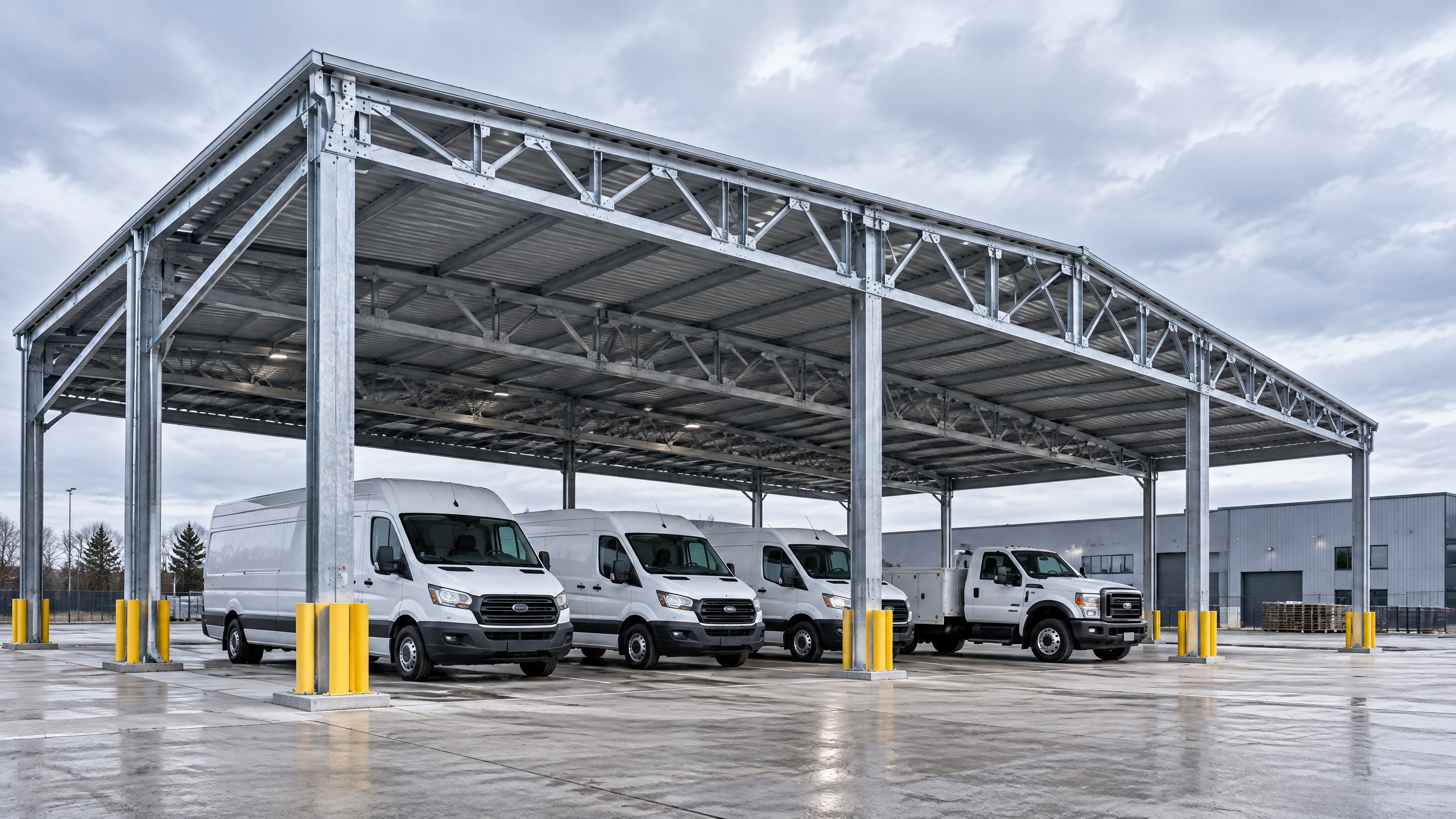
Deciding whether the choice of public transport shelter canopy manufacturer materially affects a commercial or industrial carport procurement is not abstract — it is a function of project complexity, site constraints, and long-term operational objectives. In straightforward, repeatable commodity installs a generic supplier may suffice; in any scenario involving customized structural canopy specification, integrated solar arrays, complex vehicle movement (commercial parking layout or vehicle clearance planning), coordination with operational access, constrained foundations, or phased roll‑outs, manufacturer selection is a primary project risk driver. This guide explains when the manufacturer choice becomes determinative, what evidence and contractual deliverables to require, and how to structure procurement and implementation to protect schedule, safety and long‑term value.
Note: site‑specific structural capacity, foundations, permits, electrical design, approvals, lead time, price, energy yield and warranty require a documented project basis and qualified local professionals, installers, utilities and authorities.
Buyer context and scope boundary: who should read this and when the manufacturer is central
Audience
- Distributors and resellers specifying product families.
- Architects and design consultants integrating canopies into site plans.
- Contractors and general builders managing civil and electrical trades.
- Developers and asset owners procuring parking and fleet shelters.
- Solar EPCs and fleet operators integrating PV or other systems.
Scope boundary
- This guide focuses on structural and systems interactions where the public transport shelter canopy manufacturer is a key variable. It does not replace local regulations, nor substitute for geotechnical, structural or electrical design by licensed professionals.
- It addresses commercial and industrial applications such as fleet depots, retail and office parking, last‑mile logistics yards and transport interchanges. It does not extend to decorative pedestrian shelters where loads and interfaces are minimal.
When the manufacturer matters
- The manufacturer matters when the canopy is a primary structural/operational element: long‑span canopies, integrated PV arrays, bespoke spans over heavy vehicle lanes, or where foundations and interfaces must be engineered precisely to the canopy system.
- It is less decisive for short‑span, off‑the‑shelf shelters with standard anchors and simple site conditions.
Key phrase: public transport shelter canopy manufacturer — your procurement should treat this supplier as a systems partner when the project requires technical customization, certified component traceability, or integrated electrical works.
Core decision principle: assessing manufacturer as commodity vs strategic partner
Decision principle statement
- Treat the manufacturer as strategic when the project outcome depends on system engineering beyond catalogue item supply. Treat them as a commodity supplier when the product is standard, repeatable, and geographically simple to install without specialist interfaces.
Decision factors (will the manufacturer selection materially alter outcomes?)
- Complexity of canopy geometry and structural canopy specification.
- Integration with energy systems (PV), drainage, lighting, or security.
- Site constraints (underground services, limited crane access, phased handover).
- Required warranties, maintenance regimes and spare‑parts availability.
- Regulatory and client compliance obligations (e.g., accessibility, wind, snow loads, flood risk).
- Supply chain transparency and factory quality management.
Decision table: When to consider manufacturer strategic vs commodity
| Factor | Manufacturer as Commodity | Manufacturer as Strategic |
|---|---|---|
| Standardised small spans, repetitive units | ✓ | |
| Custom long spans or cantilevers | ✓ | |
| Simple anchor/foundation conditions | ✓ | |
| Complex foundation or embedment requirements | ✓ | |
| Off‑the‑shelf finish and no electrical works | ✓ | |
| Integrated PV, lighting, BMS, or EV readiness | ✓ | |
| Short lead time and local stock available | ✓ | |
| Phased delivery, factory acceptance testing needed | ✓ |
Interpretation: use the table to triage whether to engage manufacturers early for engineering input or to treat them as a late-stage supplier.
Planning inputs: what you must know before you shortlist manufacturers
Every rational procurement begins with defined inputs. Incomplete inputs shift risk to price and schedule.
Essential planning inputs
- Site survey and measured drawings (topography, obstacles, existing services).
- Geotechnical report (bearing capacity and recommended foundation types).
- Local wind, snow and seismic data for structural design loads.
- Vehicle and pedestrian movement studies that inform commercial parking layout and vehicle clearance planning.
- Utilities and electrical distribution points for PV or lighting integration.
- Flood risk mapping and drainage strategy (use FEMA maps where applicable) [2].
- Accessibility and disabled parking requirements for layout and shelter placement (see guidance) [1].
- Operational phasing and handover constraints and a project phasing plan that aligns with site operations.
- Permitting pathway and timeframe with local authorities.
Inputs mapped to procurement consequences
- Geotech → foundation specification and price variation.
- Wind/snow data → structural canopy specification and manufacturer engineering review.
- Vehicle clearance planning → canopy height, column placement and protective bollards.
- Operational access coordination → delivery windows, crane zones, temporary closures.
Checklist table: Minimum data to provide to manufacturers during RFP
| Data item | Why it matters | Who typically provides |
|---|---|---|
| Survey & as‑built drawings | Aligns fabrication to site geometry | Surveyor / Client |
| Geotechnical report | Foundation type and depth | Geotech engineer |
| Load criteria (wind, snow, seismic) | Structural design inputs | Structural engineer / Manufacturer |
| Vehicle movement plan | Column location and vehicle clearance planning | Traffic engineer / Client |
| Electrical point loads & metering | PV/electrical integration | Electrical engineer / EPC |
| Project phasing plan | Delivery and installation sequencing | Project manager |
| Permitting list & timelines | Procurement schedule and approvals | Client / Planning consultant |
Provide these documents to shortlisted manufacturers early. Absent these, manufacturers’ proposals will carry qualification language and contingency pricing.
Technical specification and interfaces: what to require and verify
The technical scope should be structured so that manufacturer responsibilities are explicit and measurable.
Core technical elements to specify
- Structural canopy specification: design live and dead loads, wind and snow load factors, connection details, serviceability limits (deflection), corrosion class for materials (e.g., marine or industrial environments).
- Foundation interface: anchor type, grout specification, tolerances for column plumb, and expected plate/anchor embedment.
- Electrical interfaces: PV mounting points, cable routing zones, inverter/control panel locations, earthing continuity and lightning protection pathways.
- Drainage and roof water management: guttering, downpipes, and interfaces to storm sewer or on‑site attenuation.
- Finish and durability: powder coating classes, anodising for aluminium, galvanising for steel, sacrificial zinc for fasteners.
- Access for maintenance: safe access points for PV cleaning, light replacement and structural inspection.
- Security interfaces: CCTV mounts, conduit runs, mounting points for signage or ticketing equipment.
Interface responsibilities matrix
- Who supplies what must be explicit. For example, is the manufacturer responsible for anchors and bolting, or is the main contractor supplying sleeves, grout and rebar? Is electrical testing included in their scope or the EPC’s?
Performance verification and acceptance
- Require factory drawings and structural calculations stamped by a qualified engineer.
- Define factory acceptance tests (FAT) for assemblies where appropriate.
- Define site acceptance tests (SAT) and commissioning protocols.
- Require delivery documentation: mill certificates for primary materials, weld procedure specifications and weld records where applicable.
Safety and compliance
- Incorporate applicable construction safety standards into the contract and ensure the manufacturer’s installation procedures align with local regulations (OSHA standards are a useful reference for site safety in the U.S.) [3].
Exact phrase inclusions: include "structural canopy specification", "installation readiness", and "operational access coordination" within these interfaces and responsibilities.
Procurement evidence and factory capabilities: what to ask for and how to evaluate
Procurement for systems requires evidentiary evaluation beyond price.
Manufacturer capability checklist
- Engineering capacity: in‑house structural engineers, CAD/CAM and FEA capabilities for bespoke canopies.
- Quality management: copies of factory QA/QC procedures, inspection plans, and non‑conformance reporting.
- Traceability: ability to provide material mill certificates, fastener traceability and finishes documentation.
- Production control and lead times: documented production timelines and capacity constraints.
- Logistics and packaging: protective crating for long shipments and handling constraints.
- After‑sales support: spare parts policy, typical lead times for replacement components, and maintenance manuals.
Evidence to request (minimum)
- Detailed bills of materials and manufacturing drawings for the specific project.
- Structural calculations, with clear assumptions and boundary conditions (note that local stamp/endorsement may be required by authorities).
- Installation method statements and lift plans demonstrating installation readiness.
- Factory test plans and evidence of process controls (not claimed certifications).
- References for comparable technical scope (do not accept unverifiable claims; request contactable references and validated project descriptions).
Evaluating proposals
- Compare like‑for‑like: ensure proposals are based on the same scope and inputs (use the planning inputs checklist).
- Flag exclusions and qualifications: these are often where risk is hidden (e.g., manufacturer excludes design responsibility for foundations).
- Insist on commercial terms that align payment with deliverables: design drawings, materials release, factory acceptance, shipping, and on‑site completion.
Decision table: Procurement scorecard (example attributes)
| Attribute | High importance | Low importance |
|---|---|---|
| Engineer‑backed structural calculations | ✓ | |
| Local supply chain and stocking | ✓ | |
| Ability to supply integrated PV mounting and BOP | ✓ | |
| Standard catalogue components only | ✓ | |
| Transparent lead times and production schedule | ✓ | |
| Minimal documentation provided | ✓ |
Use the scorecard matrix to rank bidders. Weight attributes according to project priorities (safety, schedule, lifecycle cost).
Include an explicit link to system solutions such as Titan industrial and logistics system where appropriate as a product example within Carportiva’s offering, and reference all systems for system families and sourcing guides for procurement templates.
Site installation, handover and operations: coordinating multiple interfaces
Installation readiness is not binary — it is a staged checklist addressing logistics, safety and handover.
Pre‑installation coordination
- Confirm delivery access and crane zones with site logistics plan.
- Confirm foundation completion to tolerance and that concrete curing meets requirements.
- Coordinate temporary traffic management and operational access coordination with site stakeholders.
- Confirm location of buried services to prevent strike risks during foundation and anchor works.
On‑site installation responsibilities
- Clarify which trades provide competent lift crews, who supervises structural connections, and which subcontractor signs off on electrical interconnections.
- Ensure that lifting plans, edge protection, exclusion zones and fall‑arrest systems are confirmed as per construction safety standards [3].
- Perform dimensional check on delivered components against factory drawings to intercept fabrication errors before install.
Commissioning and handover
- Execute a structured acceptance test list: structural inspection, fastener torque checks, electrical continuity, inverter functional tests (if PV), and drainage flow tests.
- Document defects and agree remediation timelines.
- Provide as‑installed drawings, maintenance manuals and spare parts list to the asset owner.
- Schedule deferred inspections (e.g., after first winter or storm season) to validate performance.
Operational considerations
- For fleet depots and commercial parking layout, assure safe pedestrian routes, vehicle turning paths and marked clearance zones are maintained after canopy placement.
- Consider lifecycle support: access for maintenance, replacement parts, repainting cycles and responsibility for corrosion control.
Exact phrase: make sure installation readiness is documented in the contract and that the manufacturer supplies installation method statements and lift plans.
Implementation risks and mitigations: protecting schedule, cost and safety
Risk identification and practical mitigations
- Risk: Incomplete site data leads to foundation redesign and delays.
- Mitigation: Require geotechnical report and survey as a pre‑bid requirement; allow manufacturer limited review period before final fabrication release.
- Risk: Misaligned interfaces between canopy supports and underground services.
- Mitigation: Early clash detection workshops, marked up survey drawings and on‑site verification before cutting or drilling.
- Risk: Factory fabrication errors discovered on site.
- Mitigation: Factory acceptance tests and pre‑shipping inspection; photographic records and third‑party inspection where justified.
- Risk: Lead time overruns for long‑lead components (e.g., custom extrusions, tempered glass).
- Mitigation: Stage procurements with long‑lead items released early; include schedule buffers for critical path items.
- Risk: Electrical integration conflicts with utility timelines.
- Mitigation: Early coordination with utilities; define responsibilities and sequence for metering and grid connection.
- Risk: Safety incidents during installation causing stoppages.
- Mitigation: Integrate manufacturer installation plan with site safety plan; ensure competent supervision and enforce standards [3].
- Risk: Concealed project scope exclusions (e.g., foundations not included).
- Mitigation: Create a scope matrix in the contract that states who is responsible for each element (foundation, anchors, electrical final connection).
Risk register template (excerpt)
| Risk | Likelihood | Impact | Owner | Mitigation |
|---|---|---|---|---|
| Missing geotech data | Medium | High | Client | Pre‑bid geotech or conditional pricing |
| Factory QA gaps | Low | High | Manufacturer | FAT and third‑party inspection |
| Utility connection delay | Medium | Medium | EPC / Client | Early utility application and contingency slack |
| Installation safety incident | Low | High | Main contractor | Integrated safety plan and competent supervision |
Practical contracting levers
- Holdbacks linked to completion milestones.
- Performance bonds or parent company guarantees for specialist systems.
- Clear liability for latent defects and timeline for defective item replacement.
Named six-step buyer workflow: an executable procurement path
Follow this named workflow to treat the public transport shelter canopy manufacturer as a system partner where appropriate.
- Define and document the project baseline
- Deliverable: consolidated project brief, survey, geotech, site constraints and the project phasing plan.
- Who: client with design team.
- Early manufacturer prequalification and capability audit
- Deliverable: shortlist based on engineering capacity, QA evidence and demonstrable experience in similar technical scope.
- Who: procurement team.
- Issue technical RFP with structured inputs
- Deliverable: RFP pack including structural canopy specification, vehicle clearance planning, and explicit scope matrix.
- Who: client/engineer.
- Technical evaluation, clarification and sample inspection
- Deliverable: scored proposals, factory inspection notes, FAT scope and proposed changes.
- Who: evaluation panel (procurement, engineer, client rep).
- Contract award with phased deliverables and acceptance criteria
- Deliverable: contract with staged payments, delivery schedule, installation readiness requirements and acceptance tests.
- Who: legal and procurement.
- Mobilise, install and commission with staged verification
- Deliverable: as‑built drawings, commissioning certificates, maintenance manuals and final handover.
- Who: contractor, manufacturer, EPC.
This workflow is iterative: for large projects repeat steps 2–4 for sub‑systems (PV, lighting, ticketing).
Frequently asked questions (FAQ)
Q: How early should I involve the public transport shelter canopy manufacturer? A: Involve them during conceptual design for any project with bespoke geometry, integrated PV, constrained access or phased delivery. Their engineering input reduces rework risk and informs realistic lead‑times.
Q: Can I ask the manufacturer to design foundations? A: Manufacturers often provide anchor designs tied to their canopies, but local foundation design should reflect site geotechnical data and local codes and is typically the responsibility of a local structural engineer. Ensure contractual clarity.
Q: How do I handle variation for site conditions discovered after award? A: Use clear change order procedures and hold contingency funds for unforeseen ground conditions. Pre‑bid ground investigation reduces this risk.
Q: What documentation should be mandatory from manufacturers? A: As‑built drawings, structural calculations, material certificates, installation method statements, FAT/SAT records, maintenance manuals and a spare parts list.
Q: Are there standard clearance heights for different vehicle classes? A: Clearance depends on vehicle class, overhead services and operational access. Use vehicle clearance planning during design and consult relevant roadway guidance for highways and transit areas [4].
Q: How important is local after‑sales support? A: Very. Access to replacement components, timely technical support and local installers significantly affects lifecycle cost and downtime.
Two practical decision tables for procurement scenarios
Decision table 1: Manufacturer involvement by project type
| Project type | Manufacturer role | Benefit of early engagement |
|---|---|---|
| Small retail carpark, standard single spans | Manufacturer as supplier | Minimal; ordering and delivery logistics |
| Large retail carpark with PV over long spans | Manufacturer as partner | Alignment on structural canopy specification, PV mounting, wiring routes |
| Fleet depot with heavy vehicle lanes | Manufacturer as partner | Vehicle clearance planning, protective details, amenity integration |
| Transport interchange with phased operation | Manufacturer as partner | Project phasing plan and installation readiness for staged handovers |
| Temporary or rental shelters | Manufacturer as supplier | Short lead times and simple installation |
Decision table 2: Documentation required by risk tier
| Risk tier | Minimum documentation required | Recommended additional evidence |
|---|---|---|
| Low (standard product, simple site) | Shop drawings, installation manual | Material certificates |
| Medium (some customization, PV) | Engineer calculations, FAT plan, installation readiness checklist | Third‑party inspection reports |
| High (custom long spans, operational constraints) | Full engineering package, geotech, FAT and SAT, logistics plan, site supervision plan | Performance bonds, on‑site manufacturer supervision, spare parts kit |
Use these tables to calibrate procurement documentation and resource allocation.
Mid‑article call to action If you need a systems conversation—for bespoke spans, industrial fleet shelters or integrated logistics configurations—contact us to discuss project inputs and procurement templates: /inquiry or info@carportiva.com.
Commercial and contractual considerations: pricing, lead times and warranties
Structuring commercial terms
- Price clarity: require itemised bills of quantities and rates for variations.
- Lead time transparency: require an agreed production and delivery schedule with key milestones (drawings approval, material release, shipping).
- Holdbacks and retention: use contractual holdbacks tied to remedial periods and latent defect windows.
- Warranty framing: specify warranty start date (practical completion or commissioning), coverage scope and exclusions. Warranties will vary by material, finish and integrated components (e.g., PV modules and inverters typically carry independent warranties from electrical providers).
Procurement strategies to control cost and schedule
- Modular specification: where practical standardise modules to reduce bespoke extrusions and long‑lead items.
- Early materials buy: for long‑lead items, consider client purchase or manufacturer buy‑out with price protection clauses.
- Local supply: balance the cost savings of a global manufacturer against local installer availability and import lead times.
Note on warranty and energy yield: stated energy yield for PV systems and warranty cover for integrated systems must be evaluated with an EPC, inverter supplier and module manufacturer and require a documented project basis.
Integration with energy systems and solar considerations
Solar integration considerations
- Structural capacity: canopy must be designed for PV dead loads and wind uplift magnified by panels.
- Cable routing and combiner locations: ensure routing paths in structural canopies and defined conduit penetrations.
- Module layout and maintenance access: panels should be arranged to allow cleaning and replacement without major scaffolding.
- Inverter and BOP location: define thermal management and service access; coordinate with electrical utility metering requirements.
Performance and guarantees
- Energy yield estimates should be provided by qualified PV engineers based on site orientation, shading analysis and local irradiance data.
- PV warranties (module, inverter, performance) remain with the PV supplier and require separate contractual handling.
Operational safety
- Earthing and lightning protection must be addressed as part of the electrical design and be coordinated with the structural canopy specification to ensure continuity.
For Carportiva systems that combine architectural aluminium carports and commercial solar carports, detailed coordination between manufacturer, EPC and the asset owner is essential to avoid scope gaps.
Final checks before award: a recommended procurement punchlist
Legal and technical confirmation
- Confirm responsibility matrix for foundations, anchors, electrical termination and civil works.
- Require manufacturer’s final structural calculations and a QA plan to be incorporated into the contract.
- Confirm insurance coverage for fabrication, transit and site installation.
Logistics and schedule
- Confirm crane capacities, lift plans and site access windows in the project phasing plan.
- Confirm shipping and customs responsibilities if components are internationally fabricated.
People and training
- Confirm availability of trained installers and the role the manufacturer will play onsite (supervision, training, commissioning).
Operational handover
- Agree on final documentation: as‑built drawings, maintenance manuals, spare parts list and warranty certificates.
Remember: site-specific structural capacity, foundations, permits, electrical design, approvals, lead time, price, energy yield and warranty require a documented project basis and relevant local qualified professionals, installers, utilities and authorities.
Conclusion: when manufacturer choice becomes decisive and how to manage it
The public transport shelter canopy manufacturer becomes a decisive choice when the canopy is more than an item — when it is an engineered structure that interfaces with foundations, vehicles, electrical systems and operations. Treat the manufacturer as a strategic partner for complex commercial and industrial applications: demand engineering evidence, verify factory practices, coordinate logistics, and embed acceptance tests into contract milestones.
For simpler, standardised shelter deployments, the manufacturer’s role is transactional and procurement can prioritise cost and logistics. Regardless of pathway, early clarity on technical inputs (survey, geotech, loads, vehicle clearance planning) and contractual responsibilities reduces ambiguity and cost.
If your project requires system‑level thinking for industrial or logistics applications, including options like the Titan industrial and logistics system, review our all systems and consult our sourcing guides for templates and checklists. For project‑specific conversations and to start a documented procurement basis with technical intake, contact the team: /inquiry or info@carportiva.com.
Sources and further reading
- U.S. Access Board: guidance on parking and accessibility considerations for guidance on accessible parking layouts and spaces [1].
- FEMA: flood maps and flood zone information to inform siting and foundation options [2].
- OSHA construction standards for installation and site safety requirements [3].
- Federal Highway Administration guidance on roadside and clearance considerations where canopies interface with highways [4].
Note: This guide is intended as procurement and planning guidance. Site‑specific structural capacity, foundation design, permitting, electrical design, approvals, lead times, pricing, energy estimates and warranty commitments must be developed on a documented project basis with qualified local professionals, installers, utilities and authorities.
References
- U.S. Access Board parking guidance: https://www.access-board.gov/ada/guides/chapter-5-parking/
- FEMA flood maps: https://www.fema.gov/flood-maps
- OSHA construction standards: https://www.osha.gov/laws-regs/regulations/standardnumber/1926
- Federal Highway Administration: https://highways.dot.gov/
Keep the project brief connected.
Bring the actual project brief to the engineering table.
Share your location, layout, target application and available technical inputs. Carportiva can help identify the relevant product-interface information before a project-specific commercial discussion.
Request a project discussion