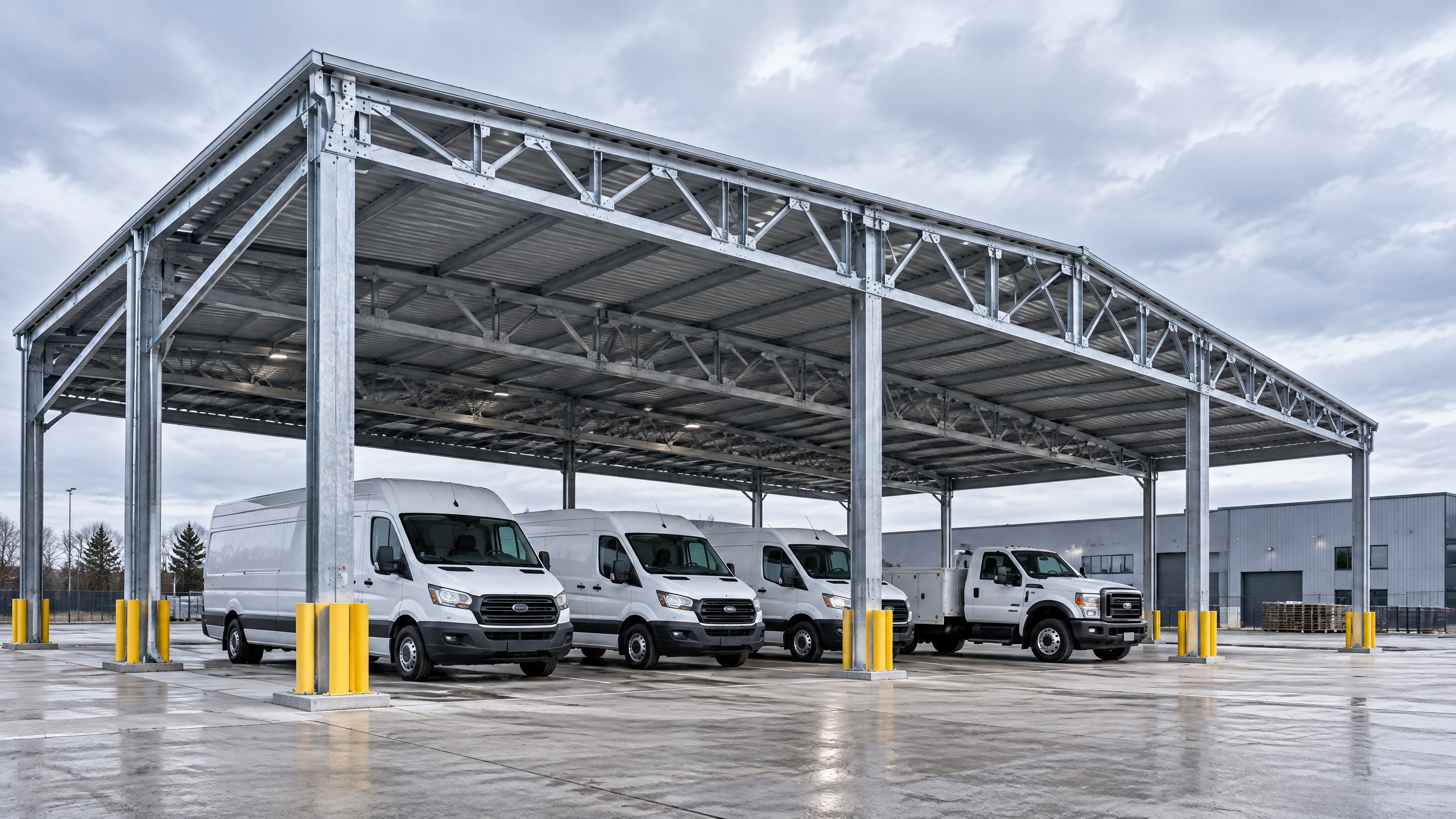
A fleet carport supplier should be specified as a project-critical partner, not just a vendor: the supplier’s product definition, manufacturing verification, installation coordination and post‑installation responsibilities all materially affect cost, programme and long‑term operations. This guide explains how to set clear, evidence‑based scope boundaries, define technical interfaces (foundations, electrical, drainage, access), and run procurement evaluation so you secure a supplier capable of delivering the intended service life, maintainability and warranty obligations. It highlights the planning inputs buyers must provide (fleet profile, commercial parking layout, vehicle clearance planning), the supplier evidences you should require (material test certificates, factory QA, reference installations), and a practical six‑step buyer workflow to move from brief to operational handover. For safety, compliance and energy yield outcomes, confirm site‑specific structural capacity, foundations, permits, electrical design, approvals, lead time, price, energy yield and warranty on a documented project basis with relevant local qualified professionals, installers, utilities and authorities.
Buyer context and scope boundary: who does what and why it matters
When purchasing carport infrastructure for fleets or commercial sites, the buyer must define which responsibilities remain with the owner/developer, and which are the carport supplier’s contractual remit. A fleet carport supplier often delivers the structural canopy, fixings, factory-fitted electrical and solar mount systems (if specified), and installation labour or supervision. However, boundaries vary widely by project:
- Owner/developer responsibilities commonly include site acquisition, planning permissions, ground condition reporting, soil investigations, civil works (bulk excavation, drainage and access roads), power connection applications and fleet operational coordination.
- Supplier responsibilities commonly include structural canopy specification, manufacturing, supply of anchorages or proprietary foundations (if included), electromechanical interfaces for solar, erection supervision and warranty for supplied items.
Clear scope boundaries reduce risk: define them in the contract and include an interface register. The buyer’s brief must state whether the supplier will deliver design‑only, supply‑and‑install, supply‑and‑commission, or turnkey delivery including foundations and electrical grid connection.
Decision table — Typical scope allocation
| Responsibility | Typical buyer/developer scope | Typical fleet carport supplier scope |
|---|---|---|
| Site investigation & geotech | X | |
| Planning approvals & permits | X | |
| Foundations (concrete) | X or shared | Supplier proprietary pad solutions optional |
| Structural canopy supply | X | |
| Structural canopy erection | X (or supervised) | |
| Electrical grid connection | X | Interface works, AC/DC combiner to be defined |
| Solar PV modules & inverters | Optional (buyer) | Optional (supplier) |
| O&M & warranty support | X (owner) | X (supplier for delivered scope) |
State in procurement documents which items require supplier design submittals (e.g., wind and snow loading calculations, structural canopy specification) and which are purchaser‑supplied information (e.g., geotechnical report, utility single line diagrams).
Core decision principle: align supplier capability with project risk profile
The primary procurement question is: can a candidate fleet carport supplier carry the specific combination of technical, programme and interface risks that your project presents? Evaluate suppliers against a short list of risk dimensions:
- Technical fit: experience with the structural canopy specification required (span, bay size, glazing or solid cladding, PV integration).
- Interface competence: history of operational access coordination in active depots or logistics yards.
- Programme reliability: demonstrated manufacturing capacity, lead times and contingency plans for supply chain disruption.
- Aftercare: warranty terms, spare parts logistics and field service capability in your region.
Match supplier capability to project criticality. For high‑availability fleet operations (e.g., 24/7 delivery depots), preferentially source suppliers who can demonstrate proven O&M delivery and minimal installation downtime. For speculative commercial car parks, the emphasis may shift toward lowest capital cost and energy yield potential.
Decision table — Supplier selection criteria (weighted)
| Criterion | Weight (%) | Rationale |
|---|---|---|
| Structural & design capability | 25 | Ensures canopy fits fleet vehicle clearance planning and loading |
| Installation & site logistics | 20 | Critical for installation readiness and minimal disruption |
| Quality assurance & evidence | 20 | Materials, factory QA and test records reduce latent defects |
| Programme & lead time certainty | 15 | Affects project phasing plan and commissioning dates |
| Aftercare & warranty | 10 | Reduces long‑term operational risk |
| Local/regional presence | 10 | Improves coordination with authorities, utilities, installers |
Score suppliers quantitatively and require supporting evidence for claims.
Planning inputs every buyer must provide (and why they matter)
Procurement succeeds when buyer inputs are complete, accurate and issued early. The following inputs are minimum for a robust supplier shortlist and accurate tender returns.
- Site survey and geotechnical report
- Provide topographic survey, utility locations and geotechnical boreholes. The supplier needs these for foundation and anchor design; without them, tender returns will be allowances only.
- State assumed frost depth, groundwater table and any contamination constraints.
- Fleet profile and operational requirements
- Specify fleet mix by vehicle types, gross vehicle dimensions and turning templates. This informs vehicle clearance planning and canopy span choices.
- Include shift patterns, peak ingress/egress windows and permitted temporary closures to inform operational access coordination.
- Commercial parking layout
- Provide the parking layout early: bay sizes, aisle widths, EV charging locations, accessible bays and drive aisles. Compliance with accessible parking guidance should be checked against national/local codes; U.S. projects can reference [U.S. Access Board guidance] for parking and accessible routes [1].
- If integrating EV chargers, indicate conduit/power pit locations and charging sequence.
- Wind, snow, seismic criteria and local codes
- Supply or mandate local load criteria for the structural canopy specification, including return gravity loads or seismic design requirements. If not provided, require the supplier to design to locally applicable codes, and state which codes apply.
- Utilities and electrical single line diagrams
- Provide the existing electrical distribution layout, capacity, and metering arrangements. For solar projects, include grid export constraints or feed‑in allowances, and utility contact requirements.
- Planning permissions and constraints
- Provide copies of planning approvals, covenant restrictions, or landlord consents that affect roofline, height or visibility.
- Environmental constraints
- Provide flood plain information (consult FEMA maps in the U.S. as applicable) and any ecological or heritage constraints [2]. Foundation and canopy elevation decisions often depend on flood requirements.
Without these inputs, supplier proposals will include contingency and disclaimers that undermine cost certainty. Require bidders to identify assumptions and exclusions explicitly.
Technical specification and interfaces: what to require of a fleet carport supplier
A procurement specification should combine performance requirements with verifiable evidence milestones. Below are technical topics to include; each bullet is framed as a specification item or required submission.
Structural canopy specification
- Define performance parameters: design life (typical 25–30 years for aluminium structures), target corrosion class, serviceability limits, design wind and snow loads (or reference to local codes).
- Ask for stamped structural calculations for the installed site conditions, including load paths and connection details.
- Require materials data: alloy grades, surface finish, fastener product codes and compatibility statements.
Foundations and anchor interfaces
- If the supplier supplies anchorage or pile systems, require anchor pull‑out and capacity calculations referenced to the geotechnical report.
- Define tolerances for setting-out, allowable differential settlement and requirements for grout or isolated pad details.
Vehicle clearance planning
- Specify minimum clearances for each vehicle class and ask for a clearance diagram from the supplier showing overhead, lateral and turning clearances. Include requirements for signage and lighting heights.
- Consider service equipment (antennas, roof racks) and future vehicle changes.
Electrical and solar interfaces
- For solar carports, specify DC string layout, module type (if supplied), inverter locations, combiner boxes, and AC interconnection points.
- Require a one‑line electrical diagram from the supplier showing clear demarcation of responsibility for DC/AC works, protection devices, and earthing/grounding arrangements.
- Define requirements for metering, export control and energy yield reporting if modules/inverters are within supplier scope.
Drainage, water and snow management
- Require canopy drainage details: gutter capacity, downpipe locations, water quality/silt traps where required, and snow shedding mitigations (canopy angles, snow guards).
- If the canopy affects site drainage, require hydraulic calculations or a drainage impact statement.
Durability and finish
- Specify coating systems or anodising class for aluminium, expected life cycles, and touch‑up procedures. Require corrosivity class assessment in coastal or chemical exposure sites.
Lighting, signage and services
- Define lighting levels and luminaire mounting points. For safety and access, ensure lighting is coordinated with vehicle clearance planning and pedestrian walkways.
- Include conduit routing and access panels for future serviceability.
Documentation and deliverables
- Require the supplier to provide: detailed shop drawings, structural calculations, material certificates, factory test records, as‑built drawings and an operation & maintenance manual.
- Specify electronic file formats (BIM/3D models, PDF drawings) to suit your design management process.
Interfaces responsibility matrix — example
| Interface | Buyer responsibility | Supplier responsibility |
|---|---|---|
| Geotechnical report | Provide | Use for foundation design |
| Foundation construction | Provide/Contractor | Provide anchor design & setting‑out |
| Structural canopy supply | Supply per spec, provide stamped calculations | |
| Electrical grid connection | Apply and pay | Provide one‑line diagram to connect at agreed point |
| Civil works (paving, drainage) | Provide | Coordinate staging and tie‑in points |
| Permit submissions | Provide / lead | Supply technical documentation for approvals |
Require the supplier to sign off interfaces in the project phasing plan to prevent gaps that create site delays.
Procurement evidence and factory quality: what to ask for and how to evaluate it
Procurement evaluation should prioritise verifiable evidence of manufacturing quality, capacity and product consistency rather than marketing claims.
Factory QA and material traceability
- Ask for the supplier’s factory QA certificate (e.g., ISO 9001) and detail how traceability is maintained for critical structural components and fasteners.
- Require material test certificates (MTCs) for structural aluminium and bolts; these must correspond to batch numbers on delivered materials.
Manufacturing process and tolerances
- Request production tolerances for primary members and connection holes; tolerance control affects erection speed and fit‑up on site.
- Ask for pre‑assembly photos or videos for off‑site modular elements and any factory load testing conducted on representative assemblies.
Factory acceptance testing (FAT)
- Define mandatory FATs: dimensional checks, connection torque testing, and PV string continuity and insulation tests if solar modules/inverters are supplied.
- Specify who witnesses FATs and where (factory or off‑site test facility). Propose independent inspection if required.
Reference installations and field performance
- Request recent references with contactable owners/operators and site data: project programme, changes, warranty claims. Do not accept anonymous or unverifiable case studies.
- For energy‑producing systems, require access to energy yield data from comparable arrays, but base final yield estimates on project‑specific irradiance and shading studies.
Supply chain resilience and lead time transparency
- Require a schedule of critical long‑lead items with committed lead times and alternative sourcing plans.
- Ask the supplier to disclose key sub‑suppliers for galvanizing, PV modules, inverters and fasteners; validate their capacity.
Commercial clarity
- Require itemised pricing for options (e.g., PV supply, foundations, lighting) and clear definitions of what constitutes a change order.
- Request standard warranty terms in writing, and any maintenance obligations that are conditions for warranty validity.
Evidence checklist for procurement submissions
- Stamped structural calculations referencing site loads
- Material test certificates and batch traceability
- Factory QA certificate and FAT plan
- Shop drawings and GA drawings
- Project programme with manufacturing milestones and delivery windows
- Client references with comparable scope
Mid‑article CTA: For detailed system specifications and regional manufacturing options, see our Titan industrial and logistics system product detail at Titan industrial and logistics system and review all systems or our sourcing guides. For project enquiries or to request supplier documentation, contact /inquiry or email info@carportiva.com.
Site installation and operations: making installation readiness part of procurement
Installation readiness is a contract deliverable that should be defined before award. A supplier that can deliver parts on time is insufficient if site logistics, access, and operational constraints are not addressed.
Installation readiness items to define in contracts
- On‑site storage requirements and protection: specify whether the supplier or buyer provides laydown areas, security and temporary weather protection.
- Access & temporary works: plan crane lifts, traffic management, and escort requirements for deliveries. For live depots, require operational access coordination to avoid fleet disruption.
- Lifting and mechanical equipment: specify who provides cranes, slings and lifting engineers, and whether the supplier includes specialist lifting frames.
- Setting‑out tolerances and datum control: require a site setting‑out survey by a qualified surveyor and confirm responsibilities for any remedial civils.
Commissioning and handover
- Define acceptance tests for both structural and electrical systems. For solar arrays, include tests such as insulation resistance, string verification and inverter commissioning.
- Require as‑built drawings and O&M manuals at handover. Define the period for defect liability and the process for remedial works.
Operational access coordination
- For fleet operations, require the supplier to prepare a detailed traffic management and phasing plan, aligned to the buyer’s shift patterns, to maintain critical movements during installation.
- Include communication protocols and on‑site points of contact for daily coordination.
Maintenance and spare parts
- Ask for a recommended maintenance schedule with tasks, frequencies and estimated costs.
- Specify lead times for critical spares and a spares purchase list for the first 5–10 years.
Health & Safety
- Require the supplier to provide method statements, risk assessments and a project‑specific safety plan in accordance with applicable construction standards (e.g., OSHA construction standards in the U.S. where relevant) [3].
- Ensure coordination of emergency access routes and firefighting signage.
Implementation risks and mitigation strategies
Commercial carport and fleet shelter projects involve a range of measurable risks. Below are common risks and practical mitigation measures:
Ground conditions and foundation risk
- Risk: unexpected ground conditions or high groundwater leading to foundation redesign and delays.
- Mitigation: require a geotechnical investigation pre‑tender; include provisional sum or contingency if only limited information is available.
Permitting and planning delays
- Risk: late planning conditions or permit rejections.
- Mitigation: allow time in the project phasing plan for applications and include responsibilities and costs for any planning condition compliance work.
Supply chain and component lead times
- Risk: long lead times for structural extrusions, PV modules or inverters.
- Mitigation: require suppliers to provide confirmed lead times and alternative approved sub‑suppliers; consider staged procurement of long‑lead items.
Interface failure between trades
- Risk: electrical contractor or civils not ready when the canopy arrives.
- Mitigation: implement a detailed phasing plan and supplier attendance at pre‑installation coordination meetings. Include installation readiness milestones in the contract.
Health & Safety incidents
- Risk: injuries during erection causing stoppages.
- Mitigation: require supplier to produce project‑specific risk assessments and to train or supervise subcontractors; align with local safety standards [3].
Performance shortfall (energy yield, corrosion)
- Risk: lower-than-expected energy yield or premature corrosion.
- Mitigation: require firm design inputs for energy models and material specifications suited to local environment; require warranties and long‑term monitoring where appropriate.
Change orders and scope creep
- Risk: budget and programme impacts from owner or design changes.
- Mitigation: a tightly defined scope with a clear change control procedure, and pricing schedule for typical variations.
Regulatory compliance and approvals
- Risk: electrical or structural approvals take longer than planned.
- Mitigation: early engagement with authorities and utilities; ensure supplier provides necessary technical documentation for submissions.
Climate and weather disruption
- Risk: adverse weather during installation slows programme.
- Mitigation: schedule critical lifts for seasonal windows; have contingency days in the project phasing plan.
A named six‑step buyer workflow: from brief to operational handover
This is a practical workflow you can adopt to select and manage a fleet carport supplier.
- Define the strategic brief and boundary of responsibilities
- Create a procurement brief that states whether you want design‑and‑supply, supply‑and‑install, or turnkey delivery. Include site inputs: survey, geotech, fleet profile and commercial parking layout.
- Prequalification and shortlist
- Issue a PQQ requesting evidence of factory QA, previous projects, manufacturing capacity, and financial standing. Shortlist suppliers with demonstrable experience relevant to your structural canopy specification.
- Issue tender documents and manage clarifications
- Provide complete planning inputs and a design basis. Insist bidders return priced options and list assumptions and exclusions. Run a compulsory site visit and Q&A period.
- Evaluate bids against weighted criteria
- Score bids using the supplier selection criteria table above. Validate claims: visit factories if possible, check material certificates and witness FATs where critical.
- Contract award with detailed delivery milestones
- Include a project phasing plan, installation readiness milestones, penalties for missed critical dates (carefully balanced) and a clear change order process. Require periodic design reviews and hold design deliverables as conditions precedent to manufacture.
- Construction, commissioning and handover
- Implement daily coordination meetings, require statutory sign‑offs and FAT witness reports. At handover, ensure as‑built drawings, operation & maintenance manuals and spare parts lists are delivered. Confirm defects process and warranty activation.
This workflow formalises decision points where you can accept or transfer risk, and embeds quality gates to reduce rework.
Frequently asked questions
Q: How specific must the commercial parking layout be in the tender? A: As specific as possible. The supplier pricing depends on bay dimensions, aisle widths, EV charger positions, and accessible spaces. Use your final parking layout to define canopy rows, column lines and service routes; without it, bids must include allowances.
Q: Who is usually responsible for foundations? A: It varies. Many buyers supply foundations through their civil contractor, with the supplier providing anchor designs and setting coordinates. In some turnkey offers the supplier supplies proprietary pad or pile systems. Define this clearly to avoid disputes.
Q: What documentation should I insist on before manufacturing starts? A: Signed and approved shop drawings, stamped structural calculations, material test certificates or MTCs, and a confirmed manufacture programme. These should be contractually required deliverables.
Q: How do I ensure vehicle clearance planning is adequate for future fleet changes? A: Specify minimum clearances beyond current vehicle heights and account for possible roof‑mounted equipment. Ask for a canopy clearance diagram and include a clause permitting minor vertical adjustment where feasible.
Q: Can I combine PV supply with the structural canopy from the same supplier? A: Yes, many fleet carport suppliers offer integrated solar solutions; however, verify their PV sub‑supply chain, inverter warranties and energy yield modelling. If you separate PV procurement, clearly define DC/AC interface points.
Q: What are reasonable warranty expectations? A: Expect manufacturer warranties for structural components and finishes as standard; solar modules and inverters usually carry separate manufacturer warranties. Exact warranty length and scope must be documented per project; verify warranty transferability and regional service support.
Q: How do I confirm installation readiness on site? A: Require an installation readiness checklist as a pre‑deliverable, including completed foundations per tolerance, access for lifting equipment, temporary works approvals, and operational access coordination plans.
Q: What standards apply to jobsite safety? A: Local construction safety standards apply (e.g., OSHA construction standards in the U.S.). Require contractor safety plans and proof of worker competence as part of the procurement package [3].
Decision support: choosing between supplier service models
Suppliers generally offer one of three delivery models. Evaluate these against project priorities.
- Design‑and‑supply
- Pros: Lower owner site management burden; supplier guarantees structural design.
- Cons: Requires buyer to manage foundations, civils and electrical contractor coordination.
- Supply‑and‑install (turnkey canopy erection)
- Pros: Simplifies on‑site delivery and contractor coordination; supplier manages quality through erection.
- Cons: Higher capital cost; may still require owner to supply electrical grid connection.
- Turnkey (including foundations and electrical)
- Pros: Single point of responsibility for performance and schedule.
- Cons: Higher cost and potential loss of direct control over civils subcontracts.
Map your organisational capacity and risk appetite to select the appropriate model. For complex depots with active fleets, turnkey can reduce operational risk by centralising responsibility for installation readiness and operational access coordination.
Closing practical notes and mandatory professional confirmations
- Ensure your procurement documents state that site‑specific structural capacity, foundations, permits, electrical design, approvals, lead time, price, energy yield and warranty require a documented project basis and verification by relevant local qualified professionals, installers, utilities and authorities.
- Engage early with local utilities and planning authorities. Late electrical or planning constraints commonly drive delay.
- Budget for contingency: ground risk, late approvals and weather will impact schedule.
- Consider long‑term asset management: include spare parts lists and recommended maintenance intervals in the contract.
FAQ addendum: common procurement pitfalls
- Pitfall: Vague scope leading to disputes. Remedy: make scope and exclusions explicit, require supplier assumptions.
- Pitfall: Accepting photos instead of MTCs. Remedy: demand traceable material certificates referenced to batch numbers.
- Pitfall: Overlooking access during erection. Remedy: require a supplier‑produced installation traffic management plan aligned to your shift patterns.
Conclusion: specifying a fleet carport supplier is a multipart, evidence‑led decision
Specifying a fleet carport supplier for a commercial carport project is not a commodity purchase; it requires a documented design basis, precise interface definitions and verifiable factory and field evidence. Use the buyer inputs checklist, require the structural canopy specification and interface deliverables, and enforce installation readiness milestones in contracts. Evaluate suppliers against the risk‑weighting table provided, insist on material traceability and FATs, and adopt the six‑step buyer workflow to move from brief to handover. For integrated industrial solutions, review our modular options at Titan industrial and logistics system, browse all systems and consult our sourcing guides for template documents.
For project enquiries and to request detailed supplier documentation, contact /inquiry or email info@carportiva.com.
References
- U.S. Access Board, Parking Guidance: https://www.access-board.gov/ada/guides/chapter-5-parking/
- FEMA Flood Maps: https://www.fema.gov/flood-maps
- OSHA Construction Standards: https://www.osha.gov/laws-regs/regulations/standardnumber/1926
- Federal Highway Administration: https://highways.dot.gov/
References
- U.S. Access Board parking guidance: https://www.access-board.gov/ada/guides/chapter-5-parking/
- FEMA flood maps: https://www.fema.gov/flood-maps
- OSHA construction standards: https://www.osha.gov/laws-regs/regulations/standardnumber/1926
- Federal Highway Administration: https://highways.dot.gov/
Keep the project brief connected.
Bring the actual project brief to the engineering table.
Share your location, layout, target application and available technical inputs. Carportiva can help identify the relevant product-interface information before a project-specific commercial discussion.
Request a project discussion