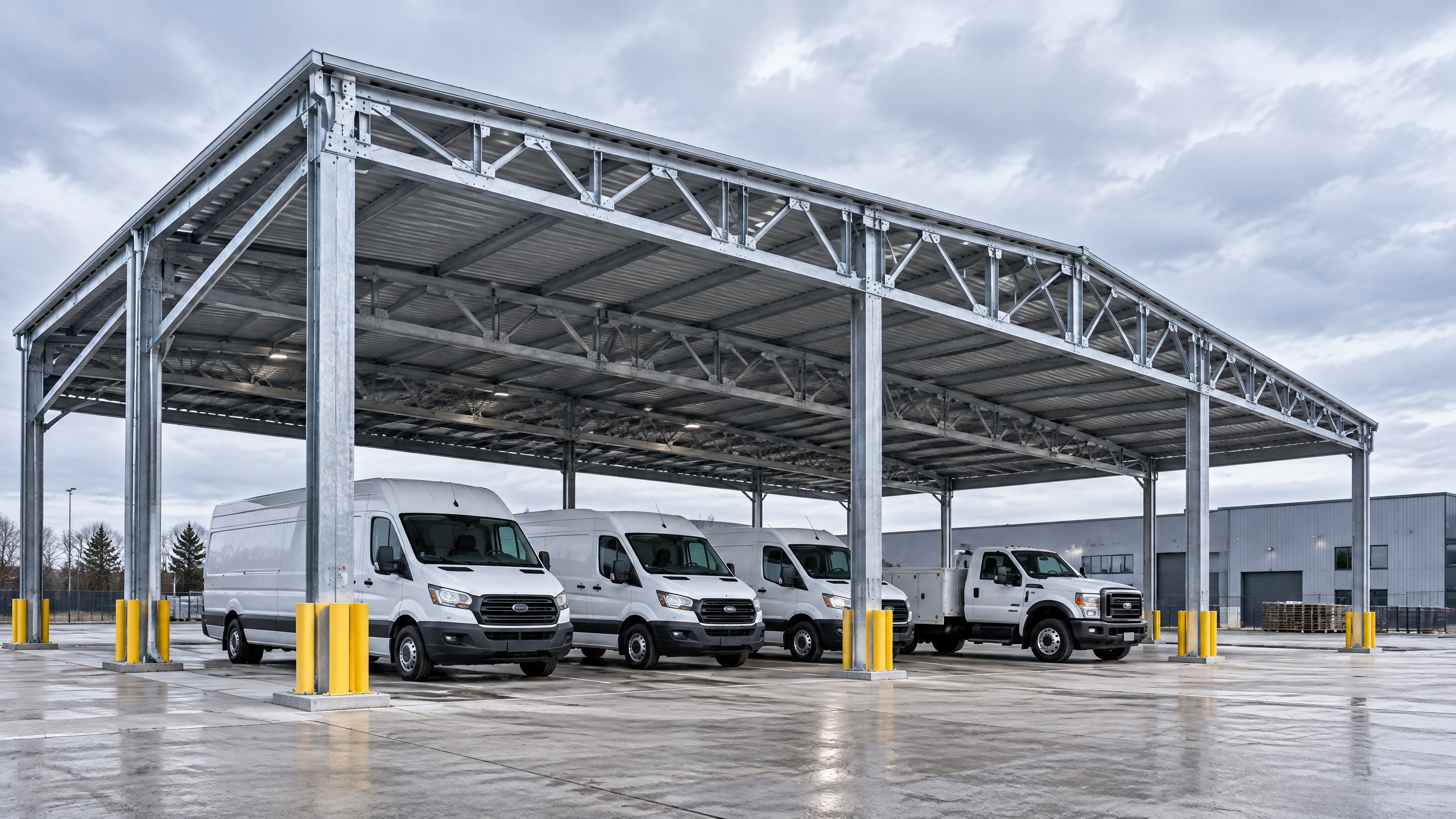
Direct answer (short): For a hotel parking canopy project supply you must confirm the project's defined scope, site constraints, and the exact product interfaces before contracting. Specifically, verify site geometry, subgrade and drainage, structural attachment points and penetrations, roof and guttering interfaces, electrical routing for lighting and EV or PV systems, accessible routes and guest circulation, fire and emergency access, construction phasing to avoid guest disruption, staging and crane access, and handover responsibilities for commissioning and maintenance. Confirm roles and approvals: who delivers design intent, who provides engineered shop drawings, who secures local permits, who performs inspections and who installs. Validate procurement milestones, inspection points and test responsibilities with supplier and installer. Do not assume site-specific decisions—local qualified engineers, authorities, utility providers and installers must make the final determinations for structural capacity, permit approval, code interpretation, lead time, price, energy yield and warranty applicability.
Why this checklist matters to B2B buyers
Hotel projects are operational and guest-facing. A canopy that arrives without verified interfaces can delay opening, increase temporary parking costs, or create unsafe conditions. Confirmations early in procurement align manufacturers, installers, main contractors and facility managers on tolerances, deliveries and handover requirements. This guide focuses on the supply-related confirmations you need to de-risk design, delivery and installation for hotel parking canopy project supply, and it sets clear boundaries about decisions that must remain with qualified local professionals.
Scope boundaries (what this guide does and does not promise)
This guide helps you identify confirmations and responsibilities for hotel parking canopy project supply and connected design, sourcing, delivery and implementation considerations. It does not promise or approve:
- structural capacity or safe loading limits;
- permit approval or interpretation of codes;
- final code compliance or local authority acceptance;
- specific lead times, prices, energy yield, or warranty terms.
Final, site-specific decisions must be made by local qualified professionals, authorities, utility providers and installers.
Key confirmations checklist
Decision table — Who confirms what (high level)
| Item to confirm | Typical responsible party |
|---|---|
| Project scope and deliverables (product, quantity, finishes) | Client / Developer + Procurement |
| Site survey, levels, and underground services | Geotech/Surveyor + Contractor |
| Structural interface and engineered attachment details | Structural engineer + Supplier |
| Electrical routing, meter and utility connections | Electrical engineer + Utility provider |
| Drainage, stormwater and flood elevation | Civil engineer + Local authority |
| Accessibility and pedestrian circulation | Architect + Accessibility consultant |
| Phasing and disruption plan | Main contractor + Installer |
| Handover, maintenance, spare parts | Supplier + Facilities manager |
Use this table to record who signs each item off before contract award.
Site, access and ground confirmations
Practical confirmations:
- Confirm precise as-built site dimensions and levels with a recent topographic survey and utility scan, and update supplier drawings before fabrication.
- Locate underground services and confirm allowable excavation or anchoring methods. If piling, confirm soil-bearing strata and piling clearance.
- Check flood elevation and potential inundation zones; align canopy elevation and column foundations with local flood maps and mitigation (see FEMA flood maps) [2].
- Confirm staging areas, crane position, vehicle routes and loading zones for material deliveries and removal of waste.
- Verify hotel operational constraints: peak check-in/out times, valet zones, and temporary traffic measures so installation can be phased to maintain guest experience.
Decision table — Site access & installation risks
| Risk area | Confirmation required | Typical mitigation |
|---|---|---|
| Restricted delivery access | Max vehicle length/weight, height restrictions | Use local delivery specialists, split deliveries |
| Limited crane or laydown | Crane availability, ground bearing | Temporary road reinforcement, alternate lifting |
| Night or weekend work restrictions | Local noise/permit rules, hotel policies | Schedule work windows, use low-noise equipment |
| Undisclosed utilities | Service locate reports | Pre-excavation scans, as-built verification |
Structural interfaces and engineering workflow
What to confirm with engineers and suppliers:
- Confirm the canopy-to-structure or canopy-to-ground interface: if attaching to an existing parking structure or building façade, verify attachment locations, reinforcement requirements and fire or waterproofing details.
- Require supplier responsibility to provide engineered shop drawings for review by the project's local structural engineer. The supplier typically models the canopy; a licensed engineer stamps the anchor and foundation design to local codes.
- Confirm allowable tolerances for column spacing and roof alignment, and who accommodates deviations found during on-site verification.
- For mixed-structure projects (eg. integrated canopies over porte-cochères), confirm coordination with architectural glazing, soffits and drainage penetrations.
Note: Do not accept structural capacity claims without stamped calculations from local licensed engineers.
Electrical, solar and lighting considerations
Confirmations for electrical scope:
- Identify whether the canopy includes lighting, security cameras, EV charging or photovoltaic arrays. For commercial solar carports, confirm system boundaries between the canopy supplier and the solar EPC.
- Confirm who supplies electrical raceways, conduit runs, junction boxes and metering points. Provide single-line diagrams early so the supplier can coordinate roof penetrations and cable trays.
- If integrating PV, confirm early whether the supplier delivers the PV mounting interface only, or delivers a full system. For Carportiva’s commercial solar carports, link the mechanical system scope to the electrical scope in procurement documents (Carportiva system range).
- Validate utility interconnection requirements with the local utility provider, including point-of-interconnection, metering and tariff information.
- Plan for emergency shut-offs and access for maintenance.
Accessibility, circulation and emergency access
Confirm pedestrian and vehicular circulation requirements, especially for guest safety:
- Verify accessible parking counts, dimensions and routes for hotel guests and staff. Where projects have healthcare-like requirements or if the site is adjacent to a medical facility, coordinate hospital parking canopy accessible routes with accessibility consultants early [1].
- Confirm drop-off points, valet operations, luggage trolleys, and wheelchair ramps. Ensure canopy column placement does not obstruct passenger loading zones.
- Coordinate with fire and emergency planners to maintain fire lanes and hydrant access during and after installation.
When projects resemble other building types:
- If you are working with hospital-related projects, review hospital parking canopy design early to capture stretcher access, ambulance turn radii and bi-directional traffic patterns.
- If the project is part of residential mixed-use, consult apartment parking canopy design guidance to align with occupant parking allocations and pedestrian paths.
Cite accessibility guidance where applicable [1].
Phasing, logistics and site coordination
Confirm the installation phasing and roles:
- Establish phased installation that accommodates hotel operations: phased canopy sections, temporary pedestrian routing, and temporary parking allocations.
- Confirm hospital parking canopy installation phasing if the project supports or is adjacent to healthcare facilities to avoid disruptions to critical services.
- Confirm roles for site coordination: who is the daily point of contact, who signs off on completed phases, and who tracks snag lists.
- Establish a clear delivery schedule with milestones for fabrication start, shipment, on-site delivery and installation windows. Record penalties or remedies for missed milestones in procurement documents if appropriate.
Include these items in the master construction schedule and the contractor’s sequence of work. For complex installations, require a detailed site coordination plan from the supplier before mobilization.
Supplier selection and product scope
What to confirm with potential suppliers and manufacturers:
- Confirm whether the supplier is providing an integrated scope (canopy, structural steel, roofing, guttering, lighting, PV mounting) or a partial scope (supply-only of frames or PV interface). Use precise contract language.
- Ask for references on similar hospitality projects and documentation of previous installations, but do not accept generalized performance claims without site references.
- Clarify shop drawing, submittal and approval processes: who produces the submittals, response time windows, and how change orders are managed.
- Verify spare parts, consumables and maintenance access elements included in the supply scope.
If hospital requirements are relevant, verify the hospital parking canopy manufacturer’s experience in regulated environments. If the project has residential components, consult apartment parking canopy design guidance early with your architect.
Link to product lines and additional technical guides: see all systems and our sourcing guides.
Procurement contracts and quality assurance
Confirm contractual milestones and quality acceptance:
- Include inspection and acceptance points: pre-shipment inspection, on-site inspection of anchors and interfaces, and final acceptance with the facilities manager.
- Define responsibility for non-conforming items and remedial works.
- Require as-built documentation and O&M manuals as a contract deliverable.
- Include Service Level expectations for spares and maintenance response timeframes if long-term support is required.
Do not use the procurement contract as the place to shift responsibility for local statutory approvals or engineering compliance from the licensed professionals who must legally perform them.
Five-step buyer workflow (named)
- Discover: Gather project brief, hotel operational constraints and site survey (topo, utilities, flood).
- Engage: Issue RFQ/RFP with precise scope, interfaces and required submittals; invite shortlisted suppliers.
- Validate: Receive shop drawings and third-party engineering inputs; coordinate with local engineers, utility providers and authority having jurisdiction.
- Execute: Finalize contract, confirm fabrication schedule, coordinate delivery and on-site mobilization following agreed phasing.
- Handover & Operate: Complete acceptance testing, receive as-built documentation and transition to facilities for maintenance.
Optional Step 6 — Continuous Support: Establish spare parts and maintenance agreements with the supplier if ongoing support is required.
Mid-article CTA: If you are ready to align scope and supplier responsibilities for hotel parking canopy project supply, start the procurement conversation through /inquiry or email our technical team at info@carportiva.com.
Typical risks and how to confirm mitigations
Decision table — Risk, likely consequence and confirmation action
| Risk | Consequence | Confirmation action |
|---|---|---|
| Unverified site levels | Misfit of columns, rework | Require as-built verification before fabrication |
| Incomplete electrical scope | Late PV/EV integration | Deliver single-line and interconnection requirements early |
| Poorly defined phasing | Guest disruption | Agree on phased install windows and on-site liaisons |
| Anchor conflicts with utilities | Delays, redesign | Subsurface utility scans and engineer review |
| Ambiguous warranty responsibilities | Ongoing disputes | Specify warranty scope and claim process in contract |
Documentation and handover
Confirm the handover deliverables:
- As-built drawings showing installed conditions and any deviations.
- Engineering certificates or stamped drawings for anchors and foundations where applicable.
- O&M manuals, spare parts lists and warranty contact points (but do not assume warranty terms—confirm them in contract).
- A snag list with deadlines for rectification and final acceptance criteria.
Related sourcing terms
In project research, these connected terms should be reviewed against the same live brief: hospital parking canopy site coordination. They are search phrases, not separate technical guarantees.
FAQ
Q: Who must sign off on structural anchor designs? A: A locally licensed structural engineer engaged by the project must review and stamp anchor and foundation designs. The supplier provides the information package; the licensed engineer provides final approval for local code compliance.
Q: Will the supplier obtain local permits? A: Permit responsibility is a contractual choice. Confirm in procurement whether the supplier, main contractor, or client is responsible for obtaining permits. This guide does not approve permits or regulatory compliance.
Q: How do I coordinate solar PV if I want a commercial solar carport? A: Confirm at procurement whether the canopy supplier provides PV mounting only or a turnkey PV solution. Coordinate early with the chosen solar EPC and the local utility for interconnection requirements; reference the supplier’s mechanical interfaces (Carportiva system range).
Q: Do accessibility rules differ for hotel parking? A: Yes—accessibility counts and routes must follow local regulations and standards; in the U.S., consult federal accessibility guidance for vehicular and pedestrian provisions in parking areas [1]. Local codes and the authority having jurisdiction define exact requirements.
Q: What checks do I require before fabrication? A: Require an approved set of shop drawings, coordinated utility locations, confirmed anchor details, and documented responsibility for any deviations discovered on site.
Conclusion
For hotel parking canopy project supply, a focused confirmation process that ties site reality to contract scope prevents costly delays and preserves guest experience. Use the checklists and workflow above to assign responsibilities, require essential submittals, and coordinate with local specialists who make final, site-specific decisions. For system options and technical details, review the Carportiva system range and related sourcing guides. When ready, open a procurement dialogue via /inquiry or info@carportiva.com.
References
- U.S. Access Board parking guidance: https://www.access-board.gov/ada/guides/chapter-5-parking/
- FEMA flood maps: https://www.fema.gov/flood-maps
- OSHA construction standards: https://www.osha.gov/laws-regs/regulations/standardnumber/1926
- Federal Highway Administration: https://highways.dot.gov/
Keep the project brief connected.
Bring the actual project brief to the engineering table.
Share your location, layout, target application and available technical inputs. Carportiva can help identify the relevant product-interface information before a project-specific commercial discussion.
Request a project discussion