# How Should Buyers Evaluate Battery Storage Integration With a Solar Carport?
Buyers should evaluate solar carport battery storage as one coordinated infrastructure system, not as a PV canopy purchase with a battery added later. The decision is whether a defined site need—such as managing an approved grid-import profile, controlling export, supporting selected critical loads, or coordinating planned EV charging—justifies the additional equipment, controls, siting, safety planning, interconnection work, and operating responsibilities.
Start with site data, a parking and circulation plan, utility information, and a clear operating objective. Then require a project-specific concept showing the intended power paths, equipment locations, operating modes, protection and controls, and evidence deliverables. The U.S. Department of Energy (DOE) notes that energy storage can help stabilize the grid and that solar plus storage can power critical building loads during outages, while also observing that distribution-grid interconnection may be challenging.[1] Buyers should therefore evaluate opportunity and implementation risk together.
This guide is an evidence-led B2B sourcing framework, not engineering, legal, fire-safety, or permitting advice. Final system selection, design, siting, installation, interconnection, permits, emergency procedures, inspections, and authorization to operate must be determined by local qualified engineers, installers, utility providers, authorities having jurisdiction (AHJs), and other applicable authorities.
1. Define the owner’s operating boundary before comparing battery proposals
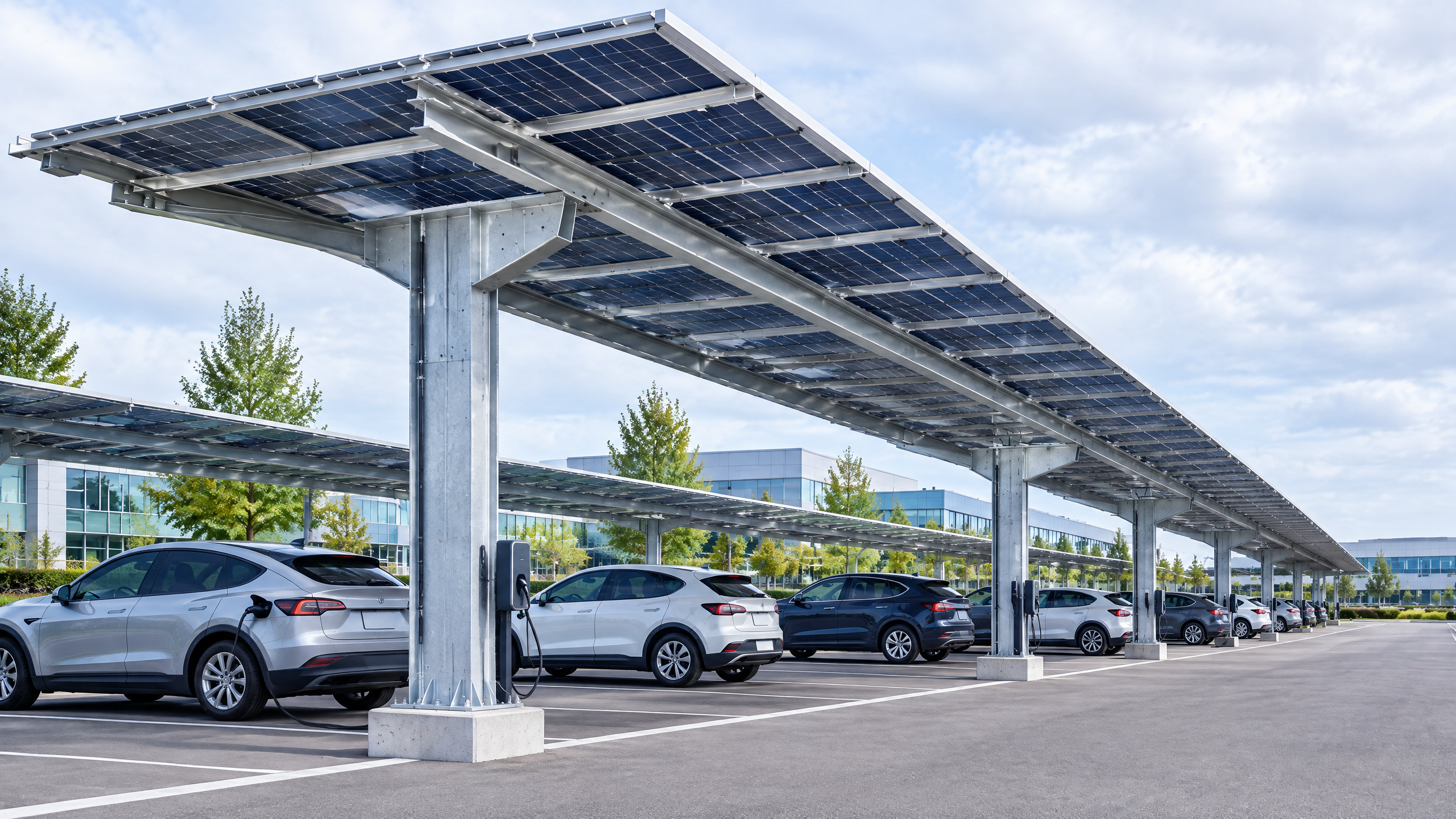
A solar carport integrates structure, PV modules, drainage, parking access, and electrical distribution. Storage adds battery management, power conversion, controls, communications, alarms, and maintenance. Before asking for a capacity or equipment proposal, the buyer should write an owner brief that says what the combined system must do and what it is not expected to do.
Separate the objectives that are often mixed into one request:
- Solar use: on-site consumption, allowed export, limited export, or no-export operation, as determined through the utility process.
- Load management: changing the site’s grid import profile within agreed operating rules.
- Resilience: supplying a specifically defined critical-load group during a grid outage, rather than assuming full-facility backup.
- EV charging: whether charging is a present load, a future provision, a managed load, or excluded from an outage case.
- Operations: who monitors alarms, approves settings, maintains equipment, communicates with the utility, and coordinates incident response.
- Physical works: whether battery pads, foundations, conduits, switchgear, barriers, fencing, lighting, drainage changes, and emergency access are included.
The owner brief should distinguish power—what must be supplied at a moment—from energy over time, permitted operating windows, export/import behavior, and critical-load priorities. Those are different engineering questions. A battery stated only in terms of a nameplate figure does not establish that it suits the site’s operating duty.
Buyer context and scope boundary
This framework suits commercial, industrial, institutional, fleet, campus, retail, logistics, and public-sector parking-site projects. It does not prescribe a chemistry, system size, setback, equipment layout, tariff result, service life, savings outcome, or local requirement. Those depend on the site, climate, adopted codes, local regulations, utility rules, equipment configuration, and professional review.
At the first feasibility meeting, include the owner’s facilities and risk stakeholders; structural and electrical engineers; PV/carport designer; storage integrator; local installer; utility or interconnection personnel; relevant fire/building officials; and EV-charging designer where applicable. Early coordination can expose conflicts between a technically possible equipment location and vehicle circulation, access, utilities, drainage, accessibility, fire planning, or structural scope.
| Buyer question | Evidence to request | Risk if it remains unanswered |
|---|---|---|
| What operating outcome is required? | Owner-approved use-case brief, interval load data, preliminary operating scenarios, critical-load list | Equipment may be chosen without a verifiable duty. |
| Where can the equipment go? | Scaled site concept showing carport, storage, electrical gear, access, drainage, utilities, and parking | Civil, safety, or access conflicts may appear late. |
| How will it interact with the grid? | Utility process map, preliminary one-line, import/export assumptions, control narrative outline | Interconnection constraints may remain hidden. |
| Who controls each interface? | Responsibility matrix for design, logistics, installation, commissioning, monitoring, and emergency coordination | Gaps arise between carport, PV, storage, and site works. |
| What proof supports the selection? | Submittal register for project drawings, manuals, and applicable configuration-specific evidence | General marketing material can be mistaken for project evidence. |
A written boundary also avoids a common assumption: a grid-connected battery does not automatically create backup power. A backup function normally requires a purpose-designed architecture, compatible protection and controls, an isolation approach, and a defined critical-load boundary. The concept package should say whether outage operation is in scope, its intended conditions, and who will verify it.
2. Test the operating case against site data and real scenarios
A battery case is stronger when it can be traced to a limited number of scenarios. Ask the design team to assess a normal grid-connected period, low-solar period, high-load period, any proposed export-control condition, and an outage case if resilience is included. The purpose is not to predict a commercial result; it is to make inputs, limits, and unresolved assumptions visible.
Use representative interval electricity data and, if relevant, existing or planned EV-charging data. Pair these with PV-production assumptions that reflect the preliminary carport layout, orientation, shading, and local conditions. This makes three questions explicit:
- When is solar available? PV output changes with weather and season.
- When does the site need electricity? Building and charging demand may not coincide with solar generation.
- What may the system do at the point of interconnection? Equipment ratings, protection, approved settings, and utility requirements govern this.
DOE’s carport guidance identifies weather and utility safety, drainage, component access, vehicle clearance, underground utilities, and fire lanes as planning issues for carport projects.[2] Treat them as feasibility inputs, not later construction details. Cable routes from the canopy to power-conversion equipment and storage can affect trenching, crossings, constructability, service access, and the location of electrical gear. Qualified professionals should survey the existing service, switchgear, transformer interfaces, communications, and relevant utility infrastructure before the buyer seeks a firm equipment solution.
For resilience, perform load triage before choosing storage equipment. Identify life-safety systems, safety-critical process loads, communications, selected building functions, EV charging, and non-critical loads. Identify loads that can be shed, those with starting or transient characteristics, and those already served by other emergency systems. The local project engineer can then develop and validate a critical-load, switching, and protection concept.
Ask bidders to identify their data source and period; operating cases assessed; assumed charging, discharging, import, export, and backup limits; critical-load boundary; weather or flood constraints; and anticipated service, transformer, switchgear, or civil changes. Record each unresolved point in an assumption register with an owner, source, status, and required closing evidence.
Mid-article CTA — Planning solar carport battery storage? Share your site objective, preliminary layout, and available electrical information through Carportiva’s inquiry form or email info@carportiva.com. Local engineers, installers, utilities, and authorities determine final project decisions.
3. Compare architectures through visible structural, electrical, and operational interfaces
At feasibility stage, buyers do not need to select a final wiring topology. They do need a preliminary one-line diagram and coordinated site plan. Request a diagram that identifies PV arrays, DC equipment where used, power-conversion equipment, battery system, AC distribution, main service, meter or point of common coupling, critical-load equipment if proposed, EV chargers, controls/communications, and emergency disconnects. Name the party responsible for each interface.
Architecture affects where conversion occurs, whether existing PV can be incorporated, what must communicate, outage behavior, maintenance access, and protection coordination. Ask qualified designers to compare feasible approaches against the owner’s stated use case rather than treating one supplier default as the only option.
The physical relationship between canopy and storage also requires a drawing. DOE highlights foundation and soil conditions, weather exposure, cable management, appropriate enclosures, grounding and bonding, service access, vehicle-clearance protection, drainage, fire-lane approval, and utility-strike risk.[2] A battery cabinet or enclosure may be separate from, near, or remote from the carport; each option changes cable routes, access, vehicle-impact measures, civil works, and emergency planning.
A coordination drawing should answer practical questions: Can personnel access doors, labels, disconnects, and ventilation features without closing essential traffic routes? Are equipment and columns protected from vehicle contact? Will drainage be directed away from equipment? Can emergency responders access the area? Are delivery and lifting paths feasible? Are fencing, bollards, gates, lighting, accessible paths, and parking circulation coordinated?
| Interface | Buyer definition | Required coordination output |
|---|---|---|
| Carport and PV | Module arrangement, drainage, loads, grounding/bonding, clearance, service access | Structural/PV concept and maintenance-access plan |
| Storage and conversion | Footprint, environmental envelope, AC/DC paths, controls, disconnecting means | One-line, site plan, equipment schedule, control narrative |
| Existing electrical system | Service configuration, protection, metering, transformer and point-of-connection interfaces | Field-survey record, utility information, electrical study scope |
| EV charging and loads | Current/future chargers, control priority, outage behavior, critical-load boundary | Load schedule and operating-mode matrix |
| Civil and safety works | Pads, trenches, drainage, access, barriers, signage, lighting, fire lanes | Civil concept, utility-locate plan, emergency-access concept |
For every interface, identify the source of truth: issued drawing, field survey, utility document, manufacturer instruction, or AHJ direction. This is especially important when the structure, PV system, storage system, electrical contractor, and civil scope are purchased under separate contracts.
4. Make utility interconnection and controls formal design gates
Solar carport battery storage can consume or export electricity, follow a schedule, respond to site load, curtail PV, preserve energy for a stated purpose, or limit export. Those capabilities make interconnection and controls central design matters—not paperwork to address after equipment selection.
IEEE 1547-2018 covers technical specifications and testing for interconnection and interoperability between distributed energy resources and electric power systems. Its scope includes operation, testing, safety, maintenance, power quality, abnormal-condition response, islanding, commissioning, and periodic tests.[3] It is not a permit or an automatic approval. It shows that interconnection is a whole-system matter involving configuration, settings, installation evaluation, documentation, and testing.
The DOE-supported BATRIES toolkit identifies recurring barriers involving storage terminology, export control, unrealistic assumptions for limited- or non-export systems, inadvertent export, grid constraints, design changes during review, standards updates, and operating schedules.[4] A buyer should ask the utility how it will classify, study, accept, test, and monitor the specific proposed operating mode. Calling a proposal “non-export” does not itself establish utility acceptance.
Before releasing equipment, seek documented answers through the local utility process:
- Is the application for PV, storage, or paired solar-plus-storage, and which diagrams or studies are required?
- What is the intended point of interconnection and metering arrangement?
- Is export allowed, limited, prohibited, or controlled by an approved schedule?
- Which inverter functions, protection settings, telemetry, remote-disconnect provisions, inspections, or witness tests apply?
- How are changes to equipment, operating schedule, or export limit handled after application?
- What does the system do during a communications fault, utility outage, or control fault?
Require a control narrative as a procurement deliverable. It should cover normal operation, load priorities, battery state-management assumptions, export logic where applicable, fault behavior, alarm escalation, manual authority, data ownership, cybersecurity responsibilities, and change control. It must align with the one-line diagram and final interconnection terms. The serving utility, qualified electrical professionals, and AHJ determine the final pathway, settings, testing, and authorization conditions.
5. Source safety, siting, emergency planning, and accessibility as a single package
Safety must be built into the layout and operating plan. NFPA 855, the Standard for the Installation of Stationary Energy Storage Systems, provides minimum requirements for mitigating hazards associated with energy storage systems.[5] Local adoption and enforcement differ; buyers should confirm applicable editions, local interpretations, and required submittals with the AHJ.
UL states that UL 9540 covers energy-storage systems and equipment, including electrical, electrochemical, mechanical, and other technologies intended to supply electrical energy. Its scope includes charging/discharging, protection, controls, and communications among other aspects.[6] Request evidence for the configured system and its intended installation context rather than isolated component literature.
UL describes UL 9540A as a test method for evaluating thermal-runaway fire propagation in battery energy-storage systems. Its test levels consider behavior from cells and modules through units and installations, including heat and gas release, propagation, and installation-level fire protection.[7] Such evidence does not determine where any unit may be installed. Appropriate evidence, configuration, protection approach, separation, and local interpretation must be assessed by qualified professionals and the AHJ.
EPA advises communities considering BESS to comply with state and local siting, zoning, marking, and permitting requirements; consider system design, battery management, quality assurance, and current safety standards; consider remote monitoring; and communicate with local responders on emergency plans.[8] EPA also notes potential suppression, emission, cleanup, and disposal challenges in an incident. Make emergency coordination a source-selection deliverable.
The local review package may include a current site plan, access routes, equipment identification, isolation points, signage concept, hazard communication, monitoring/alarm information, emergency contacts, responder familiarization, and escalation procedures. California’s Office of the State Fire Marshal lists a safety meeting, site and equipment inspection, commission plan, emergency operation plan, fire/explosion control summary, and signage among its commercial review topics.[9] This is a useful prompt, not a substitute for local requirements.
Also check site usability. Equipment pads, doors, barriers, drainage routes, and trenches should not compromise pedestrian circulation, accessible parking, visibility, or vehicle flow. DOE advises considering accessible parking access and incorporating fire lanes and required vehicle clearances in carport design.[2] Qualified local designers should review the final layout against applicable accessibility, building, fire, electrical, and planning requirements.
6. Require auditable, configuration-specific project evidence
A procurement specification should say what evidence is due, who reviews it, when it is required, and how changes are controlled. It should not rely on broad technical claims or generic “compliance” language.
Create a pre-award submittal register covering:
- site, structural, civil, electrical, controls, access, and labeling drawings;
- installation, operation, maintenance, handling, and lifting documentation;
- applicable listing, test, or certification documentation relevant to the jurisdiction and actual configuration, with scope verified;
- utility application, correspondence, study outcomes where available, and required test/witness records;
- safety, emergency, monitoring, and commissioning documents;
- receiving inspections, training records, final settings records, as-builts, and handover documents; and
- contractual end-of-life, disposal, or recycling responsibilities where relevant.
Separate product evidence from project evidence. A data sheet describes an item; project evidence shows how selected equipment will be located, connected, controlled, tested, and documented at this site. For any certificate or test report, confirm the issuer, model/configuration, edition or date, conditions/limitations, and alignment with the equipment schedule.
Use a requirements traceability matrix to compare bids. Map each requirement to an evidence document, drawing, test, or responsible party, and mark the response as provided, exception, assumption, or not applicable. If remote monitoring or utility communication is in scope, include access control, network ownership, permitted remote actions, software-update responsibility, data retention, alarm routing, and offboarding in the review.
7. Coordinate factory, shipment, installation, and commissioning as one evidence chain
Quality control starts before delivery. Establish one coordination plan covering the carport provider, PV suppliers, storage integrator, freight coordinator, civil contractor, electrical installer, utility, and commissioning lead. The plan should show dependencies, owners, records, inspection points, and escalation routes; it should not make unsupported delivery or approval commitments.
At pre-shipment stage, obtain a package matched to the purchased configuration: approved drawings, equipment identifiers, packing list, handling/lifting information, storage requirements, manuals, and any contractually required inspection or acceptance records. Confirm that equipment identifiers and labels correspond with the approved schedule. If there is a factory witness or pre-shipment inspection, define its scope, evidence, corrective-action path, and shipment-release authority.
Battery transport needs separate ownership. The U.S. Pipeline and Hazardous Materials Safety Administration (PHMSA) states that lithium batteries are regulated as hazardous material under U.S. DOT Hazardous Materials Regulations and must meet applicable requirements for air, highway, rail, or water transport.[10] PHMSA also states that designs offered for transport must have passed the UN Manual of Tests and Criteria Section 38.3 tests and that manufacturers must make test summaries available on request.[10] The legally responsible shipper must determine actual classification, packaging, marking, documentation, carrier instructions, and route requirements. The buyer should obtain confirmation of responsibility and relevant shipment records.
Before installation, verify delivery/offload and lifting routes, temporary storage, foundation readiness, utility locates, trench sequence, weather protection, traffic management, security, qualified crews, inspections, and waste handling. DOE warns that underground utility strikes can cause safety, delay, and cost issues and advises verification rather than reliance on drawings alone.[2]
Commissioning turns an installed asset into a controlled operating system. DOE recommends a commissioning plan and budget before construction and identifies documentation, array testing, and whole-system performance testing as key PV elements.[2] For the integrated project, define equipment inspection, electrical verification, protective-function and control tests, alarm/monitoring validation, utility-required tests, critical-load test boundaries where applicable, training, deficiency closure, final settings control, and handover. The utility, AHJ, equipment documentation, and qualified professionals determine test procedures and witnessing.
| Project gate | Buyer check | Evidence record |
|---|---|---|
| Design release | Does purchased equipment match the coordinated layout, one-line, safety concept, and interconnection path? | Approved equipment schedule, revision register, open-issues log |
| Pre-shipment | Does the shipment match the approved configuration and handling plan? | Packing list, identifiers, manuals, lifting/handling records, agreed inspection records |
| Receipt | Are transport, delivery, storage, and condition responsibilities documented? | Applicable shipment documents, receiving inspection, damage/exception log |
| Installation | Are civil, structural, electrical, controls, safety, and access interfaces ready in sequence? | Inspection checklists, utility-locate verification, nonconformance log |
| Handover | Has the integrated system been tested and documented under approved procedures? | Commissioning results, training record, final settings, as-builts, O&M and emergency package |
Numbered buyer workflow
- Write the owner brief with objectives, resilience boundary, loads, EV intent, constraints, and exclusions.
- Collect baseline data: interval load data, electrical drawings, parking plan, utility information, and known site constraints.
- Develop an integrated concept with a site plan, preliminary one-line, operating narrative, interface matrix, and assumption register.
- Engage utility and authorities early through local interconnection, planning, building, fire, and electrical processes.
- Issue a comparable sourcing package with evidence requirements, responsibilities, exceptions format, coordination scope, and commissioning expectations.
- Evaluate technical fit and safety evidence together, including access, emergency coordination, controls, transport, and installation method.
- Reconcile interfaces before release and manage deviations through written change control.
- Control factory-to-site records, receiving checks, installation inspections, and nonconformances.
- Commission and hand over with approved records, training, final settings, as-builts, and operational ownership.
- Operate with governance for alarms, inspection/maintenance, controlled settings or software changes, and emergency-plan review.
FAQ
Is a battery necessary for every solar carport?
No. A solar carport can be a PV and shade project without storage. Storage should be considered only against a defined operating need and the site’s interconnection, safety, layout, and operational constraints.
Does a battery automatically provide backup power?
No. Backup needs a project-specific design for critical loads, isolation, protection, controls, compatible equipment, commissioning, and required utility and code coordination. Ask for an outage operating narrative rather than inferring capability from the presence of a battery.
What is the procurement difference between UL 9540 and UL 9540A?
UL describes UL 9540 as a standard for energy-storage systems and equipment; UL 9540A is a thermal-runaway fire-propagation test method.[6][7] They address different matters. The relevance of a given document to a specific installation must be determined with qualified professionals and the AHJ.
Should the battery be located under the carport?
There is no universal answer. Assess equipment requirements, access, vehicle impact, drainage, flood exposure, cable route, emergency access, maintenance, and code requirements through a coordinated site plan. Local engineers, installers, fire officials, and AHJs determine the final siting.
How should buyers assess a non-export proposal?
Ask the utility how it defines non-export or limited export, which control method and fault behavior it accepts, which study assumptions apply, and what testing or monitoring it requires. BATRIES identifies export-control, inadvertent-export, and operating-schedule issues as material interconnection topics.[4]
Who makes final project decisions?
The buyer makes commercial decisions. Local qualified engineers, installers, utility providers, AHJs, and relevant authorities make or govern final technical, interconnection, permitting, inspection, safety, and operating determinations.
Conclusion
A credible solar carport battery storage decision is evidence-led: define the operating boundary, test it against site data, coordinate carport and electrical interfaces, treat utility review as a design gate, and source safety, logistics, installation, and commissioning records together. Insist on visible assumptions, configuration-specific evidence, and accountable interfaces. Final project decisions remain with the appropriate local qualified engineers, installers, utility providers, and authorities.
For a structured early-stage coordination discussion, use Carportiva’s inquiry form or email info@carportiva.com.
References
- U.S. Department of Energy: Improving the Interconnection for Solar Energy and Battery Storage
- U.S. Department of Energy FEMP: Install and Commission a Photovoltaic System
- IEEE 1547-2018: Interconnection and Interoperability of Distributed Energy Resources
- BATRIES Toolkit and Guidance for the Interconnection of Energy Storage and Solar-Plus-Storage
- NFPA 855: Standard for the Installation of Stationary Energy Storage Systems
- UL Solutions: Energy Storage System Testing and Certification
- UL Solutions: UL 9540A Test Method for Battery Energy Storage Systems
- U.S. EPA: Battery Energy Storage Systems—Main Considerations for Safe Installation and Incident Response
- California Office of the State Fire Marshal: Battery Energy Storage Systems
- U.S. PHMSA: Transporting Lithium Batteries
Bring the actual project brief to the engineering table.
Share your location, layout, target application and available technical inputs. Carportiva can help identify the relevant product-interface information before a project-specific commercial discussion.
Request a project discussion