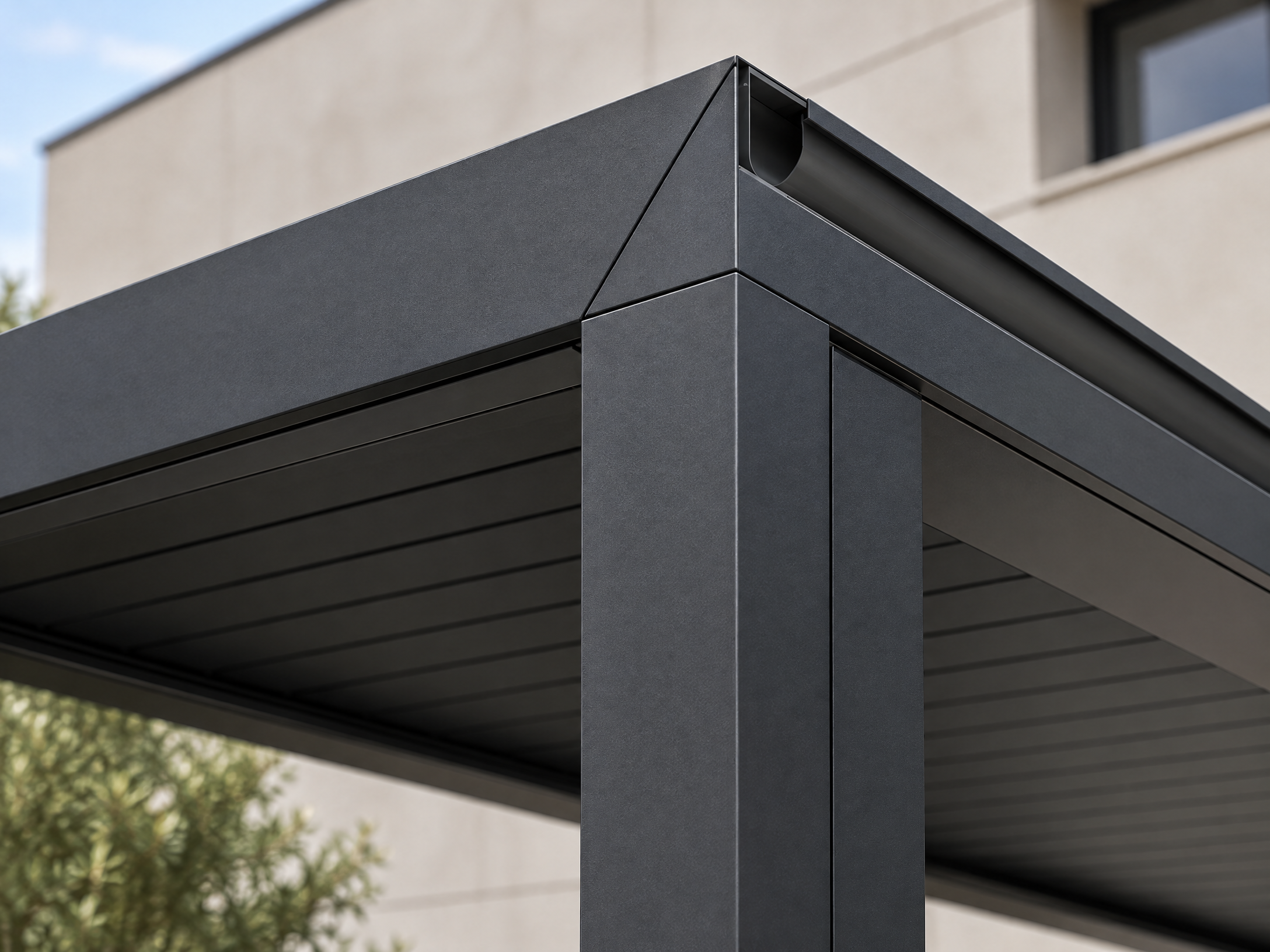
# What Should Buyers Specify for a Powder-Coated Aluminium Carport Finish?
Direct answer (first 140 words) Buyers should specify a defined pretreatment, a polyester-based TGIC or TGIC-free exterior-grade powder-coating system with total film thickness (TFt) targets, clear appearance and adhesion criteria, approved touch-up limits, and a documented sample and inspection regime. Scope boundary: this guide covers finish specification, handling, sample approval, acceptance criteria and maintenance for powder coated aluminium carports used as building-mounted or free-standing vehicle shelters in Europe and North America. It does not prescribe structural sizing, footing dimensions, electrical systems, approvals or project-specific load capacities — those remain the responsibility of the project structural engineer, local authority and installer.
Buyer context and scope boundary
- Primary readers: procurement managers, specification writers, project engineers and asset owners procuring aluminium carports for commercial or multi-residential sites across Europe and North America.
- Applicable product set: extruded or pressed aluminium posts, beams, brackets, roof purlins and metal flashings used on carport products such as Carportiva NordArch, NordFlat, SolarGrid and Titan systems. See product pages at /products/nordarch, /products/nordflat, /products/solargrid, /products/titan for system-level geometry and compatibility.
- Not covered: structural design, anchorage load calculations, footing design, electrical interconnection of PV or EV chargers, or local permit approvals. For foundations and site work refer to /guides/carport-foundation-requirements and for snow load considerations see /guides/aluminium-carport-snow-load-guide.
Core principle
Specify the finish as a controlled system: defined chemistry and surface preparation + measured coating properties + agreed appearance and inspection checkpoints. A finish specification transfers risk: the fabricator supplies materials and processes to the specification; the buyer or buyer’s representative verifies compliance through samples, production inspections and documented acceptance. Maintain clear responsibility boundaries in contract documents for pretreatment, coating application, handling, packaging and on-site installation.
Decision 1 — Pretreatment and substrate control Why pretreatment matters Aluminium finishes depend on correct surface chemistry. Poor cleaning, incorrect conversion coating or inconsistent anodic pretreatment lowers adhesion and reduces corrosion resistance, causing premature chalking, blistering or flaking.
Specify these pretreatment elements
— Aluminium alloy and temper
- Require alloy and temper traceability for all extrusions and pressed parts per The Aluminum Association designations [11]. Material certificates should list alloy and temper and the supplier. Do not assume every aluminium product uses the same alloy. Alloys and tempers affect etching and conversion performance.
— Cleaning and degreasing
- Specify an alkaline or solvent-free cleaning stage to remove oils and machining residues followed by a rinse. The process should prevent contamination carry-over to the conversion stage.
— Conversion coating
- Specify a chromate or non-chromate (trivalent chromium or zirconium-based) conversion coating compatible with the topcoat and local environmental regulations. Where chromates are restricted by law, require trivalent conversion with documented adhesion test results. Provide process control limits (bath concentration, temperature, dwell time) and frequency of bath monitoring.
— Mechanical preparation limits
- Define limits on mechanical surface damage: no deep gouges or extrusion die marks that break the substrate; maximum local burr height, and requirements for deburring and light sanding of cut edges. Specify acceptable mill finish tolerances from the extrusion producer per The Aluminum Association standards [11].
Decision 2 — Coating system and performance targets Specify a tested, industry-accepted coating chemistry and measurable performance metrics rather than vague marketing names.
— Coating type and chemistry
- For exterior carports in temperate climates specify an exterior-grade polyester powder coat designed for architecture (TGIC or modern TGIC-free polyester formulated for outdoor performance). For high UV/exposure coastal sites consider fluoropolymer (PVDF) liquid finishes; if specifying powder for coastal exposure, require accelerated testing evidence and local field samples before acceptance. Provide chemistry limits and request Technical Data Sheets (TDS) from the coating supplier.
— Film thickness and cut-back allowances
- Define target total dry film thickness (DFT) range (e.g., 60–80 µm typical for durable architectural polyester powder coats) with minimum and maximum acceptable limits. Require thickness measurement method (magnetic or eddy-current gauge calibrated to aluminium) and sampling frequency. For edges and crevices define minimum acceptable DFT (edge build is typically lower; specify a minimum such as 40 µm in critical areas) and document acceptable “thin” zone areas.
— Adhesion and flexibility tests
- Require adhesion testing (cross-cut or pull-off where applicable) and mandrel bend/flexibility tests on production samples. Specify acceptance criteria (no flaking or loss of adhesion under defined test conditions). Cite ISO 12944 principles for specifying protective paint systems for durable performance [12].
— Salt spray and accelerated weathering
- For coastal or aggressive environments require accelerated corrosion test data and clear limits on interpretation. Salt spray (ASTM B117) performance alone is an incomplete indicator of outdoor weathering; request complementary QUV-A/UV-B or natural exposure data and mandate a performance baseline from the coating supplier. Do not demand a single test pass/fail level without context; instead require documented test method, duration and comparison to a reference sample.
Decision 3 — Appearance, colour consistency and gloss Appearance influences perceived quality and long-term satisfaction. Specify clear, measurable appearance criteria.
— Colour standard and tolerances
- Use a defined colour standard (e.g., RAL, NCS) and require supplier-supplied batch-matched spray-applied reference panels, 300 x 300 mm minimum. Establish acceptable ΔE tolerances using CIELAB measurement under specified lighting; for adjacent items require ΔE ≤ 2.0 measured on specified instrument and conditions. Specify who will perform instrumental comparisons: buyer, independent lab, or coating supplier.
— Texture and gloss
- Define texture (smooth, fine-texture, hammertone) and gloss level (60° gloss value or range). Require supplier gloss charts and acceptance tests. For textured powders, require mock-ups to demonstrate hiding and uniformity.
— Visible defects and cosmetic acceptance
- Define a defect matrix: acceptable and non‑acceptable defects per square metre thresholds. Typical categories:
- Contamination specks/particles: maximum count per m² and size threshold (e.g., ≤ 0.5 mm permitted up to X per m²).
- Orange peel or orange-skin: measured subjectively against approved panel; permit minor texture variations within the tolerance band.
- Runs, sags, bare spots, heavy film variation: zero tolerance.
- Edge thinness and overspray: specify acceptable touch-up limits (see Handling and Touch-up section).
- Document inspection lighting and viewing distance (e.g., standard D65 lighting, viewing at 2 m).
Decision 4 — Samples, pre-production approval and QA checks Use a staged approval process to reduce production risk.
— Sample hierarchy and approval gates
- Prototype sample: full-size or representative assembly including corner, cut edge and fastener holes. Buyer review and sign-off required before production.
- Production sample: first-piece coating run from production line; buyer or inspector acceptance required.
- Periodic samples: scheduled sampling frequency for continuing production (e.g., first production run, then weekly or per X tonnes depending on throughput).
— Documentation to request from supplier
- Coating supplier TDS and SDS.
- Batch certificate for powder (batch ID, manufacture date).
- Pretreatment process records.
- Thickness and adhesion test records.
- Colour and gloss instrument readings for approved samples.
— Third-party inspection
- If buyer requires independent verification, specify the scope: witness of tests, sampling procedure, report content. Define who pays for third-party inspection in the contract.
Decision 5 — Handling, packaging and installation protection Prevent damage between coating completion and final installation.
— Handling rules at fabricator and on-site
- Specify minimum safe handling clearances, use of protective gloves, and non-abrasive slings/padding at lift points. Require parts to be stacked with protective separators to avoid contact abrasion.
- Require zero-impact handling of critical edges and corners after coating; if handling will expose coated edges to abrasion during assembly, specify protective edge trims or design changes.
— Packaging and transport
- Define packaging requirements: interleaving non-shedding tissue or polyethylene foam, corrosion inhibiting packaging if transit will expose parts to condensation, and layout of fasteners separated in pouches. Specify wood-free direct contact materials if concerned about tannin stains.
— On-site storage and staging
- Specify that coated components be stored under cover and off the ground. Define maximum storage time before installation without protective re-inspection. Where prolonged site storage is unavoidable, require periodic visual inspections and reconditioning before installation.
Decision 6 — Touch-up limits and approved repair methods Touch-ups must be specified so buyers can accept repairs without compromising overall performance.
— Acceptable damage thresholds
- Define damage acceptance criteria by size and quantity. Example: up to 3 isolated scratches per component, each ≤ 3 mm length and not exposing more than 10% of total aluminium area of the part may be repaired in accordance with the approved touch-up procedure. For larger or multiple defects require correction at the fabricator.
— Approved touch-up materials and methods
- Specify manufacturer‑approved touch-up paints (liquid or powder repair) and procedures: clean the area, abrade edges lightly, apply conversion treatment if required, apply primer if specified, then topcoat and cure per manufacturer instructions. Document drying times and re-inspection steps.
— Limits on field repairs
- Field repairs should be limited to small areas. For structural connections where corrosion protection may be critical, require factory repair or replacement. Make clear responsibility: fabricator owns coated finish until delivery acceptance; after buyer or installer acceptance, on-site damage risk transfers to the buyer or appointed contractor.
Two useful tables (coating selection and defect acceptance) Table 1 — Typical coating system options and typical use cases
| Coating system | Typical use case | Notes |
|---|---|---|
| Polyester TGIC powder | Standard temperate exterior, general-purpose carports | Good outdoor durability; widely available |
| Polyester TGIC-free architectural powder | Temperate regions, preference for TGIC-free chemistries | Check supplier weathering data |
| PVDF/Fluoropolymer liquid finish | High-UV, coastal, high-end architectural projects | Often applied as liquid; may not be available as powder for complex parts |
| Epoxy-polyester hybrid | Interior components, sheltered locations only | Not recommended for exterior un-sheltered parts |
Table 2 — Cosmetic defect acceptance (example matrix)
| Defect type | Maximum per m² | Maximum size per defect | Accept/Reject |
|---|---|---|---|
| Dust particles in film | 5 | ≤ 0.5 mm | Accept |
| Overspray on mating surface | 0 | Any | Reject |
| Runs or sags | 0 | Any | Reject |
| Bare metal (uncoated) area | 0 | Any | Reject unless scheduled edge exposed ≤ defined limit and sealed by approved touch-up |
| Light scratches (sealed with touch-up) | 3 per part | ≤ 3 mm | Conditional accept with approved repair |
Six-step buyer workflow
- Define project exposure and environment: classify sites as inland temperate, urban-polluted, coastal, or high-UV alpine and record in the specification. Link to product choices: /products/solargrid for PV applications requiring roofing interface coordination.
- Specify material, pretreatment and coating system: include alloy traceability, conversion method and powder chemistry plus measurable targets (DFT, adhesion).
- Require sample approvals: prototype panel and first production run acceptance with instrumented colour and gloss checks.
- Define packaging, transport and on-site storage and handling rules; assign responsibilities for damage during transit.
- Establish acceptance inspection protocol: who inspects, what tests are performed, and the acceptance criteria; decide on third-party inspection if needed.
- Agree touch-up and maintenance procedures in contract: specify approved repair materials and that fabricator supplies a touch-up kit and instructions at handover.
Mid-article CTA (explicit) If you want a draft finish specification tailored to your site exposure class and selected Carportiva product, request a specification template and sample checklist at /inquiry or email info@carportiva.com. We can provide product-fit guidance referencing /products/nordarch, /products/nordflat, /products/solargrid and /products/titan.
Practical acceptance, inspection and responsibility boundaries
- Responsibility for finish prior to delivery: the fabricator is responsible for pretreatment, coating application, QA records and packaging. The contract should state that the coating is deemed accepted after documented buyer inspection at the factory or mutually agreed acceptance point.
- Responsibility after delivery: define who owns on-site handling and protection. Transfers of risk should be explicit in delivery terms (e.g., delivery to site with buyer assuming responsibility for protection from that point). If the buyer requires the fabricator to supervise unpacking and installation to prevent damage to finishes, include that service in the contract.
- When to require rework vs accept with touch-up: require factory rework for runs, sags, large bare areas, or colour-mismatch beyond ΔE tolerance; accept small isolated scratches under the agreed repair procedure.
Maintenance guidance (practical, non-prescriptive) Routine maintenance preserves appearance and corrosion resistance:
- Cleaning frequency: recommend periodic cleaning rather than prescriptive intervals; schedule based on environment (more often in coastal and high-pollution areas). Typical practice: wash with mild detergent and soft brush or cloth, followed by a clear-water rinse. Avoid abrasive cleaners or scouring pads that abrade the topcoat.
- Inspection: visual inspection after major storms or annually for high-exposure sites to identify scratches, edge corrosion or joint sealant failure. Document findings in the asset maintenance log.
- Repairs: execute only with approved touch-up materials and follow the specified surface prep. For PV-mounted systems consult /products/solargrid and follow PV module manufacturer maintenance guidance and NREL best practices for PV O&M [14] [15].
Installation notes affecting finish longevity
- Fastener and washer selection: specify stainless steel fasteners with matched non-reactive washers to avoid galvanic corrosion at metal-to-metal joints. Avoid direct contact between dissimilar metals without isolation.
- Sealants and gasketing: specify neutral cure, paint-compatible sealants to avoid curing byproducts that may attack coatings.
- Thermal movement gaps: allow for thermal expansion to avoid paint cracking at clamped points. Coordination between structural design and finish specification is required; this is the structural engineer’s domain.
FAQ
Q: What powder-coat film thickness should I require? A: Specify a target DFT and minimum acceptable limits for the product; a common target for exterior architectural polyester powder is approximately 60–80 µm, with a minimum acceptable edge build defined (for example 40 µm). Use instrumented measurements and sampling frequencies in the contract. Do not assume one-size-fits-all: thicker films can hide defects but may risk runs on complex profiles; specify limits and measurement method.
Q: Is powder coating suitable for coastal sites? A: Powder-coated aluminium can perform in coastal environments with appropriate pretreatment and high-durability powder chemistries, but performance varies by product and exposure. For severe salt exposure, consider specifying field-proven coatings or alternative liquid fluoropolymer finishes and require accelerated and natural exposure test data from the supplier. Always require sample panels and site-specific acceptance before committing full production.
Q: How should colour tolerance be specified? A: Use an instrument-based ΔE tolerance (CIELAB) between approved sample and production batches (for example ΔE ≤ 2.0). Require consistent lighting conditions and instrument calibration. For adjacent pieces that must match exactly (e.g., two halves of a visible assembly), require batch-matching and a single approved production run.
Q: Who pays for third-party inspections? A: This is a contractual decision. Common options: buyer pays for buyer-requested third-party inspection; supplier pays for agreed random sampling QA; or costs shared depending on dispute resolution terms. Specify who is responsible in procurement documents.
Q: Can I accept field touch-up? A: Accept field touch-up only for small isolated defects using approved methods and materials. For structural connections or large-scale damage, require factory rework or replacement. Define exact limits in the contract.
Q: What maintenance will keep the finish looking good? A: Regular cleaning with mild detergents and water, inspection after major events, and prompt repair of scratches or exposed substrate using approved touch-up materials. Frequency depends on exposure: coastal or high-pollution sites need more frequent cleaning.
Conclusion
A robust powder coated aluminium carport finish specification reduces risk by making finish requirements measurable and enforceable. Define pretreatment, coating chemistry, film thickness, adhesion and appearance metrics, sample approval gates, handling and packaging, touch-up limits, and maintenance responsibilities. Keep structural, electrical and code compliance items as separate contract documents and assign clear responsibility boundaries between fabricator, buyer and installer.
Closing CTA For a project-specific specification checklist and sample panel plan tailored to your Carportiva product and site exposure classification, request our template and review service at /inquiry or email info@carportiva.com.
References
Bring the actual project brief to the engineering table.
Share your location, layout, target application and available technical inputs. Carportiva can help identify the relevant product-interface information before a project-specific commercial discussion.
Request a project discussion